


doi: 10.1007/164_2021_433.
Fundamentals of the Dynorphins/Kappa Opioid Receptor System: From Distribution to Signaling and Function
Affiliations
- PMID: 33754230
- PMCID: PMC9013522
- DOI: 10.1007/164_2021_433
Item in Clipboard
Fundamentals of the Dynorphins/Kappa Opioid Receptor System: From Distribution to Signaling and Function
Handb Exp Pharmacol.
2022.
Abstract
This chapter provides a general introduction to the dynorphins (DYNs)/kappa opioid receptor (KOR) system, including DYN peptides, neuroanatomy of the DYNs/KOR system, cellular signaling, and in vivo behavioral effects of KOR activation and inhibition. It is intended to serve as a primer for the book and to provide a basic background for the chapters in the book.
Keywords: In vivo pharmacology; KOR/dynorphins; Neuroanatomy; Review; Signaling.
© 2021. The Author(s), under exclusive license to Springer Nature Switzerland AG.
Conflict of interest statement
Figures
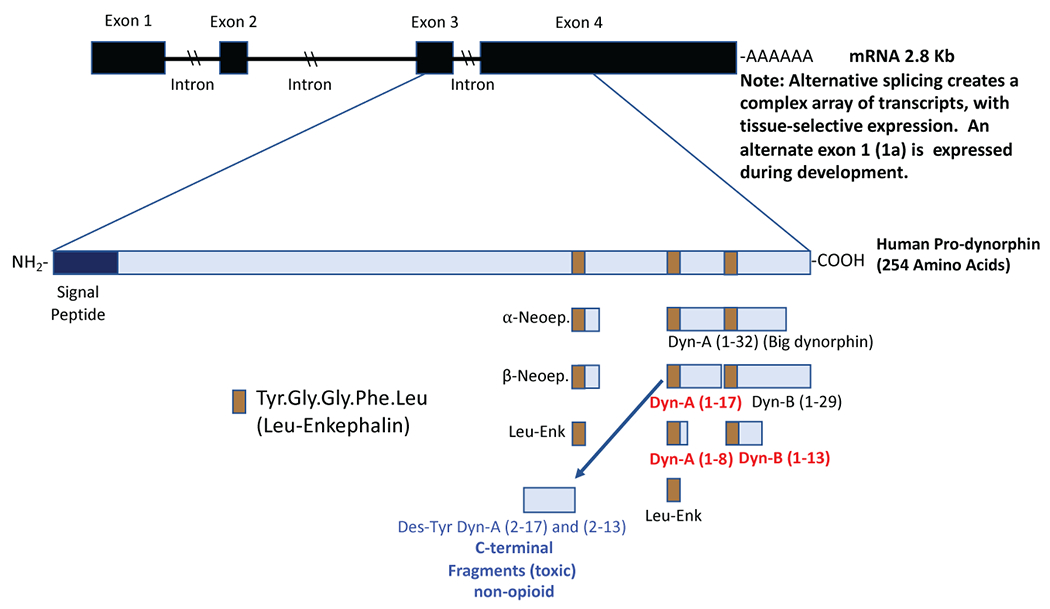
A. Dynorphin peptides are up-regulated in chronic neuropathic and inflammatory pain models (marked in red). Spinal (intrathecal) administration of DYN peptides that produce acute antinociception include Dyn A (1-8), Dyn A (1-17), Dyn B (1-13). Spinal administration of DYN peptides, Dyn A (1-17), Dyn B (1-13), Dyn A (2-17), Dyn A (2-13), produces pain-like (allodynia and hyperalgesia) responses via activation of NMDA or bradykinin receptors. [Reviewed in (Podvin et al. 2016)]. Dyn A (2-17 or 2-13) have no activity at KORs.
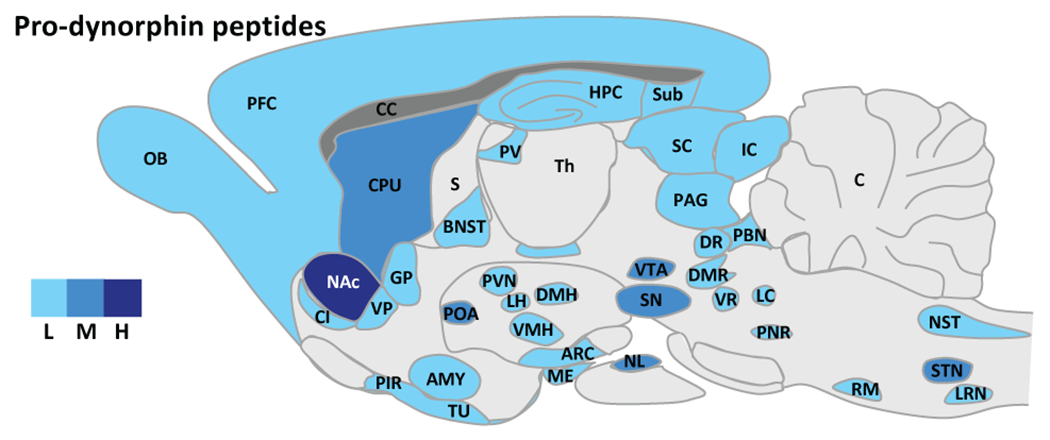
Dynorphin peptide expression in the rodent brain. L: low, M: moderate, H: high expression. Abbreviations. ARC: arcuate nucleus, hypothalamus, AMY: amygdala, BLA: basolateral nucleus, amygdala, BNST: bed nucleus of the stria terminalis, C: cerebellum, CC: corpus collosum, CeA: central nucleus, amygdala, CI: claustrum, CL: centrolateral thalamus, CM: centromedial thalamus, COA: cortical nucleus, amygdala, CPU: caudate putamen, DMH: dorsomedial hypothalamus, DMR: dorsal and medial raphe, DR: dorsal raphe, DTN: dorsal tegmental nucleus, EN: endopiriform cortex, GP: globus pallidus, HPC: hippocampus, IC: inferior colliculus, IP: interpeduncular nucleus, LC: locus coeruleus, LD: laterodorsal thalamus, LH: lateral hypothalamus, LRN: lateral reticular nucleus, ME: median eminence, MeA: median nucleus, amygdala, NAc: nucleus accumbens, NST: nucleus tractus solitarius, NL: neuronal lobe, pituitary, NRGC: nucleus reticularis gigantocellularis, OB: olfactory bulb, OCX: occipital cortex, PAG: periaqueductal gray, PBN: parabrachial nucleus, PCX: parietal cortex, PFC: prefrontal cortex, PIR: piriform cortex, PNR: pontine reticular, POA: preoptic area, PV: paraventricular thalamus, PVN: paraventricular hypothalamus, RE: reuniens thalamus, RM: raphe magnus, S: septum, SC: superior colliculus, SN: substantia nigra, STN: spinal trigeminal nucleus , Sub: subiculum, TCX: temporal cortex, Th: thalamus, TU: olfactory tubercule, VMH: ventromedial hypothalamus, VP: ventral pallidum, VR: ventral raphe, VTA: ventral tegmental area, Zi: zona incerta. [Adapted from Le Merrer et al. (2009)].
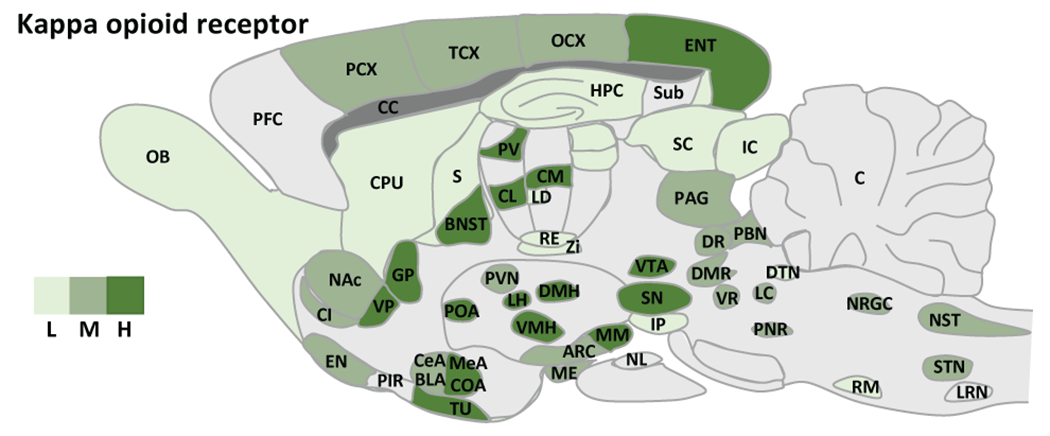
Expression of the KOR in rat brain. L: low, M: moderate, H: high expression. Abbreviations. ARC: arcuate nucleus, hypothalamus, AMY: amygdala, BLA: basolateral nucleus, amygdala, BNST: bed nucleus of the stria terminalis, C: cerebellum, CC: corpus collosum, CeA: central nucleus, amygdala, CI: claustrum, CL: centrolateral thalamus, CM: centromedial thalamus, COA: cortical nucleus, amygdala, CPU: caudate putamen, DMH: dorsomedial hypothalamus, DMR: dorsal and medial raphe, DR: dorsal raphe, DTN: dorsal tegmental nucleus, EN: endopiriform cortex, GP: globus pallidus, HPC: hippocampus, IC: inferior colliculus, IP: interpeduncular nucleus, LC: locus coeruleus, LD: laterodorsal thalamus, LH: lateral hypothalamus, LRN: lateral reticular nucleus, ME: median eminence, MeA: median nucleus, amygdala, NAc: nucleus accumbens, NST: nucleus tractus solitarius, NL: neuronal lobe, pituitary, NRGC: nucleus reticularis gigantocellularis, OB: olfactory bulb, OCX: occipital cortex, PAG: periaqueductal gray, PBN: parabrachial nucleus, PCX: parietal cortex, PFC: prefrontal cortex, PIR: piriform cortex, PNR: pontine reticular, POA: preoptic area, PV: paraventricular thalamus, PVN: paraventricular hypothalamus, RE: reuniens thalamus, RM: raphe magnus, S: septum, SC: superior colliculus, SN: substantia nigra, STN: spinal trigeminal nucleus , Sub: subiculum, TCX: temporal cortex, Th: thalamus, TU: olfactory tubercule, VMH: ventromedial hypothalamus, VP: ventral pallidum, VR: ventral raphe, VTA: ventral tegmental area, Zi: zona incerta. [Adapted from Le Merrer et al. (2009)].
References
-
- Ansonoff MA, Zhang J, Czyzyk T, Rothman RB, Stewart J, Xu H, Zjwiony J, Siebert DJ, Yang F, Roth BL, Pintar JE (2006) Antinociceptive and hypothermic effects of Salvinorin A are abolished in a novel strain of kappa-opioid receptor-1 knockout mice J Pharmacol Exp Ther 318:641–648 - PubMed
-
- Appleyard SM, Patterson TA, Jin WZ, Chavkin C (1997) Agonist-induced phosphorylation of the kappa-opioid receptor J Neurochem 69:2405–2412 - PubMed
-
- Arvidsson U, Riedl M, Chakrabarti S, Vulchanova L, Lee JH, Nakano AH, Lin X, Loh HH, Law P-Y, Wessendorf MW, Elde R (1995) The kappa-opioid receptor is primarily postsynaptic: combined immunohistochemical localization of the receptor and endogenous opioids Proc Natl Acad Sci U S A 92:5062–5066 - PMC - PubMed
MeSH terms
Substances
Grants and funding
LinkOut - more resources
Full Text Sources
Other Literature Sources
