doi: 10.3201/eid2704.204200.
Increased SARS-CoV-2 Testing Capacity with Pooled Saliva Samples
- PMID: 33755009
- PMCID: PMC8007323
- DOI: 10.3201/eid2704.204200
Item in Clipboard
Increased SARS-CoV-2 Testing Capacity with Pooled Saliva Samples
Emerg Infect Dis.
2021 Apr.
Abstract
We analyzed feasibility of pooling saliva samples for severe acute respiratory syndrome coronavirus 2 testing and found that sensitivity decreased according to pool size: 5 samples/pool, 7.4% reduction; 10 samples/pool, 11.1%; and 20 samples/pool, 14.8%. When virus prevalence is >2.6%, pools of 5 require fewer tests; when <0.6%, pools of 20 support screening strategies.
Keywords: 2019 novel coronavirus disease; COVID-19; SARS-CoV-2; coronavirus disease; diagnostics; respiratory infections; saliva; screening; severe acute respiratory syndrome coronavirus 2; viruses; zoonoses.
Figures
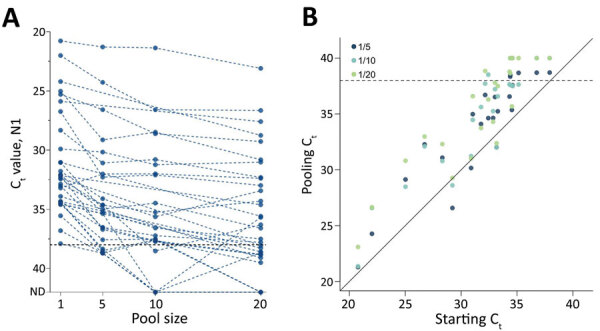
Effect of pooling on detection of severe acute respiratory syndrome coronavirus 2, by pool size and between samples tested. A) As the pool size increased, so did the Ct value (dotted lines connect pools comprising the same positive sample). Ct for positivity is set to 38. Samples falling on the x-axis indicated samples from which signal was not detected by reverse transcription quantitative PCR. B) As the pool size increased, so did the Ct. We equated this change by using linear regression (pool of 5 samples, dark blue, +2.2 Ct, 95% CI 1.4–3.0 Ct; pool of 10, light blue, +3.1 Ct, 95% CI 2.3–4.0 Ct; pool of 20, green, +3.6, 95% CI 2.7–4.4 Ct). Dashed lines indicate Ct 38 (cutoff for sample positivity). 1/5, pool of 5; 1/10, pool of 10; 1/20, pool of 20. Ct, cycle threshold.
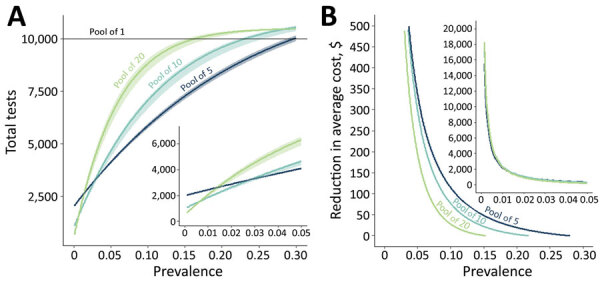
The resource-saving benefit of sample pooling for severe acute respiratory syndrome coronavirus 2 (SARS-CoV-2) testing, based on size of the pool and expected prevalence of SARS-CoV-2 within the population. A) We modeled the number of tests required to test 10,000 persons (results qualitatively scale with population) when pools contain 5, 10, or 20 samples (and individually retesting samples within positive pools) compared with testing samples individually (pool = 1 sample). As prevalence increases, so does the number of pools positive for SARS-CoV-2, thereby increasing the required number of confirmatory tests of individual samples. Therefore, over a prevalence of 2.6%, pooled samples of 5 result in fewer overall tests required than do larger pool sizes. B) At lower prevalence rates, such as when outbreaks have been controlled but ongoing screening is required, pools of 10 or 20 samples yield substantial cost savings for the same expected level of positive detections, after accounting for sensitivity differences. Values are shown in US$. Insets show the region with <5% prevalence.
Update of
-
Pooling saliva to increase SARS-CoV-2 testing capacity.medRxiv [Preprint]. 2020 Sep 3:2020.09.02.20183830. doi: 10.1101/2020.09.02.20183830. medRxiv. 2020. Update in: Emerg Infect Dis. 2021 Apr;27(4). doi: 10.3201/eid2704.204200. PMID: 32909003 Free PMC article. Updated. Preprint.
References
-
- Vogels CBF, Brackney D, Wang J, Kalinich CC, Ott I, Kudo E, et al. SalivaDirect: simple and sensitive molecular diagnostic test for SARS-CoV-2 surveillance [cited 2021 Jan 27]. https://www.cell.com/med/pdf/S2666-6340(20)30076-3.pdf
Publication types
MeSH terms
Grants and funding
LinkOut - more resources
Full Text Sources
Other Literature Sources
Medical
Miscellaneous