. 2021 May 7;372(6542):635-641.
doi: 10.1126/science.abf9648. Epub 2021 Mar 23.

The impact of population-wide rapid antigen testing on SARS-CoV-2 prevalence in Slovakia

Affiliations

The impact of population-wide rapid antigen testing on SARS-CoV-2 prevalence in Slovakia

Martin Pavelka et al. Science. .

Abstract

Slovakia conducted multiple rounds of population-wide rapid antigen testing for severe acute respiratory syndrome coronavirus 2 (SARS-CoV-2) in late 2020, combined with a period of additional contact restrictions. Observed prevalence decreased by 58% (95% confidence interval: 57 to 58%) within 1 week in the 45 counties that were subject to two rounds of mass testing, an estimate that remained robust when adjusting for multiple potential confounders. Adjusting for epidemic growth of 4.4% (1.1 to 6.9%) per day preceding the mass testing campaign, the estimated decrease in prevalence compared with a scenario of unmitigated growth was 70% (67 to 73%). Modeling indicated that this decrease could not be explained solely by infection control measures but required the addition of the isolation and quarantine of household members of those testing positive.


Figures

Fig. 1
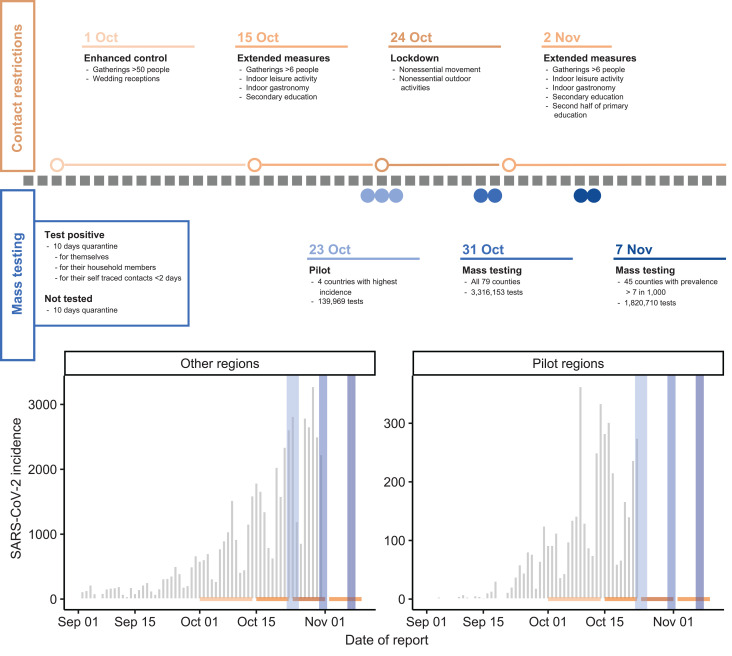
Fig. 1. Overview of interventions and premass testing epidemiology.
(Top) Description of timing and extent of national contact restriction in Slovakia (color intensity indicates intensity of the measures) and timing and extent of the mass testing campaigns. Open circles and lines in respective colors indicate the start and duration of the contact restrictions, and the blue solid circles indicate the days on which mass testing was conducted, although the highest turnout was usually on the first day. (Left) Box illustrating contact-reducing measures for those testing positive and those who chose not to be tested. (Bottom) SARS-CoV-2 infection incidence as reported by the Slovak Ministry of Health and collected through passive symptomtriggered PCR testing. Using the same color coding as at the top, contact interventions are indicated by horizontal lines, and mass testing campaigns are indicated by vertical lines. Data from the passive surveillance subsequent to the respective first mass testing campaign are omitted to clearly illustrate the trends in infection rates that led up to the mass testing and because mass testing is likely to have changed the sensitivity of the passive surveillance, thereby distorting the observation of infection trends that followed mass testing.
Fig. 2
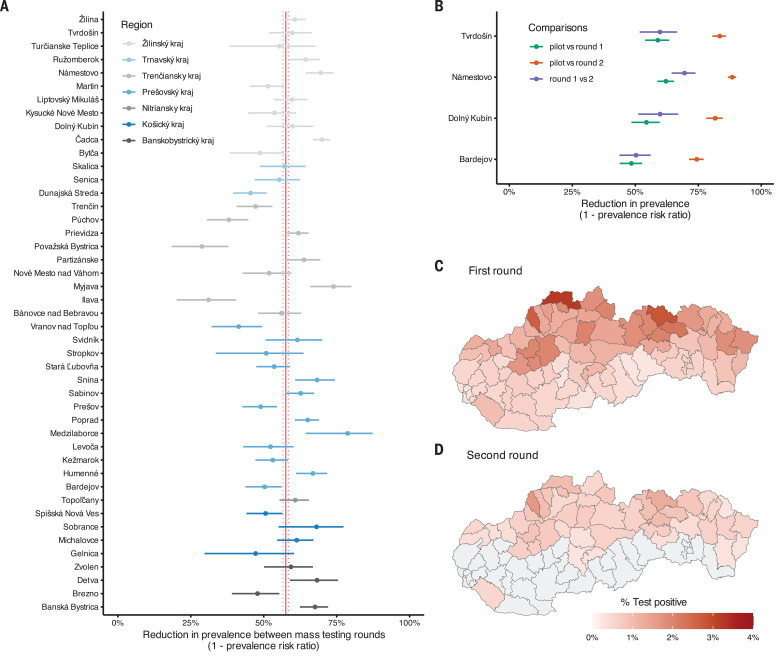
Fig. 2. The change in test positivity between mass testing campaigns.
(A) Change in test positivity [1 crude prevalence ratio (cPR)] observed from mass testing round 1 to round 2 in the 45 counties that were eligible for both rounds of mass testing. Counties are grouped and color coded into regions. The crude pooled estimate and its 95% confidence bounds are shown as red vertical lines. The confidence intervals were estimated using a normal approximation (Wald interval). (B) Change in test positivity (1 cPR) observed from the pilot mass testing round to either the first (green) or the second (orange) national round and from the first to the second mass testing round (blue) in the four counties that were included in the pilot. The confidence intervals were estimated using a normal approximation (Wald interval). (C and D) County-level test positivity in the (C) first and (D) second round of mass testing. Gray areas indicate counties that were not part of the second round because their test positivity rate was less than 7 per 1000 and hence have no estimates.
Fig. 3
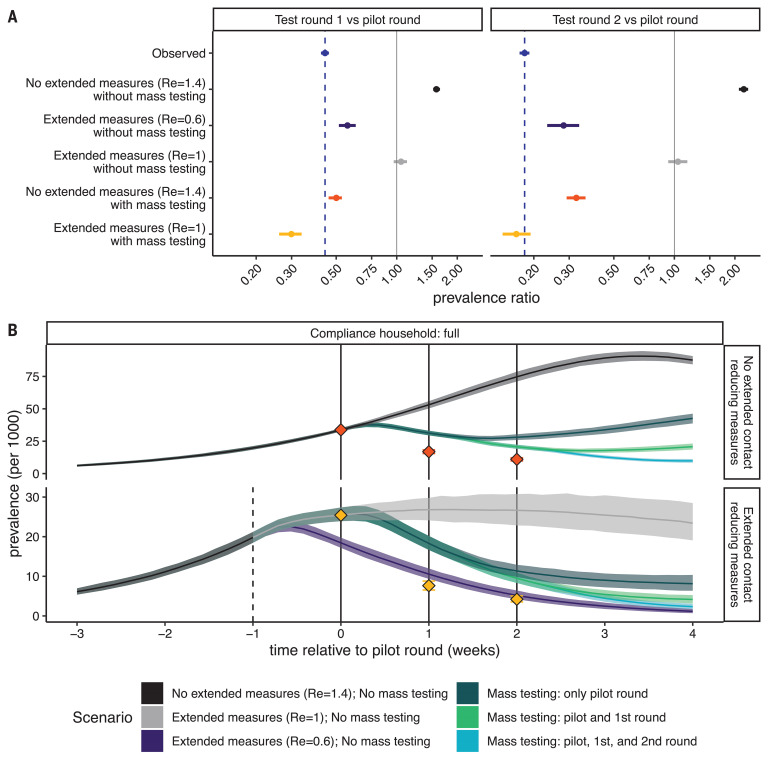
Fig. 3. Simulated relative effectiveness of the extended contact-reducing measures and the mass testing.
(A) The change in observed prevalence of infectious nonquarantining individuals between 10 and 65 years of age as predicted by the microsimulation model. For comparison, the observed test-positivity rate is shown in blue. The facets show changes (left) from the pilot to the first round of mass testing and (right) from the pilot to the second round of mass testing. Shown scenarios compare the effect of (top to bottom) no additional interventions that limit the growth rate of reproduction number (Re) = 1.4, the extended contact-reduction measures drastically reducing the growth rate to Re = 0.6 and no mass testing being conducted, the extended contact-reduction measures reducing the growth rate to Re = 1.0 and no mass testing being conducted, no change in growth rate but mass testing, and the extended contact reduction measures reducing the growth rate to Re = 1 and mass testing. In scenarios without mass testing, we compared prevalence of infectious individuals on the same days as testing occurred in scenarios with mass testing. CIs around the modeled values in each scenario are calculated as the 2.5 and 97.5% percentiles across 500 model iterations, with the point estimate representing the median. The CI around the observed value is its binomial CI. (B) Simulated infection incidence of alternative intervention strategies. Simulations are aligned by the date of the first mass test [time (t) = 0]. The dashed line indicates the timing of the extended contact-reducing measures, and the solid lines indicate the timing of the mass testing campaigns. Colors indicate the simulations stratified into whether no mass testing or one, two, or three testing rounds were performed and the effectiveness of the extended contact-reduction measures on the growth rate. Red and yellow diamonds indicate the prevalence of infectiousness observed among the tested nonquarantining age-eligible population, corresponding to the scenarios in (A).

Comment in

References

    1. Guidelines for the implementation of non-pharmaceutical interventions against COVID-19. Eur. Cent. Dis. Prev. Control (2020); www.ecdc.europa.eu/en/publications-data/covid-19-guidelines-non-pharmace....
    1. Davies N. G., et al., Lancet Public Health 10.1016/S2468-2667(20)30133-X (2020).
    1. Flaxman S., Mishra S., Gandy A., Unwin H. J. T., Mellan T. A., Coupland H., Whittaker C., Zhu H., Berah T., Eaton J. W., Monod M., Ghani A. C., Donnelly C. A., Riley S., Vollmer M. A. C., Ferguson N. M., Okell L. C., Bhatt S.; Imperial College COVID-19 Response Team , Estimating the effects of non-pharmaceutical interventions on COVID-19 in Europe. Nature 584, 257–261. (2020). 10.1038/s41586-020-2405-7 - DOI - PubMed
    1. Everyone Included, Social Impact of COVID-19Dros. Inf. Serv. D; www.un.org/development/desa/dspd/everyone-included-covid-19.html.
    1. Socio-economic impact of COVID-19. UNDP; www.undp.org/content/undp/en/home/coronavirus/socio-economic-impact-of-c....

Publication types