


Mechanisms of recurrent outbreak of COVID-19: a model-based study
- PMID: 33758464
- PMCID: PMC7972336
- DOI: 10.1007/s11071-021-06371-w
Mechanisms of recurrent outbreak of COVID-19: a model-based study
Abstract
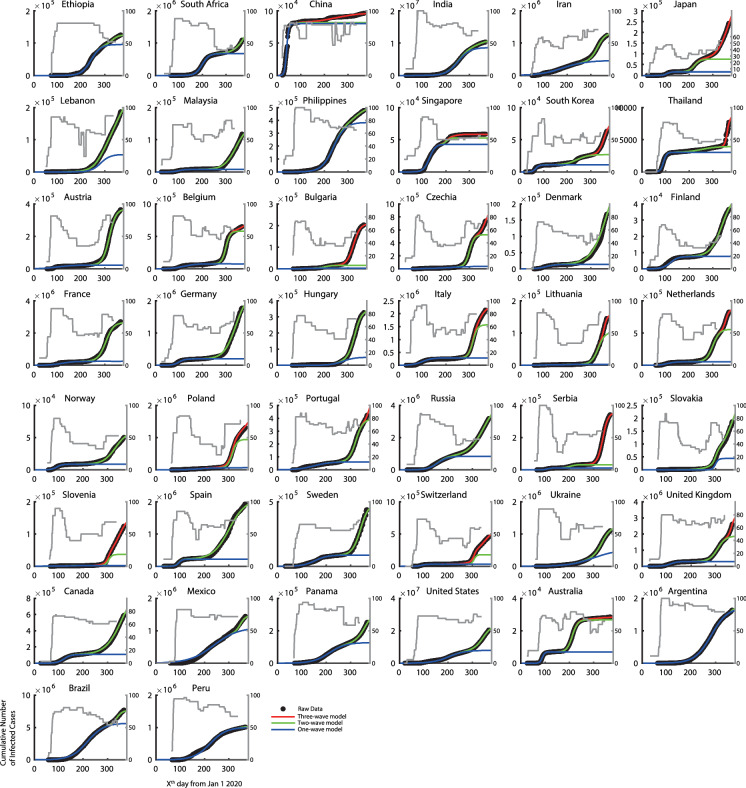
Recurrent outbreaks of the coronavirus disease 2019 (COVID-19) have occurred in many countries around the world. We developed a twofold framework in this study, which is composed by one novel descriptive model to depict the recurrent global outbreaks of COVID-19 and one dynamic model to understand the intrinsic mechanisms of recurrent outbreaks. We used publicly available data of cumulative infected cases from 1 January 2020 to 2 January 2021 in 30 provinces in China and 43 other countries around the world for model validation and further analyses. These time series data could be well fitted by the new descriptive model. Through this quantitative approach, we discovered two main mechanisms that strongly correlate with the extent of the recurrent outbreak: the sudden increase in cases imported from overseas and the relaxation of local government epidemic prevention policies. The compartmental dynamical model (Susceptible, Exposed, Infectious, Dead and Recovered (SEIDR) Model) could reproduce the obvious recurrent outbreak of the epidemics and showed that both imported infected cases and the relaxation of government policies have a causal effect on the emergence of a new wave of outbreak, along with variations in the temperature index. Meanwhile, recurrent outbreaks affect consumer confidence and have a significant influence on GDP. These results support the necessity of policies such as travel bans, testing of people upon entry, and consistency of government prevention and control policies in avoiding future waves of epidemics and protecting economy.
Keywords: COVID-19; Government policy; Logistic model; Recurrent outbreak; SEIDR model.
© The Author(s), under exclusive licence to Springer Nature B.V. 2021.
Conflict of interest statement
Conflict of interestThe authors declare no competing interest.
Figures




References
-
- Huang C, Wang Y, Li X, Ren L, Zhao J, Hu Y, Zhang L, Fan G, Xu J, Gu X, Cheng Z, Yu T, Xia J, Wei Y, Wu W, Xie X, Yin W, Li H, Liu M, Xiao Y, Gao H, Guo L, Xie J, Wang G, Jiang R, Gao Z, Jin Q, Wang J, Cao B. Clinical features of patients infected with 2019 novel coronavirus in Wuhan, China. Lancet. 2020;395:497–506. doi: 10.1016/S0140-6736(20)30183-5. - DOI - PMC - PubMed
-
- Li Q, Guan X, Wu P, Wang X, Zhou L, Tong Y, Ren R, Leung KSM, Lau EHY, Wong JY, Xing X, Xiang N, Wu Y, Li C, Chen Q, Li D, Liu T, Zhao J, Liu M, Tu W, Chen C, Jin L, Yang R, Wang Q, Zhou S, Wang R, Liu H, Luo Y, Liu Y, Shao G, Li H, Tao Z, Yang Y, Deng Z, Liu B, Ma Z, Zhang Y, Shi G, Lam TTY, Wu JT, Gao GF, Cowling BJ, Yang B, Leung GM, Feng Z. Early transmission dynamics in Wuhan, China, of novel coronavirus-infected pneumonia. N. Engl. J. Med. 2020;382:1199–1207. doi: 10.1056/NEJMoa2001316. - DOI - PMC - PubMed
-
- Zhou P, Yang XL, Wang XG, Hu B, Zhang L, Zhang W, Si HR, Zhu Y, Li B, Huang CL, Chen HD, Chen J, Luo Y, Guo H, Jiang RD, Liu MQ, Chen Y, Shen XR, Wang X, Zheng XS, Zhao K, Chen QJ, Deng F, Liu LL, Yan B, Zhan FX, Wang YY, Xiao GF, Shi ZL. A pneumonia outbreak associated with a new coronavirus of probable bat origin. Nature. 2020;579:270–273. doi: 10.1038/s41586-020-2012-7. - DOI - PMC - PubMed
LinkOut - more resources
Full Text Sources
Other Literature Sources