. 2021;2(1):58-79.
doi: 10.1007/s42761-020-00028-4. Epub 2021 Mar 18.

Parental Burnout Around the Globe: a 42-Country Study

Isabelle Roskam  1 Joyce Aguiar  2 Ege Akgun  3 Gizem Arikan  4 Mariana Artavia  5 Hervé Avalosse  6 Kaisa Aunola  7 Michel Bader  8 Claire Bahati  9 Elizabeth J Barham  10 Eliane Besson  11 Wim Beyers  12 Emilie Boujut  13 Maria Elena Brianda  1 Anna Brytek-Matera  14 Noémie Carbonneau  15 Filipa César  2 Bin-Bin Chen  16 Géraldine Dorard  13 Luciana Carla Dos Santos Elias  17 Sandra Dunsmuir  18 Natalia Egorova  19 Nicolas Favez  20 Anne-Marie Fontaine  2 Heather Foran  21 Julia Fricke  22 Kaichiro Furutani  23 Laura Gallée  1 Myrna Gannagé  11 Maria Gaspar  24 Lucie Godbout  15 Amit Goldenberg  25 James J Gross  26 Maria Ancuta Gurza  27 Ruby Hall  28 Muhammad Aamir Hashmi  29 Ogma Hatta  1 Mai Helmy  30 Thi Vân Hoang  31 Mai Trang Huynh  31 Emerence Kaneza  32 Taishi Kawamoto  33 Goran Knezevic  34 Bassantéa Lodegaèna Kpassagou  35 Ljiljana B Lazarevic  34 Sarah Le Vigouroux  36 Astrid Lebert-Charron  13 Vanessa Leme  37 Gao-Xian Lin  1 Carolyn MacCann  38 Denisse Manrique-Millones  39 Marisa Matias  2 María Isabel Miranda-Orrego  40 Marina Miscioscia  41 Clara Morgades-Bamba  42 Seyyedeh Fatemeh Mousavi  43 Badra Moutassem-Mimouni  44 Ana Muntean  45 Hugh Murphy  21 Alexis Ndayizigiye  32 Josué Ngnombouowo Tenkue  46 Sally Olderbak  47 Sophie Ornawka  15 Fatumo Osman  48 Daniela Oyarce-Cadiz  49 Pablo A Pérez-Díaz  18   50 Konstantinos V Petrides  18 Claudia Pineda-Marin  51 Katharina Prandstetter  21 Alena Prikhidko  52 Ricardo T Ricci  53 Fernando Salinas-Quiroz  54 Raquel Sánchez-Rodríguez  55 Ainize Sarrionandia  56 Céline Scola  57 Vincent Sezibera  58 Paola Silva  59 Alessandra Simonelli  60 Bart Soenens  12 Emma Sorbring  61 Matilda Sorkkila  7 Charlotte Schrooyen  12 Elena Stănculescu  62 Elena Starchenkova  63 Dorota Szczygiel  64 Javier Tapia  65 Thi Minh Thuy Tri  31 Mélissa Tremblay  15 A Meltem Ustundag-Budak  66 Maday Valdés Pacheco  67 Hedwig van Bakel  28 Lesley Verhofstadt  12 Jaqueline Wendland  13 Saengduean Yotanyamaneewong  68 Moïra Mikolajczak  1
Affiliations

Parental Burnout Around the Globe: a 42-Country Study

Isabelle Roskam et al. Affect Sci. 2021.

Abstract

High levels of stress in the parenting domain can lead to parental burnout, a condition that has severe consequences for both parents and children. It is not yet clear, however, whether parental burnout varies by culture, and if so, why it might do so. In this study, we examined the prevalence of parental burnout in 42 countries (17,409 parents; 71% mothers; Mage = 39.20) and showed that the prevalence of parental burnout varies dramatically across countries. Analyses of cultural values revealed that individualistic cultures, in particular, displayed a noticeably higher prevalence and mean level of parental burnout. Indeed, individualism plays a larger role in parental burnout than either economic inequalities across countries, or any other individual and family characteristic examined so far, including the number and age of children and the number of hours spent with them. These results suggest that cultural values in Western countries may put parents under heightened levels of stress.

Supplementary information: The online version contains supplementary material available at 10.1007/s42761-020-00028-4.

Keywords: Collectivism; Culture; Exhaustion; Individualism; Prevalence.


Conflict of interest statement

Conflict of InterestThe authors declare no competing financial interests or funding source that could have influenced the data collection, analysis, or conclusions. M.M. and I.R. have now founded a training institute (name currently masked for blind review) which delivers training on parental burnout to professionals. The institute did not participate in the funding of this study nor did it influence the process, the results, or their interpretation in any manner.

Figures
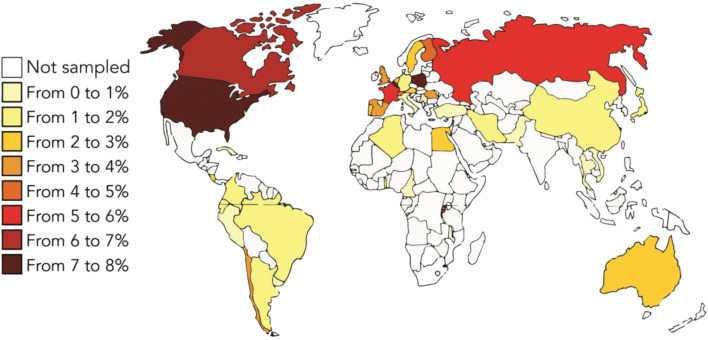
Fig. 1
Fig. 1
Prevalence of parental burnout across countries
Fig. 2
Fig. 2
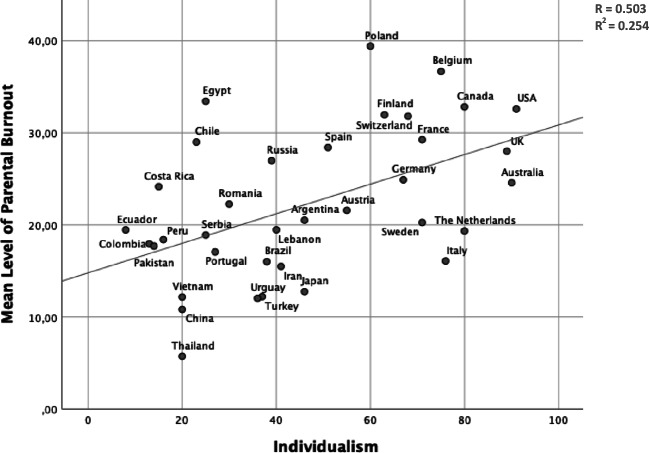
Parental burnout and individualism across countries

References

    1. Arnett JJ. The neglected 95%: Why American psychology needs to become less American. American Psychologist. 2008;63(7):602–614. doi: 10.1037/0003-066x.63.7.602. - DOI - PubMed
    1. Bleidorn W, Arslan RC, Denissen JJ, Rentfrow PJ, Gebauer JE, Potter J, Gosling SD. Age and sex differences in self-esteem—A cross-cultural window. Journal of Personality and Social Psychology. 2016;11(3):396. doi: 10.1037/pspp0000078. - DOI - PubMed
    1. Bornstein MH. Parenting and child mental health: A cross-cultural perspective. World Psychiatry. 2013;12(3):258–265. doi: 10.1002/wps.20071. - DOI - PMC - PubMed
    1. Brianda, M. E., Roskam, I., Gross, J. J., Franssen, A., Kapala, F., Gérard, F., & Mikolajczak, M. (2020). Treating parental burnout: Impact of two treatment modalities on burnout symptoms, emotions, hair cortisol, and parental neglect and violence. Psychotherapy and Psychosomatics. 10.1159/000506354. - PubMed
    1. Brianda ME, Roskam I, Mikolajczak M. Hair cortisol concentration as a biomarker of parental burnout. Psychoneuroendocrinology. 2020;117:104681. doi: 10.1016/j.psyneuen.2020.104681. - DOI - PubMed

LinkOut - more resources