This is a preprint.
Seroprevalence of anti-SARS-CoV-2 IgG antibodies in Juba, South Sudan: a population-based study
- PMID: 33758900
- PMCID: PMC7987059
- DOI: 10.1101/2021.03.08.21253009
Seroprevalence of anti-SARS-CoV-2 IgG antibodies in Juba, South Sudan: a population-based study
Update in
-
Seroprevalence of Severe Acute Respiratory Syndrome Coronavirus 2 IgG in Juba, South Sudan, 20201.Emerg Infect Dis. 2021 Jun;27(6):1598-1606. doi: 10.3201/eid2706.210568. Emerg Infect Dis. 2021. PMID: 34013872 Free PMC article.
Abstract
Background: Relatively few COVID-19 cases and deaths have been reported through much of sub-Saharan Africa, including South Sudan, although the extent of SARS-CoV-2 spread remains unclear due to weak surveillance systems and few population-representative serosurveys.
Methods: We conducted a representative household-based cross-sectional serosurvey in Juba, South Sudan. We quantified IgG antibody responses to SARS-CoV-2 spike protein receptor-binding domain and estimated seroprevalence using a Bayesian regression model accounting for test performance.
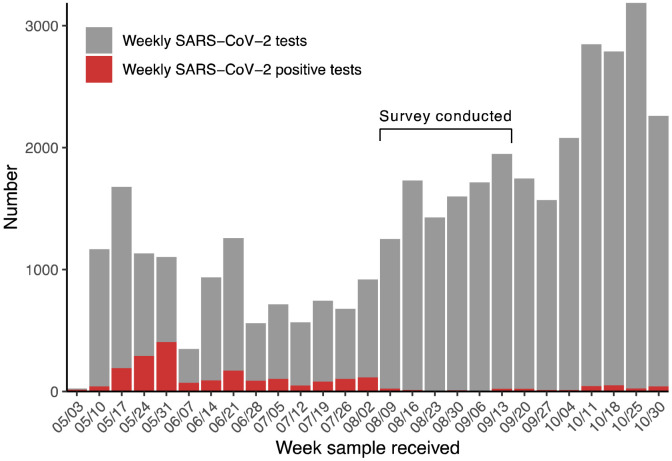
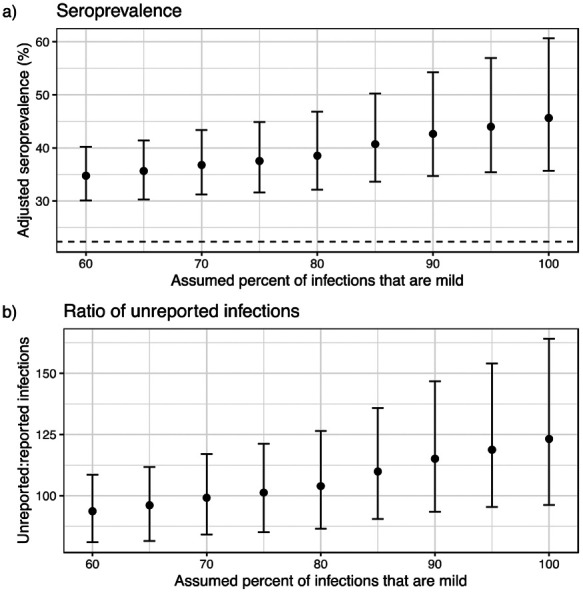
Results: We recruited 2,214 participants from August 10 to September 11, 2020 and 22.3% had anti-SARS-CoV-2 IgG titers above levels in pre-pandemic samples. After accounting for waning antibody levels, age, and sex, we estimated that 38.5% (32.1 - 46.8) of the population had been infected with SARS-CoV-2. For each RT-PCR confirmed COVID-19 case, 104 (87-126) infections were unreported. Background antibody reactivity was higher in pre-pandemic samples from Juba compared to Boston, where the serological test was validated. The estimated proportion of the population infected ranged from 30.1% to 60.6% depending on assumptions about test performance and prevalence of clinically severe infections.
Conclusions: SARS-CoV-2 has spread extensively within Juba. Validation of serological tests in sub-Saharan African populations is critical to improve our ability to use serosurveillance to understand and mitigate transmission.
Conflict of interest statement
Conflicts of interest
The authors declare no conflicts of interest.
Figures
References
-
- WHO. Weekly epidemiological update - 16 February 2021 [Internet]. [cited 2021 Feb 23]. Available from: https://www.who.int/publications/m/item/weekly-epidemiological-update---...
-
- Mbow M, Lell B, Jochems SP, et al. COVID-19 in Africa: dampening the storm? Science. American Association for the Advancement of Science; 2020; 369(6504):624–626. - PubMed
-
- WHO. Population-based age-stratified seroepidemiological investigation protocol for coronavirus 2019 (COVID-19) infection [Internet]. [cited 2021 Feb 11]. Available from: https://www.who.int/publications-detail-redirect/WHO-2019-nCoV-Seroepide...
-
- Chen X, Chen Z, Azman AS, et al. Serological evidence of human infection with SARS-CoV-2: a systematic review and meta-analysis. medRxiv. Cold Spring Harbor Laboratory Press; 2020; :2020.09.11.20192773.
Publication types
Grants and funding
LinkOut - more resources
Full Text Sources
Other Literature Sources
Miscellaneous