


Postprandial Fatty Acid Profile, but Not Cardiometabolic Risk Markers, Is Modulated by Dairy Fat Manipulation in Adults with Moderate Cardiovascular Disease Risk: The Randomized Controlled REplacement of SaturatEd fat in dairy on Total cholesterol (RESET) Study
- PMID: 33758921
- PMCID: PMC8327197
- DOI: 10.1093/jn/nxab050
Postprandial Fatty Acid Profile, but Not Cardiometabolic Risk Markers, Is Modulated by Dairy Fat Manipulation in Adults with Moderate Cardiovascular Disease Risk: The Randomized Controlled REplacement of SaturatEd fat in dairy on Total cholesterol (RESET) Study
Abstract
Background: Chronic consumption of dairy products with an SFA-reduced, MUFA-enriched content was shown to impact favorably on brachial artery flow-mediated dilatation (FMD). However, their acute effect on postprandial cardiometabolic risk biomarkers requires investigation.
Objective: The effects of sequential high-fat mixed meals rich in fatty acid (FA)-modified or conventional (control) dairy products on postprandial FMD (primary outcome) and systemic cardiometabolic biomarkers in adults with moderate cardiovascular risk (≥50% above the population mean) were compared.
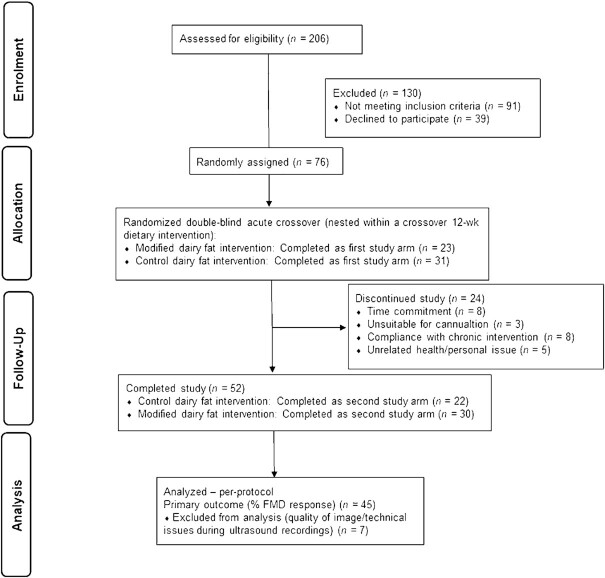
Methods: In a randomized crossover trial, 52 participants [mean ± SEM age: 53 ± 2 y; BMI (kg/m2) 25.9 ± 0.5] consumed a high-dairy-fat breakfast (0 min; ∼50 g total fat: modified: 25 g SFAs, 20 g MUFAs; control: 32 g SFAs, 12 g MUFAs) and lunch (330 min; ∼30 g total fat; modified: 15 g SFAs, 12 g MUFAs; control: 19 g SFAs, 7 g MUFAs). Blood samples were obtained before and until 480 min after breakfast, with FMD assessed at 0, 180, 300, and 420 min. Data were analyzed by linear mixed models.
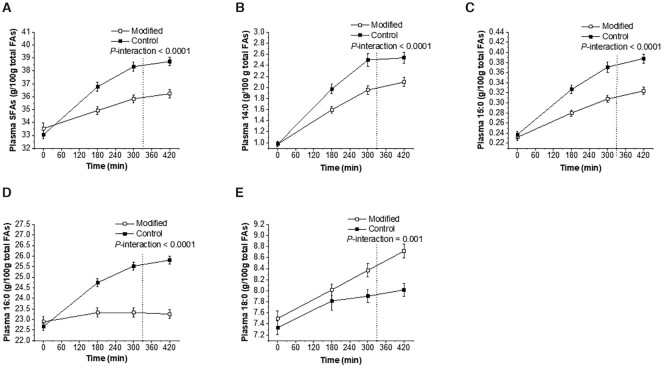
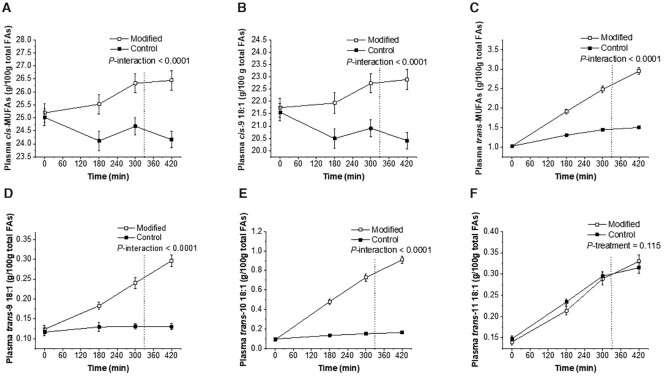
Results: Postprandial changes in cardiometabolic biomarkers were comparable between the different dairy meals, with the exception of a tendency for a 4% higher AUC for the %FMD response following the modified-dairy-fat meals (P = 0.075). Plasma total lipid FA analysis revealed that incremental AUC responses were 53% lower for total SFAs, 214% and 258% higher for total cis-MUFAs (predominantly cis-9 18:1), and trans-18:1, respectively, following the modified relative to the control dairy meals (all P < 0.0001).
Conclusions: In adults at moderate cardiovascular risk, acute consumption of sequential high-fat meals containing FA-modified dairy products had little impact on postprandial endothelial function or systemic cardiometabolic biomarkers, but a differential effect on the plasma total lipid FA profile, relative to conventional dairy fat meals.This trial was registered at clinicaltrials.gov as NCT02089035.
Keywords: endothelial function; monounsaturated fatty acids; postprandial lipemia; saturated fatty acids; sequential test meal protocol.
© The Author(s) 2021. Published by Oxford University Press on behalf of the American Society for Nutrition.
Figures
References
-
- Scientific Advisory Committee on Nutrition . Saturated fats and health. [Internet]. 2019. [cited 2020 Apr 29]. Available from: https://www.gov.uk/government/publications/saturated-fats-and-health-sac....
-
- World Health Organization . Draft guidelines on saturated fatty acid and trans-fatty acid intake for adults and children. [Internet]. 2018; [cited 2019 Apr 29]. Available from: https://extranet.who.int/dataform/upload/surveys/666752/files/Draft WHO .... - PubMed
-
- Roberts C, Steer T, Maplethorpe N, Cox L, Meadows S, Nicholson S, Page P, Swan G. National Diet and Nutrition Survey. Results from years 7–8 (combined) of the Rolling Programme (2014/15-2015/16). London: Public Health England; 2018.
-
- Thorning TK, Bertram HC, Bonjour J-P, de Groot L, Dupont D, Feeney E, Ipsen R, Lecerf JM, Mackie A, McKinley MC et al. Whole dairy matrix or single nutrients in assessment of health effects: current evidence and knowledge gaps. Am J Clin Nutr. 2017;105:1033–45. - PubMed
Publication types
MeSH terms
Substances
Associated data
Grants and funding
LinkOut - more resources
Full Text Sources
Other Literature Sources
Medical
