


Maternal First-Trimester Cow-Milk Intake Is Positively Associated with Childhood General and Abdominal Visceral Fat Mass and Lean Mass but Not with Other Cardiometabolic Risk Factors at the Age of 10 Years
- PMID: 33758934
- PMCID: PMC8245880
- DOI: 10.1093/jn/nxab047
Maternal First-Trimester Cow-Milk Intake Is Positively Associated with Childhood General and Abdominal Visceral Fat Mass and Lean Mass but Not with Other Cardiometabolic Risk Factors at the Age of 10 Years
Abstract
Background: Higher maternal cow-milk intake during pregnancy is associated with higher fetal growth measures and higher birth weight.
Objective: The aim of this study was to assess the associations of maternal milk intake during pregnancy with body fat measures and cardiometabolic risk factors at the age of 10 y.
Methods: In a population-based cohort of Dutch mothers and their children (n = 2466) followed from early pregnancy onwards, we assessed maternal first-trimester milk intake (milk and milk drinks) by food-frequency questionnaire. Maternal milk intake was categorized into 0-0.9, 1-1.9, 2-2.9, 3-3.9, 4-4.9, and ≥5 glasses/d, with 1 glass equivalent to 150 mL milk. For children at the age of 10 y, we calculated BMI and obtained detailed measures of body and organ fat by DXA and MRI. We also measured blood pressure and lipid, insulin, and glucose concentrations. Data were analyzed using linear and logistic regression models.
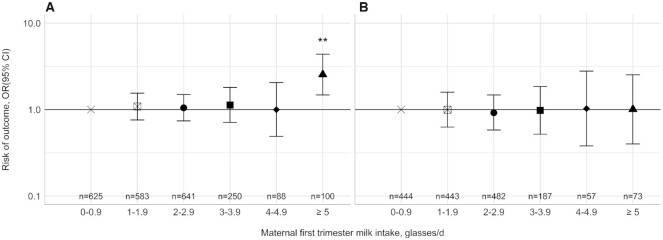
Results: Compared with children whose mothers consumed 0-0.9 glass of milk/d during their pregnancy, those whose mothers consumed ≥5 glasses of milk/d had a 0.29 SD (95% CI: 0.10, 0.48) higher BMI, 0.27 SD (95% CI: 0.08, 0.47) higher fat mass, 0.26 SD (95% CI: 0.07, 0.46) higher lean mass, 0.30 SD (95% CI: 0.09, 0.50) higher android-to-gynoid fat mass ratio and 0.38 SD (95% CI: 0.09, 0.67) higher abdominal visceral fat mass. After correction for multiple comparisons, groups of maternal milk intake were not associated with pericardial fat mass index, liver fat fraction, blood pressure, or lipid, insulin, or glucose concentrations (P values >0.0125).
Conclusions: Our results suggest that maternal first-trimester milk intake is positively associated with childhood general and abdominal visceral fat mass and lean mass, but not with other cardiometabolic risk factors.
Keywords: body fat; body mass index; childhood; lean mass; liver fat; maternal milk intake during pregnancy; pericardial fat mass; visceral fat mass.
© The Author(s) 2021. Published by Oxford University Press on behalf of the American Society for Nutrition.
Figures
References
-
- Koletzko B, Godfrey KM, Poston L, Szajewska H, van Goudoever JB, de Waard M, Brands B, Grivell RM, Deussen AR, Dodd JMet al. Nutrition during pregnancy, lactation and early childhood and its implications for maternal and long-term child health: the Early Nutrition Project recommendations. Ann Nutr Metab. 2019;74:93–106. - PMC - PubMed
-
- Pereira PC. Milk nutritional composition and its role in human health. Nutrition. 2014;30:619–27. - PubMed
-
- Willett WC, Ludwig DS. Milk and health. N Engl J Med. 2020;382:644–54. - PubMed
Publication types
MeSH terms
LinkOut - more resources
Full Text Sources
Other Literature Sources
