


Membraneless organelles restructured and built by pandemic viruses: HIV-1 and SARS-CoV-2
- PMID: 33760045
- PMCID: PMC8083626
- DOI: 10.1093/jmcb/mjab020
Membraneless organelles restructured and built by pandemic viruses: HIV-1 and SARS-CoV-2
Abstract
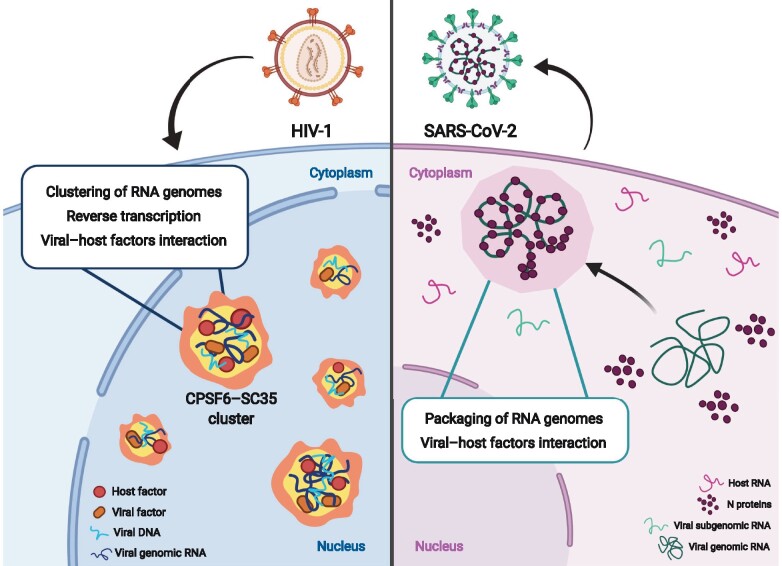
Viruses hijack host functions to invade their target cells and spread to new cells. Specifically, viruses learned to usurp liquid‒liquid phase separation (LLPS), a newly exploited mechanism, used by the cell to concentrate enzymes to accelerate and confine a wide variety of cellular processes. LLPS gives rise to actual membraneless organelles (MLOs), which do not only increase reaction rates but also act as a filter to select molecules to be retained or to be excluded from the liquid droplet. This is exactly what seems to happen with the condensation of SARS-CoV-2 nucleocapsid protein to favor the packaging of intact viral genomes, excluding viral subgenomic or host cellular RNAs. Another older pandemic virus, HIV-1, also takes advantage of LLPS in the host cell during the viral cycle. Recent discoveries highlighted that HIV-1 RNA genome condensates in nuclear MLOs accompanied by specific host and viral proteins, breaking the dogma of retroviruses that limited viral synthesis exclusively to the cytoplasmic compartment. Intriguing fundamental properties of viral/host LLPS remain still unclear. Future studies will contribute to deeply understanding the role of pathogen-induced MLOs in the epidemic invasion of pandemic viruses.
Keywords: HIV-1; LLPS; MLO; SARS-CoV-2.
© The Author(s) (2021). Published by Oxford University Press on behalf of Journal of Molecular Cell Biology, CEMCS, CAS.
Figures
References
-
- Anderson P., Kedersha N. (2008). Stress granules: the Tao of RNA triage. Trends Biochem. Sci. 33, 141–150. - PubMed
-
- Baltimore D. (1970). RNA-dependent DNA polymerase in virions of RNA tumour viruses. Nature 226, 1209–1211. - PubMed
-
- Barre-Sinoussi F., Chermann J.C., Rey F., et al. (1983). Isolation of a T-lymphotropic retrovirus from a patient at risk for acquired immune deficiency syndrome (AIDS). Science 220, 868–871. - PubMed
Publication types
MeSH terms
Substances
Grants and funding
LinkOut - more resources
Full Text Sources
Other Literature Sources
Miscellaneous
