


The neural underpinnings of intergroup social cognition: an fMRI meta-analysis
- PMID: 33760100
- PMCID: PMC8421705
- DOI: 10.1093/scan/nsab034
The neural underpinnings of intergroup social cognition: an fMRI meta-analysis
Abstract
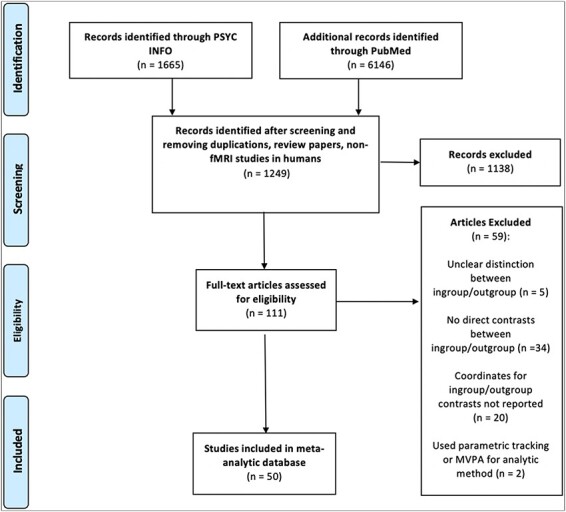
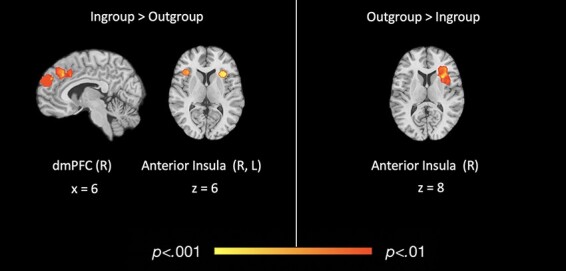
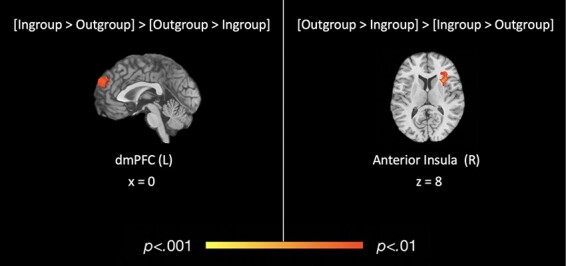
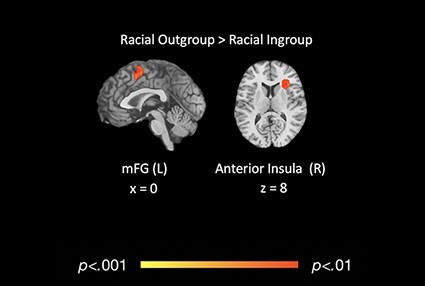
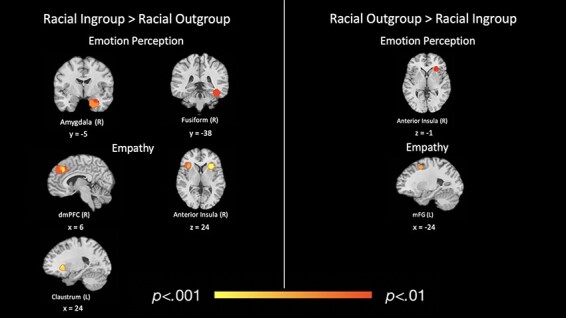
Roughly 20 years of functional magnetic resonance imaging (fMRI) studies have investigated the neural correlates underlying engagement in social cognition (e.g. empathy and emotion perception) about targets spanning various social categories (e.g. race and gender). Yet, findings from individual studies remain mixed. In the present quantitative functional neuroimaging meta-analysis, we summarized across 50 fMRI studies of social cognition to identify consistent differences in neural activation as a function of whether the target of social cognition was an in-group or out-group member. We investigated if such differences varied according to a specific social category (i.e. race) and specific social cognitive processes (i.e. empathy and emotion perception). We found that social cognition about in-group members was more reliably related to activity in brain regions associated with mentalizing (e.g. dorsomedial prefrontal cortex), whereas social cognition about out-group members was more reliably related to activity in regions associated with exogenous attention and salience (e.g. anterior insula). These findings replicated for studies specifically focused on the social category of race, and we further found intergroup differences in neural activation during empathy and emotion perception tasks. These results help shed light on the neural mechanisms underlying social cognition across group lines.
Keywords: fMRI; intergroup bias; meta-analysis; race; social cognition.
© The Author(s) 2021. Published by Oxford University Press.
Figures
References
-
- Adams R.B., Rule N.O., Franklin R.G., et al. (2010). Cross-cultural reading the mind in the eyes: an fMRI investigation. Journal of Cognitive Neuroscience, 22(1), 97–108. - PubMed
-
- Amodio D.M., Frith C.D. (2006). Meeting of minds: the medial frontal cortex and social cognition. Nature Reviews Neuroscience, 7(4), 268–77. - PubMed
-
- Balliet D., Wu J., De Dreu C.K.W. (2014). in-group favoritism in cooperation: a meta-analysis. Psychological Bulletin, 140(6), 1556–81. - PubMed
-
- Brauer M. (2001). Intergroup perception in the social context: the effects of social status and group membership on perceived out-group homogeneity and ethnocentrism. Journal of Experimental Social Psychology, 37(1), 15–31.
Publication types
MeSH terms
LinkOut - more resources
Full Text Sources
Other Literature Sources
Medical
