. 2021 Mar 24;11(1):6799.
doi: 10.1038/s41598-021-85949-1.

Potential novel biomarkers for chronic lung allograft dysfunction and azithromycin responsive allograft dysfunction

Affiliations

Potential novel biomarkers for chronic lung allograft dysfunction and azithromycin responsive allograft dysfunction

Cecilia Veraar et al. Sci Rep. .

Abstract

Chronic Lung Allograft Dysfunction (CLAD), manifesting as Bronchiolitis Obliterans Syndrome (BOS) or Restrictive Allograft Syndrome (RAS), is the main reason for adverse long-term outcome after Lung Transplantation (LTX). Until now, no specific biomarkers exist to differentiate between CLAD phenotypes. Therefore, we sought to find suitable cytokines to distinguish between BOS, RAS and Azithromycin Responsive Allograft Dysfunction (ARAD); and reveal potential similarities or differences to end-stage fibrotic diseases. We observed significantly increased Lipocalin-2 serum concentrations in RAS compared to BOS patients. In addition, in RAS patients immunohistochemistry revealed Lipocalin-2 expression in bronchial epithelium and alveolar walls. Patients with ARAD showed significantly lower Activin-A serum concentrations compared to Stable-LTX and BOS patients. Further, increased serum concentrations of Lipocalin-2 and Activin-A were predictors of worse freedom-from-CLAD in Stable-LTX patients. These biomarkers serve as promising serum biomarkers for CLAD prediction and seem suitable for implementation in clinical practice.


Conflict of interest statement

The authors declare no competing interests.

Figures
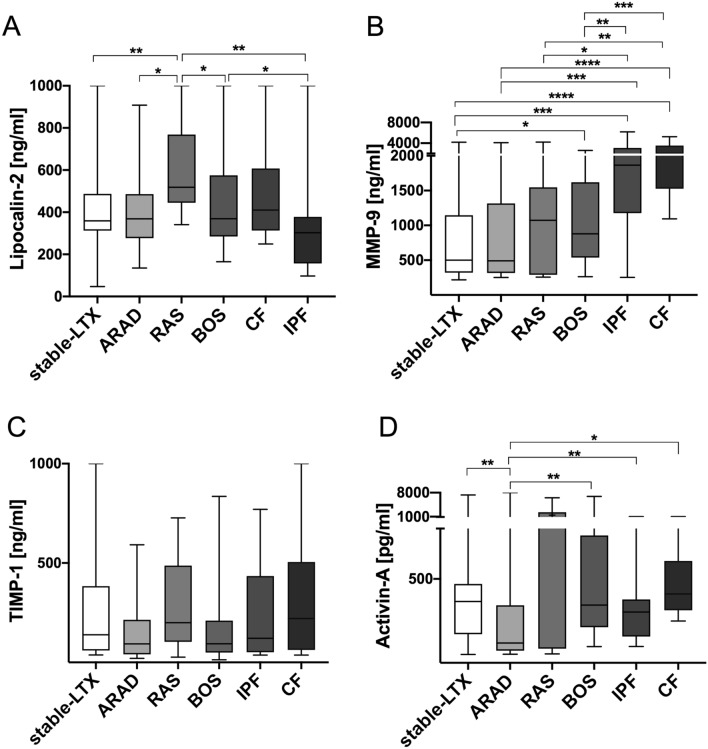
Figure 1
Figure 1
Differential expression of Lipocalin-2, Activin-A and MMP-9. Statistically significant differences for Lipcalin-2, MMP-9 and Activin-A are depicted in (A,B) and (D) where applicable. There were no statistically significant differences for TIMP-1 serum concentrations between all groups (C). Mann–Whitney U testing was performed between two groups each. The graphical depiction of all six groups together was chosen for better overview. The following p-values ware not corrected for multiple testing. *p < 0.05; **p < 0.01; ***p < 0.001 RAS Restrictive allograft syndrome, BOS bronchiolitis obliterans syndrome, ARAD azithromycin-responsive allograft dysfunction, MMP-9 matrix metalloproteinase-9, TIMP-1 tissue inhibitor of matrix metalloproteinase.
Figure 2
Figure 2
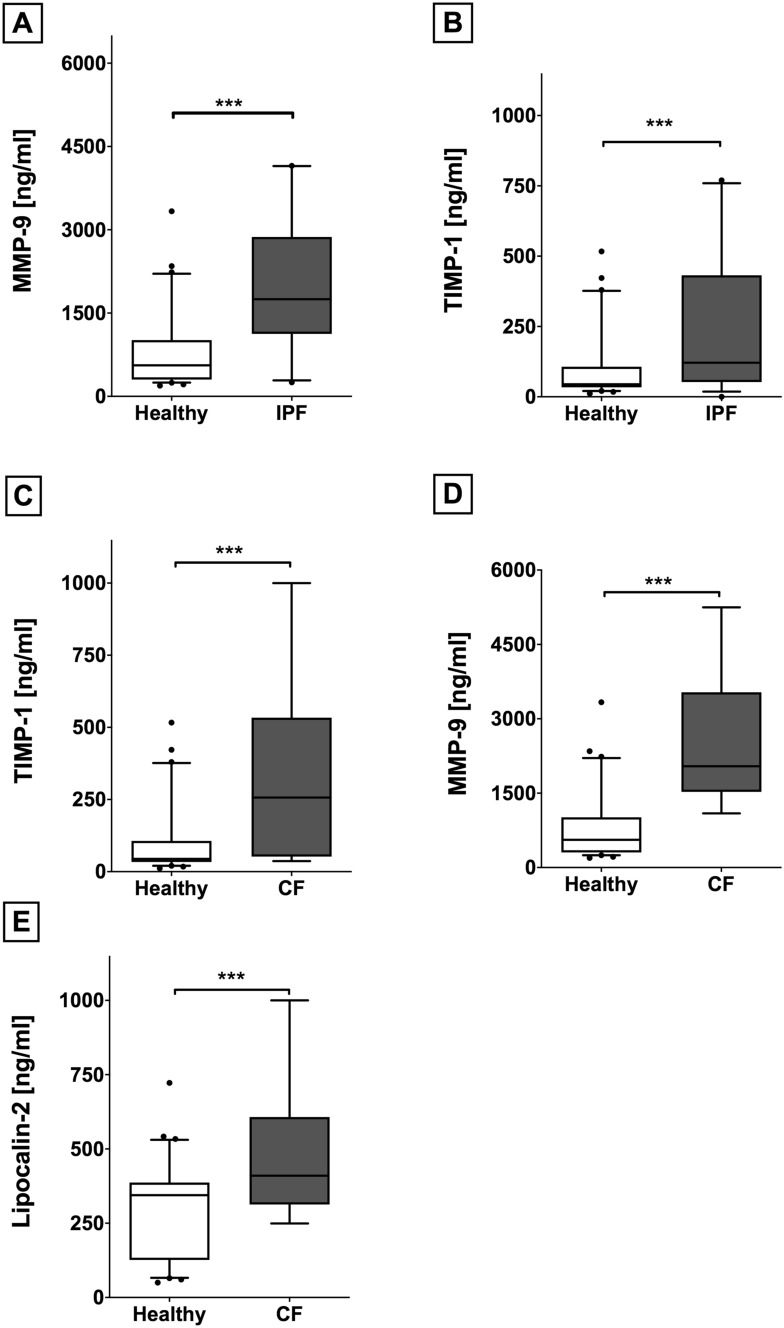
Increased expression of serum cytokines in end stage fibrotic diseases. IPF patients displayed higher serum concentrations of MMP-9 (A) and TIMP-1 (B) compared to healthy controls. CF patients also showed higher serum concentrations of MMP-9 (C) and TIMP-1 (D). Furthermore, Lipocalin-2 serum concentrations were elevated in CF patients compared to healthy volunteers (E). IPF Idiopathic pulmonary fibrosis, MMP-9 matrix metalloproteinase-9, TIMP-1 tissue inhibitors of metalloproteinase-1, CF cystic fibrosis, RAS restrictive allograft syndrome, BOS bronchiolitis obliterans syndrome.
Figure 3
Figure 3
Increased pulmonary expression of Lipocalin-2 in RAS. Immunohistochemistry: Pulmonary Lipocalin-2 expression in bronchial walls of a RAS patient. [(A) scale bar: 400 µm]; in contrast, absent expression of Lipocalin-2 in bronchial walls of a healthy control lung [(B) scale bar: 400 µm]. Lipocalin-2 expression in alveolar pneumocytes of a RAS patient [(C) scale bar: 80 µm]. No Lipocalin-2 expression in alveolar pneumocytes of a BO patient [(D) scale bar: 80 µm]. Elastica-van-Gieson staining detecting BO lesions [(E) scale bar: 400 µm]. Adjacent slide to (E) showing no increased expression of Lipocalin-2 within a BO lesion [(F) scale bar: 400 µm]. Discrete Lipocalin-2 expression in bronchial walls of an IPF patient [(G) scale bar: 160 µm] and a CF patient [(H) scale bar: 400 µm]. RAS Restrictive allograft syndrome, BO bronchiolitis obliterans, CF cystic fibrosis, IPF idiopathic pulmonary fibrosis.
Figure 4
Figure 4
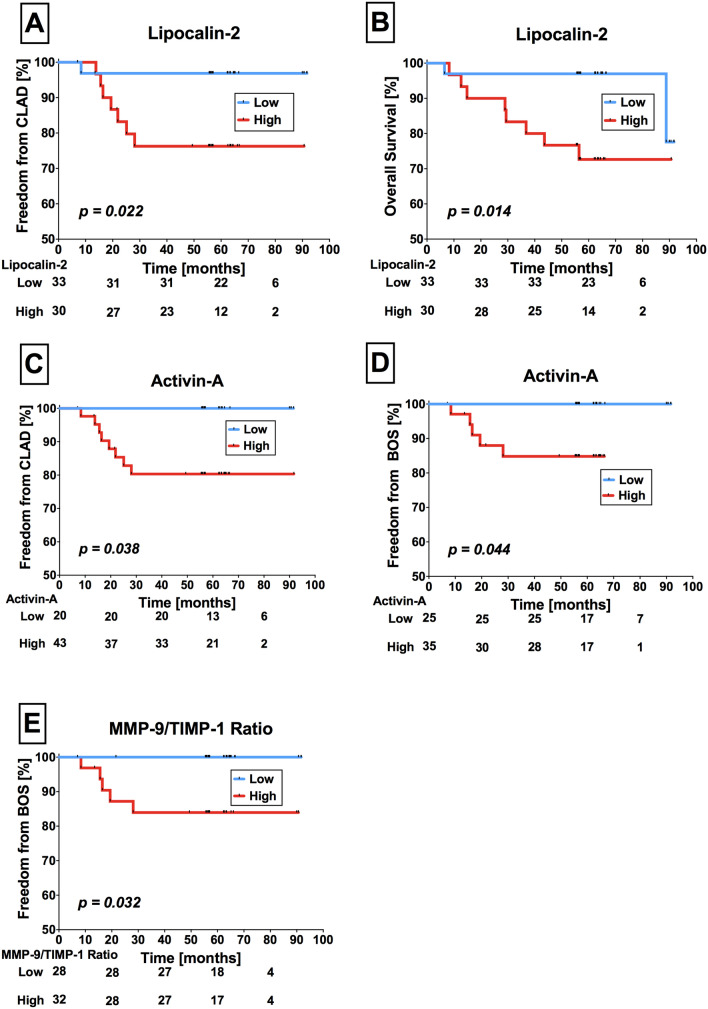
Lipocalin-2 serum concentrations in Stable-LTX predict future onset of CLAD and BOS. Stable-LTX patients with high Lipocalin-2 serum concentrations were significantly more likely to develop CLAD during follow-up compared to those with low Lipocalin-2 concentrations (A). Higher Lipocalin-2 serum concentrations in Stable-LTX patients resulted in worse OS during follow-up (B). High Activin-A serum concentrations were also associated with higher CLAD onset rates in Stable-LTX patients (C). Higher serum concentrations of Activin-A where significantly associated with the onset of CLAD subtype BOS (D). High MMP-9/TIMP-1 ratios translated to higher BOS onset rates compared to low MMP-9/TIMP-1 ratios in Stable-LTX patients (E). LTX Lung transplantation, CLAD chronic lung allograft dysfunction, RAS restrictive allograft syndrome, BOS bronchiolitis obliterans syndrome, MMP-9 matrix metalloproteinase-9, TIMP-1 tissue inhibitors of metalloproteinase-1.
Figure 5
Figure 5
Graphical depiction of the study design. Serum samples were selected of LTX patients diagnosed with CLAD (BOS (n = 30) and RAS (n = 11)), ARAD (n = 22) and Stable-LTX (n = 56), patients with end-stage pulmonary disease [IPF (n = 31) and CF (n = 15)] listed for LTX and healthy volunteers (n = 63). CLAD phenotypes, Stable-LTX and ARAD patients were diagnosed via spirometry. Prototypical spirometric volume changes over time and flow volume loops of stable lung transplanted patients/healthy people and patients with BOS and RAS are depicted. Enzyme-linked immunosorbent assays were employed for measuring cytokine serum concentrations of Lipocalin-2, MMP-9, TIMP-1, Activin-A and Follistatin. MMP-9/TIMP-1 and Activin-A/Follistatin ratios were calculated. Immunohistochemical stainings were performed in specimens of 20 patients who underwent re-transplantation for either BOS (n = 11) or RAS (n = 9), 20 patients who underwent primary LTX for either IPF (n = 10) or CF (n = 10), and 10 patients who served as healthy controls. Further, the correlation of cytokine serum concentrations and clinical outcome, including OS, future onset of CLAD and re-transplantation was analysed by performing Kaplan–Meier analysis. LTX Lung transplantation, CLAD chronic lung allograft dysfunction, BOS bronchiolitis obliterans syndrome, RAS restrictive allograft syndrome, ARAD azithromycin-reversible allograft dysfunction, IPF idiopathic pulmonary fibrosis, CF cystic fibrosis, MMP-9 matrix metalloproteinase-9, TIMP-1 tissue inhibitors of metalloproteinase-1.

References

    1. Verleden GM, Raghu G, Meyer KC, Glanville AR, Corris P. A new classification system for chronic lung allograft dysfunction. J. Heart Lung Transplant. 2014;33(2):127–133. doi: 10.1016/j.healun.2013.10.022. - DOI - PubMed
    1. Meyer KC, Raghu G, Verleden GM, et al. An international ISHLT/ATS/ERS clinical practice guideline: Diagnosis and management of bronchiolitis obliterans syndrome. Eur. Respir. J. 2014;44(6):1479–1503. doi: 10.1183/09031936.00107514. - DOI - PubMed
    1. Nishikawa T, Inomata S, Igarashi M, Goyagi T, Naito H. Plasma lidocaine concentrations during epidural blockade with isoflurane or halothane anesthesia. Anesth. Analg. 1992;75(6):885–888. doi: 10.1213/00000539-199212000-00004. - DOI - PubMed
    1. Sato M, Waddell TK, Wagnetz U, et al. Restrictive allograft syndrome (RAS): A novel form of chronic lung allograft dysfunction. J. Heart Lung Transplant. 2011;30(7):735–742. doi: 10.1016/j.healun.2011.01.712. - DOI - PubMed
    1. Sato M, Hwang DM, Waddell TK, Singer LG, Keshavjee S. Progression pattern of restrictive allograft syndrome after lung transplantation. J. Heart Lung Transplant. 2013;32(1):23–30. doi: 10.1016/j.healun.2012.09.026. - DOI - PubMed

Publication types