


Friend vs. Foe: Cognitive and Affective Empathy in Women With Different Hormonal States
- PMID: 33762905
- PMCID: PMC7982725
- DOI: 10.3389/fnins.2021.608768
Friend vs. Foe: Cognitive and Affective Empathy in Women With Different Hormonal States
Abstract
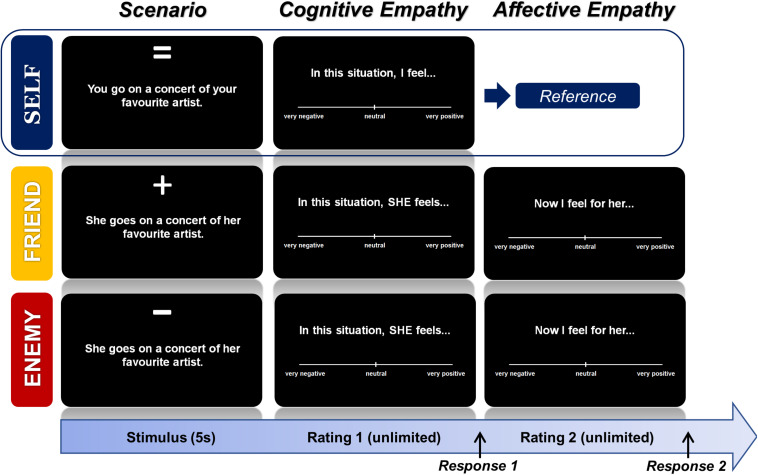
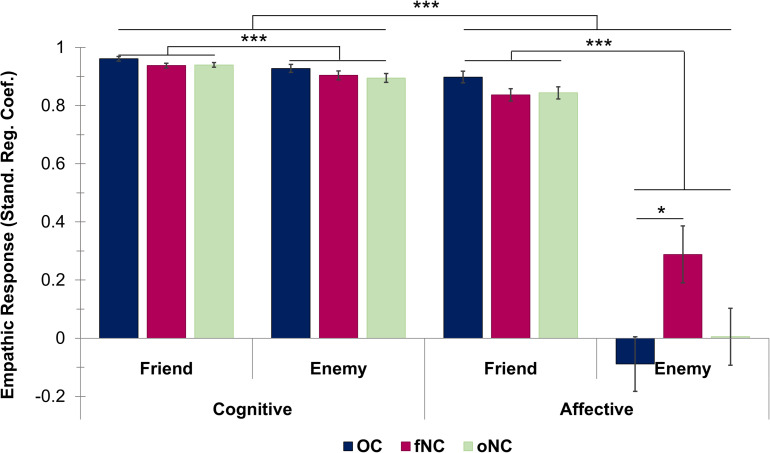
Empathy is crucial for social functioning as well as social coherence. It can be influenced by modulatory factors such as familiarity and liking (i.e., emotional closeness). Furthermore, there are first hints that hormonal status may modulate affective but not cognitive empathy in women. The aim of this study was to investigate potential separate as well as combined modulatory effects of emotional closeness and hormonal status on female cognitive and affective empathy. Three hormonal status groups of women (n = 62) were studied: (1) naturally-cycling (NC) women in the early follicular phase (fNC), (2) NC women during periovulatory phase (oNC), and (3) oral contraceptive (OC) users. All women underwent a newly developed empathy task (i.e., Tübinger Empathy Test, TET) presenting textual descriptions of positive and negative emotional scenes relating to three different perspectives (i.e., self vs. friend vs. enemy/disliked person). Regardless of hormonal status, empathic responses were higher for the friend compared to the enemy perspective for both empathy components. However, cognitive empathy was less affected by varying emotional closeness toward the target person than affective empathy. Hormonal status modulated only affective empathy. OC users showed significantly less affective empathy toward the enemy compared to the fNC women. Overall, affective empathy seems more sensitive to modulatory effects of emotional closeness and hormonal status than cognitive empathy. Possible implications of this current investigation for future research on empathy and OC use, contraceptive education as well as for other clinical applications are discussed.
Keywords: affective empathy; cognitive empathy; emotional closeness; empathy; hormonal status; oral contraceptives.
Copyright © 2021 Kimmig, Wildgruber, Wendel, Sundström-Poromaa and Derntl.
Conflict of interest statement
The authors declare that the research was conducted in the absence of any commercial or financial relationships that could be construed as a potential conflict of interest.
Figures
References
LinkOut - more resources
Full Text Sources
Other Literature Sources
