


Compliance without fear: Individual-level protective behaviour during the first wave of the COVID-19 pandemic
- PMID: 33763971
- PMCID: PMC8250211
- DOI: 10.1111/bjhp.12519
Compliance without fear: Individual-level protective behaviour during the first wave of the COVID-19 pandemic
Abstract
Objectives: The outbreak of the COVID-19 pandemic required rapid public compliance with advice from health authorities. Here, we ask who was most likely to do so during the first wave of the pandemic.
Design: Quota-sampled cross-sectional and panel data from eight Western democracies (Denmark, France, Germany, Hungary, Italy, Sweden, the United Kingdom, and the United States).
Methods: We fielded online public opinion surveys to 26,508 citizens between 19 March and 16 May. The surveys included questions about protective behaviour, perceptions of the pandemic (threat and self-efficacy), as well as broader attitudes towards society (institutional and interpersonal trust). We employ multilevel and fixed-effects regression models to analyse the relationship between these variables.
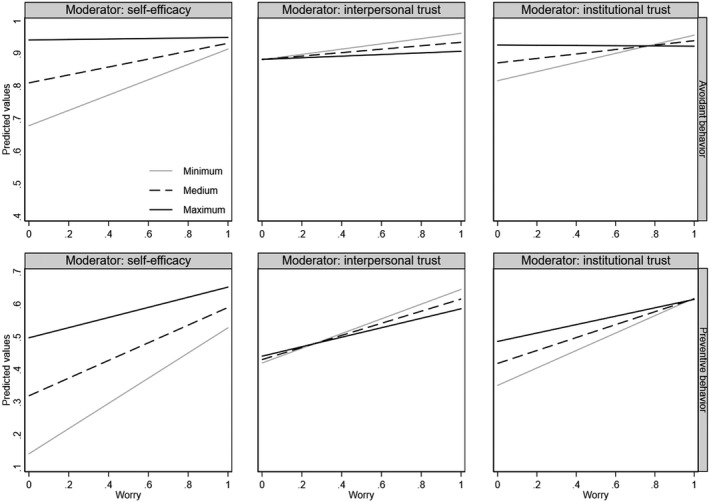
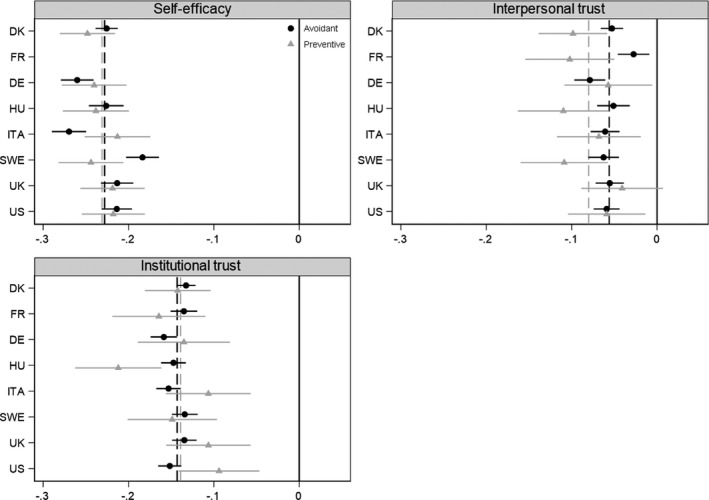
Results: Consistent with prior research on epidemics, perceptions of threat turn out as culturally uniform determinants of both avoidant and preventive forms of protective behaviour. On this basis, authorities could foster compliance by appealing to fear of COVID-19, but there may be normative and practical limits to such a strategy. Instead, we find that another major source of compliance is a sense of self-efficacy. Using individual-level panel data, we find evidence that self-efficacy is amendable to change and exerts an effect on protective behaviour. Furthermore, the effects of fear are small among those who feel efficacious, creating a path to compliance without fear. In contrast, two other major candidates for facilitating compliance from the social sciences, interpersonal trust and institutional trust, have surprisingly little motivational power during the first wave of the COVID-19 pandemic.
Conclusions: To address future waves of the pandemic, health authorities should thus focus on facilitating self-efficacy in the public.
Keywords: COVID-19; efficacy; fear; protective behaviour; trust.
© 2021 British Psychological Society.
Conflict of interest statement
All authors declare no conflict of interest.
Figures
References
-
- Amidon, T. R. , Nielsen, A. C. , Pugfelder, E. H. , Richards, D. P. , & Stephens, S. H. (2021). Visual risk literacy in “flatten the curve” covid‐19 visualizations. Journal of Business and Technical Communication, 35(1), 101–109. 10.1177/1050651920963439 - DOI
-
- Angrist, J. D. , & Pischke, J.‐S. (2008). Mostly harmless econometrics: An empiricist's companion. Princeton, NJ: Princeton University Press.
-
- Bandura, A. (1982). Self‐efficacy mechanism in human agency. American Psychologist, 37, 122–147. 10.1037/0003-066X.37.2.122 - DOI
Publication types
MeSH terms
Grants and funding
LinkOut - more resources
Full Text Sources
Other Literature Sources
Medical
