


Hypoglycaemia detection and prediction techniques: A systematic review on the latest developments
- PMID: 33763974
- PMCID: PMC8519027
- DOI: 10.1002/dmrr.3449
Hypoglycaemia detection and prediction techniques: A systematic review on the latest developments
Abstract
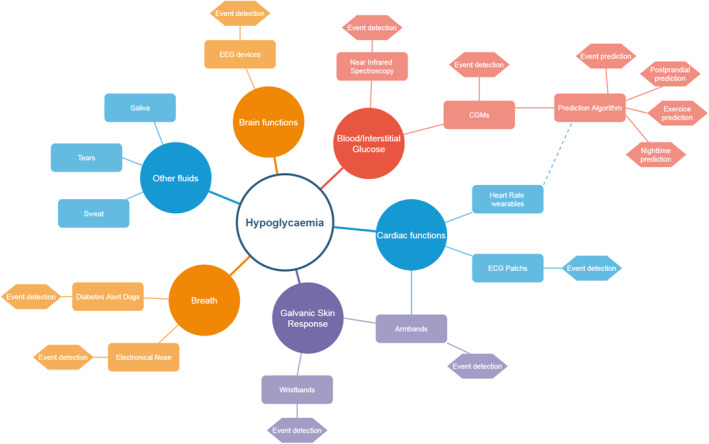
The main objective of diabetes control is to correct hyperglycaemia while avoiding hypoglycaemia, especially in insulin-treated patients. Fear of hypoglycaemia is a hurdle to effective correction of hyperglycaemia because it promotes under-dosing of insulin. Strategies to minimise hypoglycaemia include education and training for improved hypoglycaemia awareness and the development of technologies to allow their early detection and thus minimise their occurrence. Patients with impaired hypoglycaemia awareness would benefit the most from these technologies. The purpose of this systematic review is to review currently available or in-development technologies that support detection of hypoglycaemia or hypoglycaemia risk, and identify gaps in the research. Nanomaterial use in sensors is a promising strategy to increase the accuracy of continuous glucose monitoring devices for low glucose values. Hypoglycaemia is associated with changes on vital signs, so electrocardiogram and encephalogram could also be used to detect hypoglycaemia. Accuracy improvements through multivariable measures can make already marketed galvanic skin response devices a good noninvasive alternative. Breath volatile organic compounds can be detected by dogs and devices and alert patients at hypoglycaemia onset, while near-infrared spectroscopy can also be used as a hypoglycaemia alarms. Finally, one of the main directions of research are deep learning algorithms to analyse continuous glucose monitoring data and provide earlier and more accurate prediction of hypoglycaemia. Current developments for early identification of hypoglycaemia risk combine improvements of available 'needle-type' enzymatic glucose sensors and noninvasive alternatives. Patient usability will be essential to demonstrate to allow their implementation for daily use in diabetes management.
Keywords: algorithms; devices; diabetes mellitus; hypoglycaemia; sensors.
© 2021 The Authors. Diabetes/Metabolism Research and Reviews published by John Wiley & Sons Ltd.
Conflict of interest statement
Omar Diouri, Monika Cigler and Martina Vettoretti reports no conflict of interests. Julia K. Mader is co‐founder and shareholder of decide Clinical Software GmbH. Julia K. Mader is a member in the advisory board of Boehringer Ingelheim, Eli Lilly, Medtronic, Prediktor A/S, Roche Diabetes Care, Sanofi‐Aventis and received speaker honoraria from Abbott Diabetes Care, Astra Zeneca, Dexcom, Eli Lilly, MSD, NovoNordisk A/S, Roche Diabetes Care, Sanofi, Servier and Takeda. Eric Renard reports consulting services to Abbott, Air Liquide SI, Cellnovo, Dexcom, Eli‐Lilly, Insulet, Johnson & Johnson (Animas, LifeScan), Medirio, Medtronic, Novo‐Nordisk, Roche and Sanofi and research support from Abbott, Dexcom, Insulet, Roche et Tandem. Pratik Choudhary has received speaker and consultancy fees from Novo Nordisk, Sanofi, Lilly, Insulet, Medtronic, Abbott, Diabits, Novartis and research support from Medtronic, Abbottm, Novo Nordisk and Dexcom.
Figures

References
-
- International Hypoglycaemia Study Group . Glucose concentrations of less than 3.0 mmol/L (54 mg/dl) should be reported in clinical trials: a joint position statement of the American Diabetes Association and the European Association for the study of diabetes. Diabetes Care. 2017;40(1):155‐157. 10.2337/dc16-2215. - DOI - PubMed
Publication types
MeSH terms
Substances
LinkOut - more resources
Full Text Sources
Other Literature Sources
Medical
