. 2021 Mar 8;63(1):e1-e4.
doi: 10.4102/safp.v63i1.5279.

Assessment and management of shoulder pain at primary care level

Affiliations

Assessment and management of shoulder pain at primary care level

Ntambue Kauta et al. S Afr Fam Pract (2004). .

Abstract

Most patients with shoulder pain will initially visit their community health centre, private general practitioner or family physician, with various levels of experience in the assessment and management of shoulder conditions. Shoulder conditions will range from early, simple ailments that can be treated in the primary care setting, to post-traumatic injuries and complex pathologies requiring the expertise of an orthopaedic surgeon or a fellowship-trained shoulder surgeon. Correct assessment of the patient's shoulder condition at the index consultation is a prerequisite for appropriate management. This article sets out straightforward guidelines to help general practitioners confidently identify the patient's source of shoulder pain and initiate an appropriate management plan at primary care level. Criteria for urgent and elective referral for specialist care are also outlined.

Keywords: guidelines; primary care; referred shoulder pain; shoulder pain; shoulder stiffness; spontaneous shoulder pain; traumatic shoulder pain.


Conflict of interest statement

The authors have declared that no conflict of interest exists.

Figures
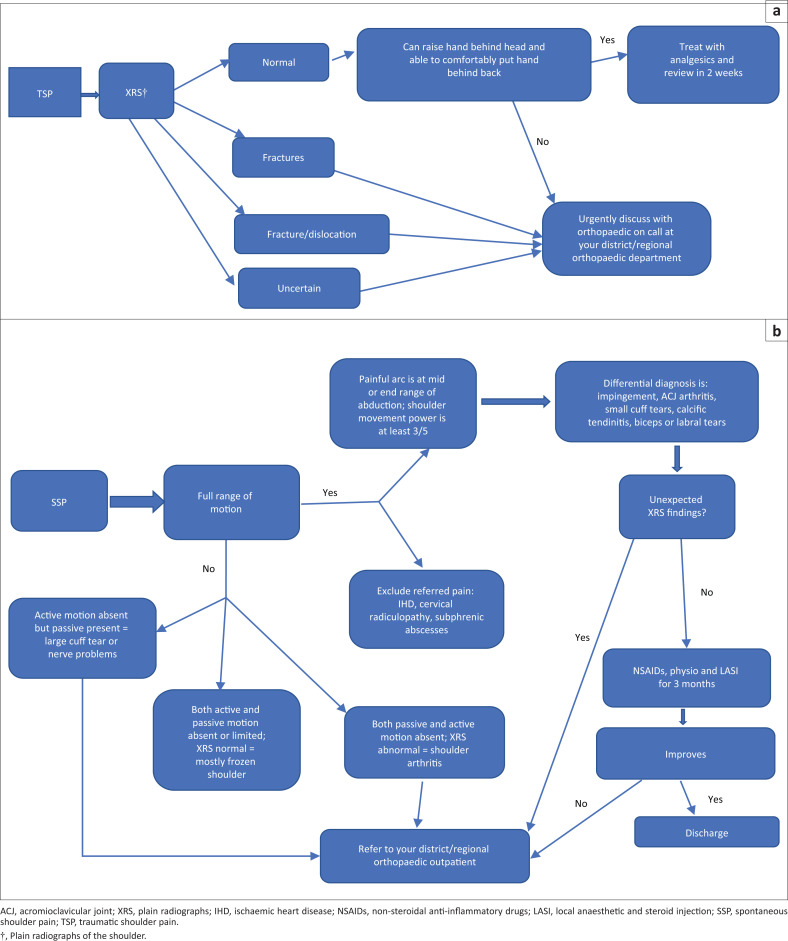
FIGURE 1
FIGURE 1
(a) Assessment and management of traumatic shoulder pain. (b) Assessment and management of spontaneous shoulder pain with no red flags.
FIGURE 2
FIGURE 2
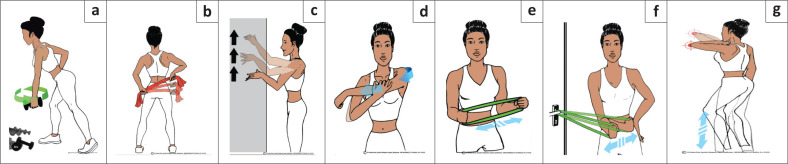
Home-based programme for shoulder stretching and strengthening exercises. (a) Pendulum stretch exercise: Perform 10 revolutions in each direction, once a day. Increase the stretch by holding a light weight (1 kilograms [kg] – 2 kg) in the swinging arm. (b) Towel stretch exercise: One end of a long enough towel is held behind your back in your affected hand and grab the opposite end with your other hand. Hold the towel in a horizontal position. Use your good arm to pull the affected arm upward to stretch it. Perform this stretch 15–30 times once a day. (c) Finger walk exercise: Reach out and touch the wall at waist level with the fingertips of the affected arm. With your elbow slightly bent, slowly walk your fingers up the wall, until you have raised your arm as far as you comfortably can. Slowly lower the arm (with the help of the good arm, if necessary). Perform this exercise 15–30 times a day. (d) Cross-body stretch: Use your good arm to lift your affected arm at the elbow, bring it up and across your body, and apply gentle pressure to stretch the shoulder. Hold the stretch for 15–20 s, 15–30 times per day. (e) Outward strengthening: Strengthening begins once range improves. Hold a rubber exercise band between your hands with your elbows at a 90-degree angle close to your sides. Rotate the lower part of the affected arm outward 15–20 degrees, and hold for 5 s. Repeat 15–20 times, once a day. (f) Inward strengthening: Hook an elastic loop band onto a closed door handle. Hold the other loop end of the elastic band with your hand on the affected side with your elbow flexed 90 degrees and arm at your side. Pull the band inward toward your tummy as far as possible and hold for 5 s. Repeat this 15–20 times, once a day. (g) Armpit stretch/elbow walk: Reach out and touch the wall at waist level with the flexed elbow of the affected arm. Slowly walk your elbow up the wall, until you have raised your arm as far as you comfortably can. Your elbow tip should be doing the work, not your shoulder muscles. Slowly lower the arm (with the help of the good arm, if necessary), and repeat. Repeat this exercise 15–30 times a day.

References

    1. Urwin M, Symmons D, Allison T, et al. Estimating the burden of musculoskeletal disorders in the community: The comparative prevalence of symptoms at different anatomical sites, and the relation to social deprivation. Ann Rheum Dis. 1998;57(11):649–655. 10.1136/ard.57.11.649 - DOI - PMC - PubMed
    1. Dachs R, Roche S, Vrettos B, et al. Assessment of undergraduate orthopaedic training at medical schools in South Africa. SA Orthop J. 2010;9(4):33–37.
    1. Hanchard NCA, Lenza M, Handoll HHG, Takwoingi Y. Physical tests for shoulder impingements and local lesions of bursa, tendon or labrum that may accompany impingement. Cochrane Database Syst Rev. 2013;2013(4):CD007427. 10.1002/14651858.CD007427.pub2 - DOI - PMC - PubMed
    1. Mitchell C, Adebajo A, Hay E, Carr A. Shoulder pain: Diagnosis and management in primary care. BMJ. 2005;331:1124–1128. 10.1136/bmj.331.7525.1124 - DOI - PMC - PubMed
    1. Zuckerman JD, Rokito A. Frozen shoulder: A consensus definition. J Should Elb Surg. 2011;20(2):322–325. 10.1016/j.jse.2010.07.008 - DOI - PubMed

LinkOut - more resources