


Short-term effects of the COVID-19 state of emergency on contraceptive access and utilization in Mozambique
- PMID: 33765080
- PMCID: PMC7993869
- DOI: 10.1371/journal.pone.0249195
Short-term effects of the COVID-19 state of emergency on contraceptive access and utilization in Mozambique
Erratum in
-
Correction: Short-term effects of the COVID-19 state of emergency on contraceptive access and utilization in Mozambique.PLoS One. 2025 Jan 3;20(1):e0317173. doi: 10.1371/journal.pone.0317173. eCollection 2025. PLoS One. 2025. PMID: 39752368 Free PMC article.
Abstract
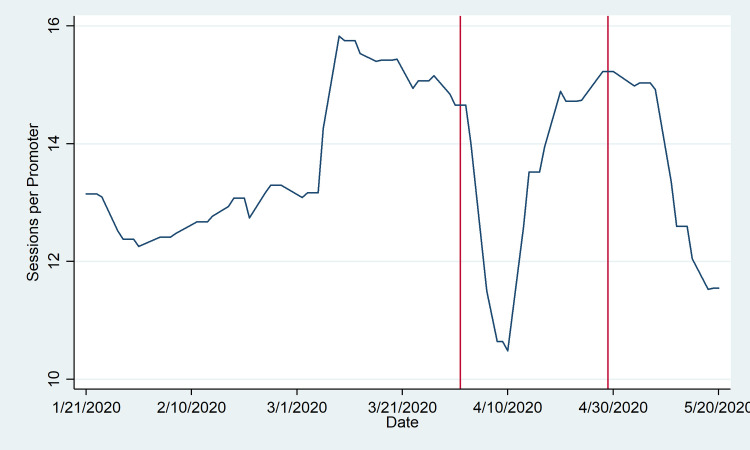
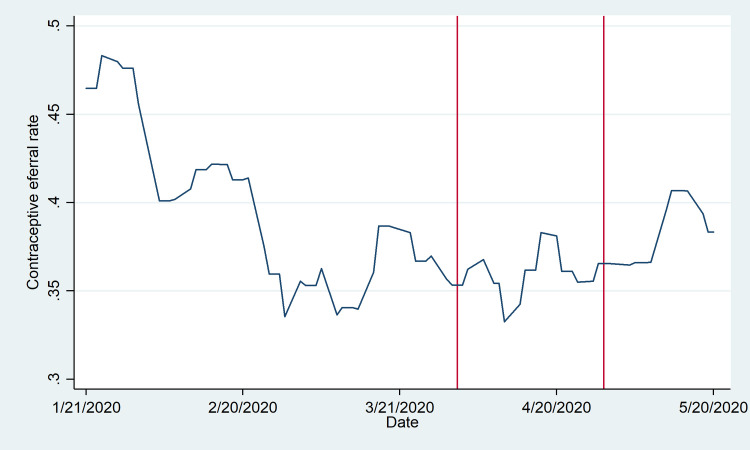
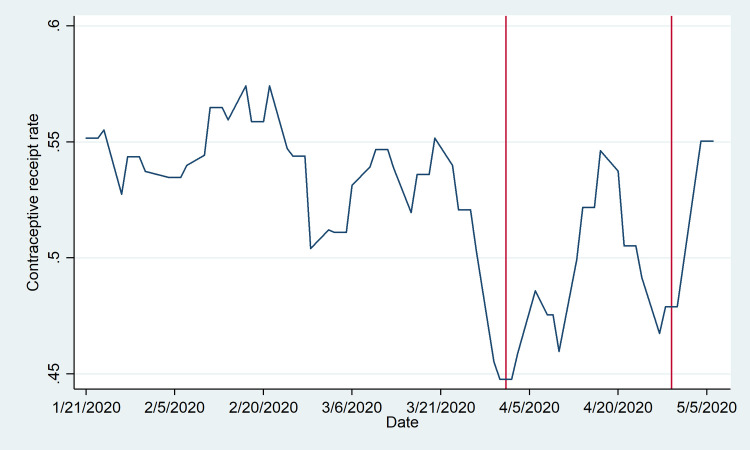
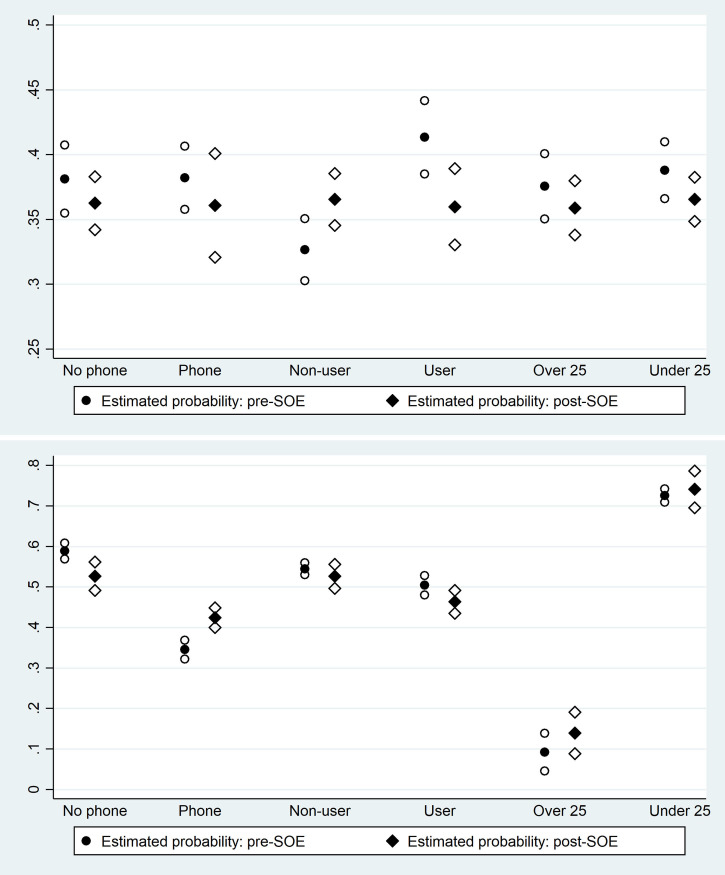
The COVID-19 pandemic has increasingly disrupted the global delivery of preventive health care services, as a large number of governments have issued state of emergency orders halting service delivery. However, there is limited evidence on the realized effects of the pandemic and associated emergency orders on access to services in low-income country contexts to date. To address this gap, this paper analyzes administrative data on utilization of contraceptive health services by women referred via community health promoters in two large urban and peri-urban areas of Mozambique. We focus on the period immediately surrounding the national state of emergency declaration linked to the COVID-19 pandemic on March 31, 2020. Data reported for 109,129 women served by 132 unique promoters and 192 unique public health facilities is analyzed using logistic regression, interrupted time series analysis and hazard analysis. The results demonstrate that the imposition of the state of emergency is associated with a modest short-term drop in both service provision and utilization, followed by a relatively rapid rebound. We conclude that in this context, the accessibility of reproductive health services was not dramatically reduced during the first phase of the pandemic-related emergency.
Conflict of interest statement
The authors have declared that no competing interests exist.
Figures
References
-
- Hall KS, Samari G, Garbers S, Casey SE, Diallo DD, Orcutt M, et al. Centring sexual and reproductive health and justice in the global COVID-19 response. The Lancet [Internet]. 2020. April 11;395(10231):1175–7. Available from: https://www.thelancet.com/journals/lancet/article/PIIS0140-6736(20)30801-1 - PMC - PubMed
-
- Nanda K, Lebetkin E, Steiner MJ, Yacobson I, Dorflinger LJ. Contraception in the era of COVID-19. Glob Health Sci Pract [Internet]. 2020. April 20 [cited 2020 May 8]; Available from: https://www.ghspjournal.org/content/early/2020/04/20/GHSP-D-20-00119 10.9745/GHSP-D-20-00119 - DOI - PMC - PubMed
-
- UN General Assembly. Transforming our world: The 2030 agenda for sustainable development [Internet]. 2015 Oct [cited 2020 Nov 15]. Report No.: A/RES/70/1. Available from: https://www.refworld.org/docid/57b6e3e44.html
-
- Sochas L, Channon AA, Nam S. Counting indirect crisis-related deaths in the context of a low-resilience health system: the case of maternal and neonatal health during the Ebola epidemic in Sierra Leone. Health Policy Plan [Internet]. 2017. November 1;32(suppl_3):iii32–9. Available from: http://academic.oup.com/heapol/article/32/suppl_3/iii32/4621472 10.1093/heapol/czx108 - DOI - PubMed
-
- Roberton T, Carter ED, Chou VB, Stegmuller AR, Jackson BD, Tam Y, et al. Early estimates of the indirect effects of the COVID-19 pandemic on maternal and child mortality in low-income and middle-income countries: a modelling study. Lancet Glob Health [Internet]. 2020. July 1;8(7):e901–8. Available from: http://www.sciencedirect.com/science/article/pii/S2214109X20302291 10.1016/S2214-109X(20)30229-1 - DOI - PMC - PubMed
Publication types
MeSH terms
Substances
LinkOut - more resources
Full Text Sources
Other Literature Sources
Medical
Miscellaneous
