Review
. 2021 Sep 8;45(5):fuab016.
doi: 10.1093/femsre/fuab016.

The endoplasmic reticulum unfolded protein response - homeostasis, cell death and evolution in virus infections

Affiliations
Review

The endoplasmic reticulum unfolded protein response - homeostasis, cell death and evolution in virus infections

Vibhu Prasad et al. FEMS Microbiol Rev. .

Abstract

Viruses elicit cell and organismic stress, and offset homeostasis. They trigger intrinsic, innate and adaptive immune responses, which limit infection. Viruses restore homeostasis by harnessing evolutionary conserved stress responses, such as the endoplasmic reticulum (ER) unfolded protein response (UPRER). The canonical UPRER restores homeostasis based on a cell-autonomous signalling network modulating transcriptional and translational output. The UPRER remedies cell damage, but upon severe and chronic stress leads to cell death. Signals from the UPRER flow along three branches with distinct stress sensors, the inositol requiring enzyme (Ire) 1, protein kinase R (PKR)-like ER kinase (PERK), and the activating transcription factor 6 (ATF6). This review shows how both enveloped and non-enveloped viruses use the UPRER to control cell stress and metabolic pathways, and thereby enhance infection and progeny formation, or undergo cell death. We highlight how the Ire1 axis bypasses apoptosis, boosts viral transcription and maintains dormant viral genomes during latency and persistence periods concurrent with long term survival of infected cells. These considerations open new options for oncolytic virus therapies against cancer cells where the UPRER is frequently upregulated. We conclude with a discussion of the evolutionary impact that viruses, in particular retroviruses, and anti-viral defense has on the UPRER.

Keywords: cell death; endoplasmic reticulum unfolded protein response; evolution; homeostasis; stress response; virus-induced cell stress.


Figures

Figure 1.
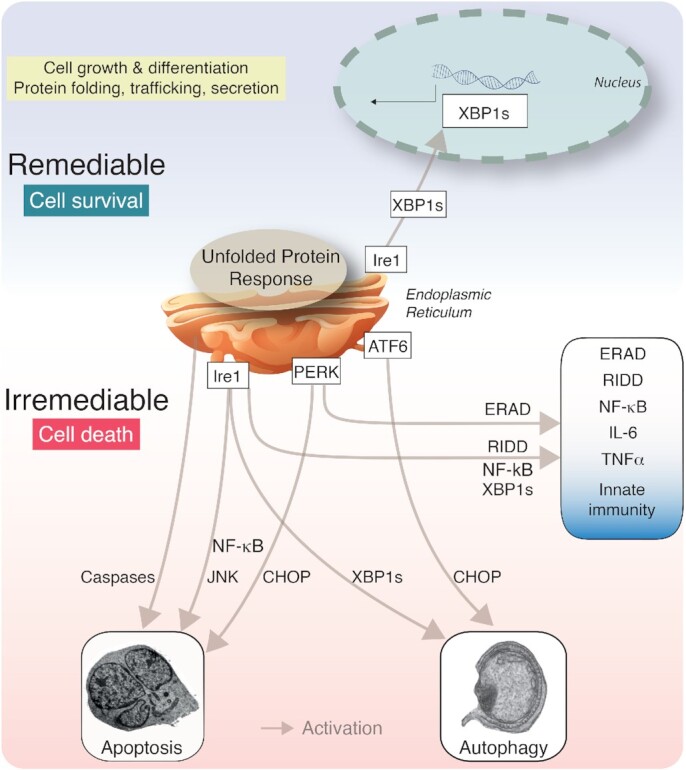
Figure 1.
The major signalling channels of the UPRER in cell survival, death and innate immunity. Distinct signalling pathways downstream of the vertebrate UPRER sensors result in cell survival, death and innate immunity. Abbreviations: Ire1, Inositol-requiring enzyme 1; Xbp1s, X-box binding protein 1 spliced; ATF6, Activating transcription factor 6; PERK, Protein kinase activated by double stranded RNA (PKR)-like ER kinase; NF-κB, Nuclear factor kappa light-chain-enhancer of activated B cells; JNK, c-Jun N-terminal kinases; CHOP, CCAAT/-enhancer-binding protein homologous protein; RIDD, Regulated Ire1-dependent decay of mRNA; ERAD, ER-associated degradation; IL-6, Interleukin-6; TNFα, Tumour necrosis factor alpha.
Figure 2.
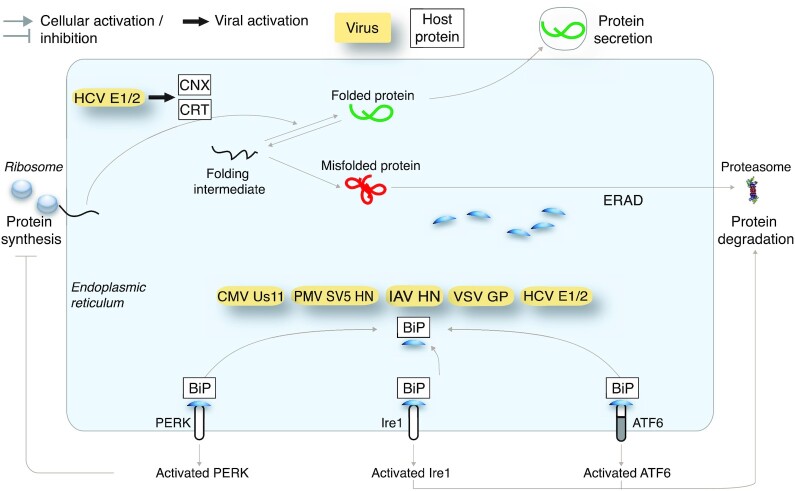
Figure 2.
Viruses sequestering BiP/Grp78 in the ER lumen. Initiation of a global UPRER in virus infections can occur by the sequestration of the ER chaperone BiP/Grp78 from the lumenal domain of the UPRER sensor proteins Ire1α, PERK and ATF6. All signalling arms of the UPRER sensors are activated as a result of BiP/Grp78 removal from ER lumenal domains of the sensor. Abbreviations: BiP, Binding immunoglobulin protein; CNX, Calnexin; CRT, Calreticulin; HCV, Hepatitis C virus; PMV, Paramyxo simian virus; IAV, Influenza A virus; CMV, Cytomegalovirus; VSV, Vesicular stomatitis virus; ERAD, ER-associated segradation; Ire1, Inositol-requiring enzyme 1; PERK, Protein kinase activated by double stranded RNA (PKR)-like ER kinase; ATF6, Activating transcription factor 6.
Figure 3.
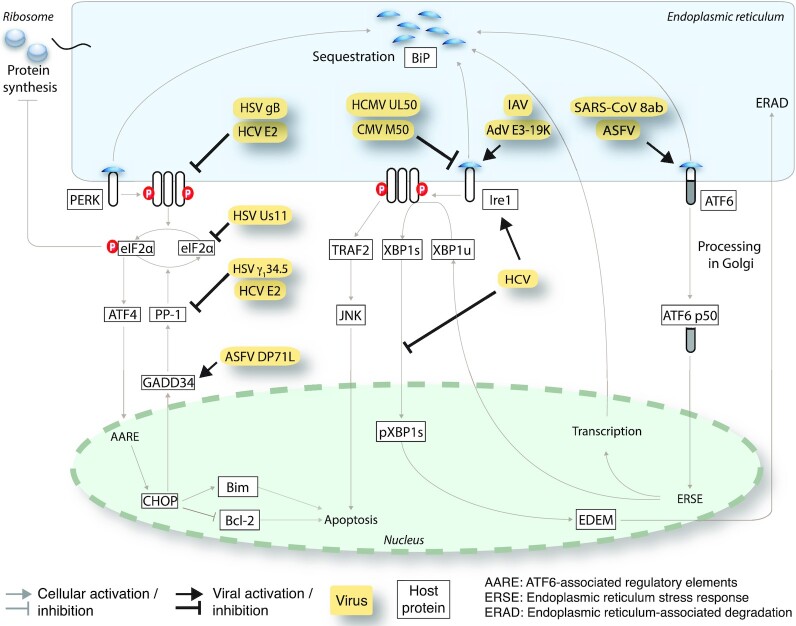
Figure 3.
Viral proteins interfering with signal transduction along the three UPRER branches Ire1, PERK and ATF6. Examples of viruses and viral proteins that activate or inactivate specific arm of the UPRER signalling by direct or indirect interactions at the level of the sensors or downstream signal transducers. Abbreviations: BiP, Binding immunoglobulin protein; eIF2α, Eukaryotic translation initiation factor 2 subunit1; Ire1, Inositol-requiring enzyme 1; ATF6, Activating transcription factor 6; PERK, Protein kinase activated by double stranded RNA (PKR)-like ER kinase; HSV, Herpes simplex virus; HCV, Hepatitis C virus; HCMV, Human cytomegalovirus; CMV, cytomegalovirus; IAV, Influenza A virus; AdV, Adenovirus; ASFV, African swine fever virus; ATF4, Activating transcription factor 4; PP-1, Protein phosphatase 1; CHOP, CCAAT/-enhancer-binding protein homologous protein; BiM, Bcl-2 like protein 11; Bcl-2, B-cell lymphoma 2; AARE, Amino acid response element; EDEM, ERAD enhancing α-mannosidase-like proteins; Xbp1s, X-box binding protein 1 spliced; JNK, c-Jun N-terminal kinases; TRAF2, TNF receptor associated factor 2.
Figure 4.
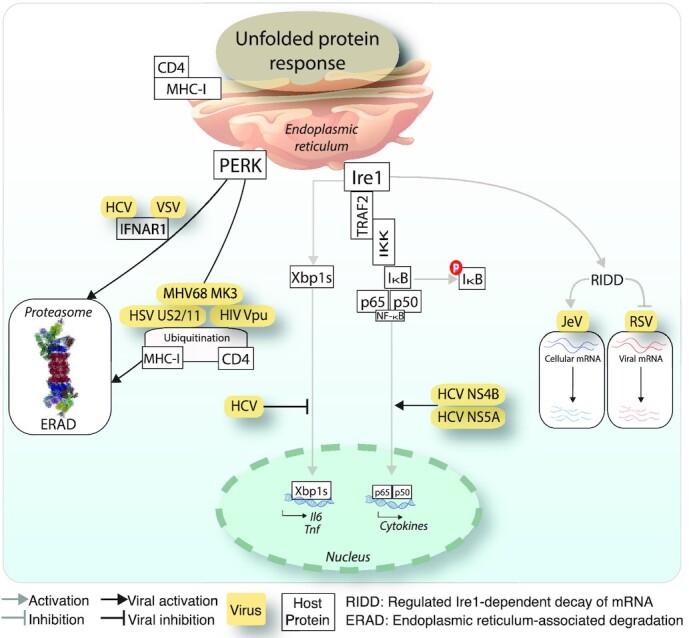
Figure 4.
Viral modulation of innate immunity effectors interlinked with the Ire1 and PERK branches of the UPRER. Viruses intercept signalling from the Ire1-Xbp1 axis to innate immunity hubs by interfering with activated NF-κB or RIDD. This can trigger proviral effects by degradation of host mRNAs or raise susceptibility to antiviral effects, for example when RIDD degrades viral RNA. PERK signalling can be activated by viruses to target key innate immunity components, such as IFNAR1 or MHC-I for proteasomal degradation. Abbreviations: PERK, Protein kinase activated by double stranded RNA (PKR)-like ER kinase; Ire1, Inositol-requiring enzyme 1; TRAF2, TNF receptor associated factor 2; IKK, IκB kinase; CD4, Cluster of differentiation 4 glycoprotein; MHC-I, Major histocombatibility factor I; RIDD, Regulated Ire1-dependent decay of mRNA; JeV, Japanese encephalitis virus; RSV, Respiratory syncytial virus; ERAD, ER-associated degradation; IL-6, Interleukin-6; TNF, Tumour necrosis factor; HIV, Human immunodeficiency virus; HSV, Herpes Simplex Virus; MHV, Mouse gammaherpes virus; HCV, Hepatitis C virus; VSV, Vesicular stomatitis virus; IFNAR1, Interferon alpha or beta receptor subunit 1.
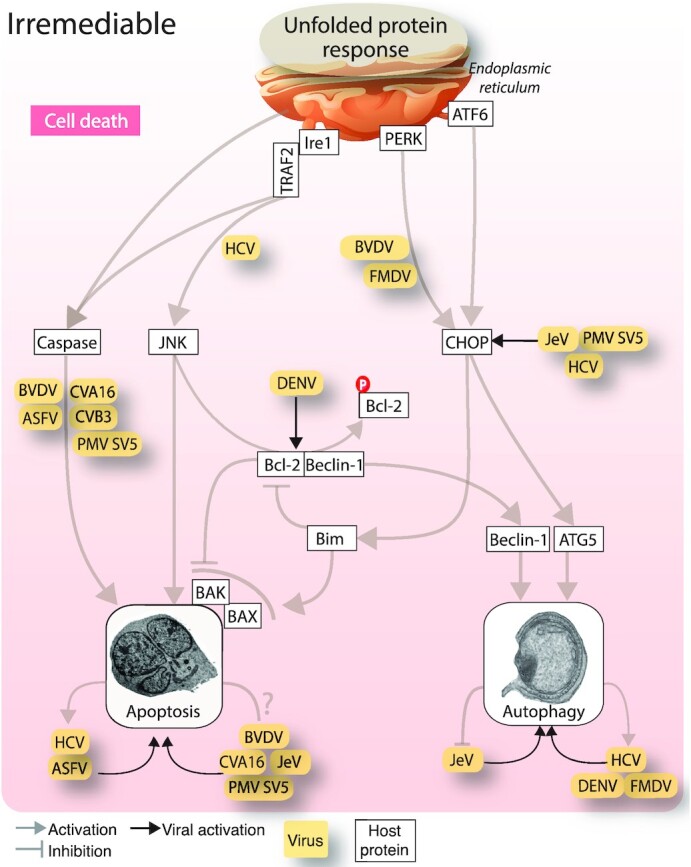
Figure 5.
Figure 5.
Viral modulation of UPRER controlled cell death pathways. Viruses and viral proteins use all the three UPRER sensor proteins for modulating cell death. The Ire1α-TRAF2-JNK signalling arm is used to promote apoptotic cell death. Several viruses promote ER stress dependent apoptosis via the caspase cascade. The PERK and ATF6 arms of the UPRER are targeted for the induction of autophagy via the CHOP transcription factor. Abbreviations: JNK, c-Jun N-terminal kinases; Ire1, Inositol-requiring enzyme 1; PERK, Protein kinase activated by double stranded RNA (PKR)-like ER kinase; ATF6, Activating transcription factor 6; BVDV, Bovine viral diarrhea virus; HCV, Hepatitis C virus; ASFV, African swine fever virus; CVA16, Coxsackievirus A16; CVB3, Coxsackievirus B3; JeV, Japanese encephalitis virus; PMV, Paramyxo simian virus; DENV, Dengue virus; TRAF2, TNF receptor associated factor 2; Bak, Bcl-2 homologous antagonist or killer; BAX, Bcl-2 associated X-protein; Bim, Bcl-2 like protein 11.

References

    1. Acosta-Alvear D, Zhou Y, Blais Aet al. XBP1 controls diverse cell type- and condition-specific transcriptional regulatory networks. Mol Cell. 2007;27:53–66. - PubMed
    1. Adolph TE, Tomczak MF, Niederreiter Let al. Paneth cells as a site of origin for intestinal inflammation. Nature. 2013;503:272–6. - PMC - PubMed
    1. Alemany R. Viruses in cancer treatment. Clin Transl Oncol. 2013;15:182–8. - PubMed
    1. Amin-Wetzel N, Saunders RA, Kamphuis MJet al. A J-Protein Co-chaperone Recruits BiP to Monomerize IRE1 and Repress the Unfolded Protein Response. Cell. 2017;171:1625–1637 e1613. - PMC - PubMed
    1. Aragon T, van Anken E, Pincus Det al. Messenger RNA targeting to endoplasmic reticulum stress signalling sites. Nature. 2009;457:736–40. - PMC - PubMed

Publication types