


Association between cholesterol efflux capacity and peripheral artery disease in coronary heart disease patients with and without type 2 diabetes: from the CORDIOPREV study
- PMID: 33766036
- PMCID: PMC7993540
- DOI: 10.1186/s12933-021-01260-3
Association between cholesterol efflux capacity and peripheral artery disease in coronary heart disease patients with and without type 2 diabetes: from the CORDIOPREV study
Erratum in
-
Correction to: Association between cholesterol efflux capacity and peripheral artery disease in coronary heart disease patients with and without type 2 diabetes: from the CORDIOPREV study.Cardiovasc Diabetol. 2021 Apr 17;20(1):79. doi: 10.1186/s12933-021-01269-8. Cardiovasc Diabetol. 2021. PMID: 33865389 Free PMC article. No abstract available.
Abstract
Background: Peripheral artery disease (PAD) is recognized as a significant predictor of mortality and adverse cardiovascular outcomes in patients with coronary heart disease (CHD). In fact, coexisting PAD and CHD is strongly associated with a greater coronary event recurrence compared with either one of them alone. High-density lipoprotein (HDL)-mediated cholesterol efflux capacity (CEC) is found to be inversely associated with an increased risk of incident CHD. However, this association is not established in patients with PAD in the context of secondary prevention. In this sense, our main aim was to evaluate the association between CEC and PAD in patients with CHD and whether the concurrent presence of PAD and T2DM influences this association.
Methods: CHD patients (n = 1002) from the CORDIOPREV study were classified according to the presence or absence of PAD (ankle-brachial index, ABI ≤ 0.9 and ABI > 0.9 and < 1.4, respectively) and T2DM status. CEC was quantified by incubation of cholesterol-loaded THP-1 cells with the participants' apoB-depleted plasma was performed.
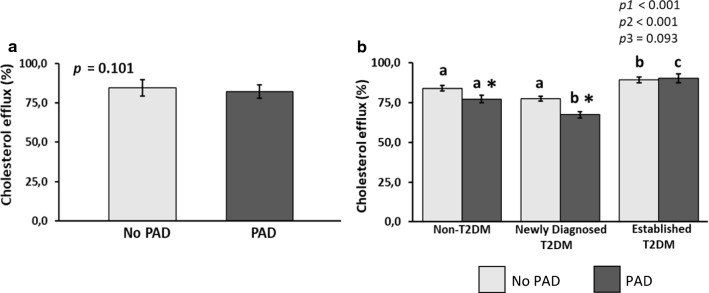
Results: The presence of PAD determined low CEC in non-T2DM and newly-diagnosed T2DM patients. Coexisting PAD and newly-diagnosed T2DM provided and additive effect providing an impaired CEC compared to non-T2DM patients with PAD. In established T2DM patients, the presence of PAD did not determine differences in CEC, compared to those without PAD, which may be restored by glucose-lowering treatment.
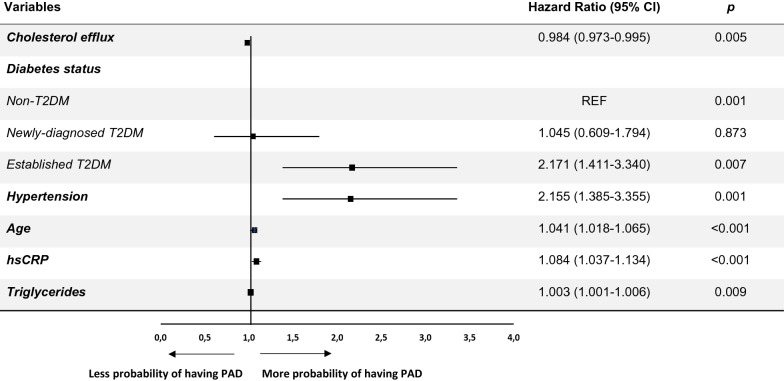
Conclusions: Our findings suggest an inverse relationship between CEC and PAD in CHD patients. These results support the importance of identifying underlying mechanisms of PAD, in the context of secondary prevention, that provide potential therapeutic targets, that is the case of CEC, and establishing strategies to prevent or reduce the high risk of cardiovascular events of these patients. Trial registration https://clinicaltrials.gov/ct2/show/NCT00924937 . Unique Identifier: NCT00924937.
Keywords: Cholesterol efflux capacity; Coronary heart disease; Peripheral artery disease; Secondary prevention; Type 2 diabetes mellitus.
Conflict of interest statement
The authors declare that they have no competing interests.
Figures
References
-
- De Luca L, Di Pasquale G, Gonzini L, Chiarella F, Di Chiara A, Boccanelli A, Casella G, Olivari Z, De Servi S, Gulizia MM, et al. Trends in management and outcome of patients with non-ST elevation acute coronary syndromes and peripheral arterial disease. Eur J Intern Med. 2019;59:70–76. doi: 10.1016/j.ejim.2018.08.010. - DOI - PubMed
-
- Hirsch AT, Haskal ZJ, Hertzer NR, Bakal CW, Creager MA, Halperin JL, Hiratzka LF, Murphy WR, Olin JW, Puschett JB, et al. ACC/AHA 2005 Practice Guidelines for the management of patients with peripheral arterial disease (lower extremity, renal, mesenteric, and abdominal aortic): a collaborative report from the American Association for Vascular Surgery/Society for Vascular Surgery, Society for Cardiovascular Angiography and Interventions, Society for Vascular Medicine and Biology, Society of Interventional Radiology, and the ACC/AHA Task Force on Practice Guidelines (Writing Committee to Develop Guidelines for the Management of Patients With Peripheral Arterial Disease): endorsed by the American Association of Cardiovascular and Pulmonary Rehabilitation; National Heart, Lung, and Blood Institute; Society for Vascular Nursing; TransAtlantic Inter-Society Consensus; and Vascular Disease Foundation. Circulation. 2006;113(11):e463–654. doi: 10.1161/CIRCULATIONAHA.106.174526. - DOI - PubMed
Publication types
MeSH terms
Substances
Associated data
LinkOut - more resources
Full Text Sources
Other Literature Sources
Medical
Miscellaneous
