. 2021 Mar 26;52(16):1-9.
doi: 10.1017/S0033291721000702. Online ahead of print.

Efficacy of attention bias modification training for depressed adults: a randomized clinical trial

Affiliations

Efficacy of attention bias modification training for depressed adults: a randomized clinical trial

Kean J Hsu et al. Psychol Med. .

Abstract

Background: This study examined the efficacy of attention bias modification training (ABMT) for the treatment of depression.

Methods: In this randomized clinical trial, 145 adults (77% female, 62% white) with at least moderate depression severity [i.e. self-reported Quick Inventory of Depressive Symptomatology (QIDS-SR) ⩾13] and a negative attention bias were randomized to active ABMT, sham ABMT, or assessments only. The training consisted of two in-clinic and three (brief) at-home ABMT sessions per week for 4 weeks (2224 training trials total). The pre-registered primary outcome was change in QIDS-SR. Secondary outcomes were the 17-item Hamilton Depression Rating Scale (HRSD) and anhedonic depression and anxious arousal from the Mood and Anxiety Symptom Questionnaire (MASQ). Primary and secondary outcomes were administered at baseline and four weekly assessments during ABMT.

Results: Intent-to-treat analyses indicated that, relative to assessment-only, active ABMT significantly reduced QIDS-SR and HRSD scores by an additional 0.62 ± 0.23 (p = 0.008, d = -0.57) and 0.74 ± 0.31 (p = 0.021, d = -0.49) points per week. Similar results were observed for active v. sham ABMT: a greater symptom reduction of 0.44 ± 0.24 QIDS-SR (p = 0.067, d = -0.41) and 0.69 ± 0.32 HRSD (p = 0.033, d = -0.42) points per week. Sham ABMT did not significantly differ from the assessment-only condition. No significant differences were observed for the MASQ scales.

Conclusion: Depressed individuals with at least modest negative attentional bias benefitted from active ABMT.

Keywords: Attention bias modification training; depression; negative attentional bias; randomized clinical trial.


Figures
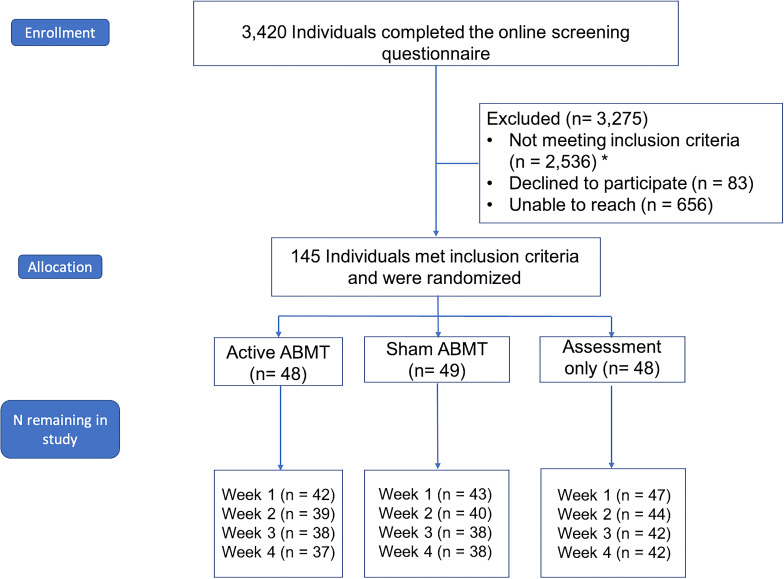
Fig. 1.
Fig. 1.
Consort diagram. CONSORT diagram documenting participant flow through the study. All available data were analyzed. *The same person may contribute to the count of more than one exclusionary criterion; in addition, although we required individuals to be stable on antidepressant medications for at least 12 weeks without a change in dosage or medication, we actually did not exclude anyone due to this criterion because: (1) after they were stable on their medication for 12 weeks they were re-evaluated for inclusion/exclusion criteria and they were excluded for another reason; (2) after they were stable on their medication for 12 weeks they were re-evaluated for inclusion/exclusion criteria and they were eligible and enrolled; or (3) we were unable to recontact participants after the 12 week waiting period and they were excluded for that reason.
Fig. 2.
Fig. 2.
Change in self-reported depression symptoms (QIDS-SR) over time presented by training condition. Effects from linear mixed effects regression with 95% confidence bands. Reductions in self-reported depression symptom severity was greater for active ABMT than assessment-only (d = −0.57, p = 0.008) and sham ABMT (d = −0.41, p = 0.067). QIDS-SR, Quick Inventory Depression Scale-Self-Report version. Means, standard deviations, and Ns at each time point are available for all primary and secondary outcomes in online Supplementary materials.
Fig. 3.
Fig. 3.
Change in the secondary outcomes (HRSD-17, MASQ-AD, MASQ-AA) over time presented by training condition. Effects from linear mixed effects regression with 95% confidence bands. Reductions in interviewer-rated depression symptom severity was greater for active ABMT than assessment-only (d = −0.49, p = 0.025) and sham ABMT (d = −0.42, p = 0.033). No training condition differences were observed for anhedonic or anxious arousal symptoms. HRSD-17, Hamilton Rating Scale for Depression-17 item; MASQ-AD, Mood and Anxiety Symptom Questionnaire-Anhedonic Symptoms; MASQ-AA, Mood and Anxiety Symptom Questionnaire-Anxious Arousal.

References

    1. Armstrong, T., & Olatunji, B. O. (2012). Eye tracking of attention in the affective disorders: A meta-analytic review and synthesis. Clinical Psychology Review, 32(8), 704–723. doi: 10.1016/j.cpr.2012.09.004. - DOI - PMC - PubMed
    1. Badura-Brack, A. S., Naim, R., Ryan, T. J., Levy, O., Abend, R., Khanna, M. M., … Bar-Haim, Y. (2015). Effect of attention training on attention bias variability and PTSD symptoms: Randomized controlled trials in Israeli and U.S. Combat veterans. The American Journal of Psychiatry, 172(12), 1233–1241. - PMC - PubMed
    1. Bar-Haim, Y. (2010). Research review: Attention bias modification (ABM): A novel treatment for anxiety disorders. Journal of Child Psychology and Psychiatry, and Allied Disciplines, 51(8), 859–870. - PubMed
    1. Beevers, C. G., Clasen, P. C., Enock, P. M., & Schnyer, D. M. (2015). Attention bias modification for major depressive disorder: Effects on attention bias, resting state connectivity, and symptom change. Journal of Abnormal Psychology, 124(3), 463–475. doi: 10.1037/abn0000049. - DOI - PMC - PubMed
    1. Clasen, P. C., Wells, T. T., Ellis, A. J., & Beevers, C. G. (2013). Attentional biases and the persistence of sad mood in major depressive disorder. Journal of Abnormal Psychology, 122(1), 74–85. doi: 10.1037/a0029211. - DOI - PMC - PubMed