. 2021 Mar 25;11(1):6862.
doi: 10.1038/s41598-021-85811-4.

Long-term changes in the small-world organization of brain networks after concussion

Affiliations

Long-term changes in the small-world organization of brain networks after concussion

N W Churchill et al. Sci Rep. .

Abstract

There is a growing body of literature using functional MRI to study the acute and long-term effects of concussion on functional brain networks. To date, studies have largely focused on changes in pairwise connectivity strength between brain regions. Less is known about how concussion affects whole-brain network topology, particularly the "small-world" organization which facilitates efficient communication at both local and global scales. The present study addressed this knowledge gap by measuring local and global efficiency of 26 concussed athletes at acute injury, return to play (RTP) and one year post-RTP, along with a cohort of 167 athletic controls. On average, concussed athletes showed no alterations in local efficiency but had elevated global efficiency at acute injury, which had resolved by RTP. Athletes with atypically long recovery, however, had reduced global efficiency at 1 year post-RTP, suggesting long-term functional abnormalities for this subgroup. Analyses of nodal efficiency further indicated that global network changes were driven by high-efficiency visual and sensorimotor regions and low-efficiency frontal and subcortical regions. This study provides evidence that concussion causes subtle acute and long-term changes in the small-world organization of the brain, with effects that are related to the clinical profile of recovery.


Conflict of interest statement

The authors declare no competing interests.

Figures

Figure 1
Figure 1
Characterizing network efficiency and small-world behaviour among healthy controls. (A) Examples of lattice and random graphs, along with a real-world graph of the experimental data from controls, plotted in circular layout. The latter graph is calculated from the average z-transformed connectivity matrix of BNA parcels in the occipital cortex (22 nodes), thresholded at P = 25% sparsity, with the former graphs generated at equivalent sizes and sparsity levels. (B,C) average local efficiency (Eloc) and global efficiency (Eglob) curves for healthy controls (black curve) along with sample 95% interval error bars, as a function of sparsity percentile threshold. The corresponding curves for lattice (blue) and random (red) graphs are also shown. The “small-world” domain is the interval in which 95% intervals do not overlap with either lattice or random graph efficiency curves for both efficiency measures (P = 3–26%).
Figure 2
Figure 2
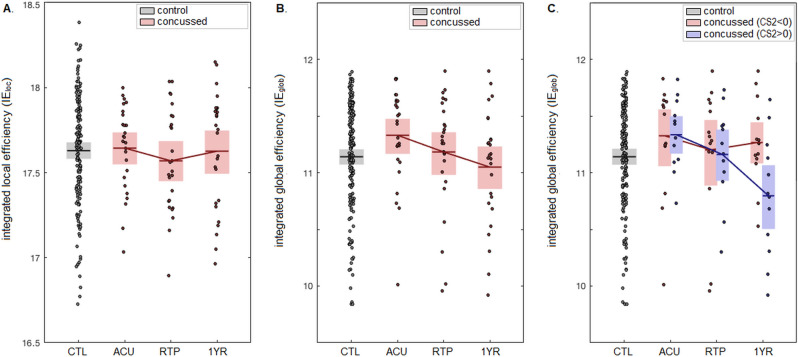
Effects of concussion on network efficiency. (A,B) depict the integrated local efficiency (IEloc) and integrated global efficiency (IEglob) values for healthy controls (black) and for concussed athletes (red) at each imaging session. (C) depicts the IEglob values for controls and concussed athletes, subgrouped based on clinical score CS2 (days to RTP symptom severity). Horizontal bars represent sample means and shaded boxes denote the 95%CIs of the mean.
Figure 3
Figure 3
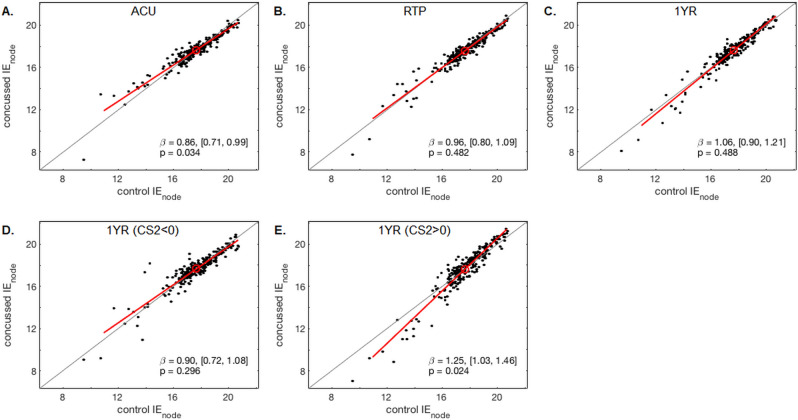
Effects of concussion on nodal efficiency distributions. Points in the scatterplots represent mean integrated nodal efficiency (IEnode) values of concussed athletes, for a given node, plotted against the corresponding mean of athletic controls. The scatterplots are shown for (A) acute injury, (B) return to play (RTP) and (C) 1 year post-RTP. Additional scatterplots show mean IEnode values of the concussed athletes at one year post-RTP, subgrouped on clinical score CS2 (days to RTP symptom severity), with (D) CS2 < 0 and (E) CS2 > 0. For all scatterplots, the line of best fit is given (red line) along with the nodal mean (red circle); the line of identity is also plotted (grey line). The slope coefficient β is also given, along with bootstrapped 95%CIs and empirical p-values.
Figure 4
Figure 4
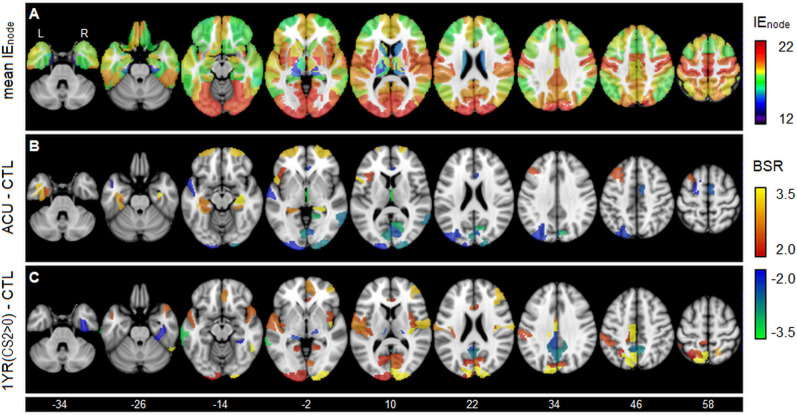
Localizing the effects of concussion on nodal efficiency. (A) The mean integrated nodal efficiency (IEnode) values, averaged over all controls. Standardized effects sizes, reported as bootstrap ratio (BSR) values, are shown for contrasts of (B) concussed athletes at acute injury (ACU) relative to controls (CTL), and for (C) concussed athletes with clinical score CS2 > 0 at one year post-RTP (1YR) relative to controls (CTL). Maps are thresholded at |BSR|> 2, equivalent to p < 0.05 uncorrected, and the z-axis coordinates of axial slices in MNI space are provided.
Figure 5
Figure 5
Relationship between network efficiency and other graph-theoretic measures. This includes Spearman correlations of healthy control values, for (A) integrated local efficiency (IEloc) and (B) integrated global efficiency (IEglob), with respect to integrated measures of mean betweenness centrality (ICBavg), mean eigenvector centrality (ICEavg), modularity (IMOD) and degree assortativity (IDAS). (C,D,E,F) depict ICBavg, ICEavg, IMOD and IDAS values for healthy controls (black) and for concussed athletes (red) at each imaging session. Horizontal bars represent sample means and shaded boxes denote the 95%CIs of the mean.

References

    1. Langer L, Levy C, Bayley M. Increasing incidence of concussion: true epidemic or better recognition? J. Head Trauma Rehabil. 2020;35:E60–E66. doi: 10.1097/HTR.0000000000000503. - DOI - PubMed
    1. CDC, C. f. D. C. a. P. (2010).
    1. Polinder S, et al. A multidimensional approach to post-concussion symptoms in mild traumatic brain injury. Front. Neurol. 2018;9:1113. doi: 10.3389/fneur.2018.01113. - DOI - PMC - PubMed
    1. McCrory P, et al. Consensus statement on concussion in sport—The 5th international conference on concussion in sport held in Berlin, October 2016. Br. J. Sports Med. 2017;51:838–847. - PubMed
    1. Guskiewicz KM, et al. Association between recurrent concussion and late-life cognitive impairment in retired professional football players. Neurosurgery. 2005;57:719–726. doi: 10.1227/01.NEU.0000175725.75780.DD. - DOI - PubMed

Publication types