. 2021 Mar 9:12:630292.
doi: 10.3389/fgene.2021.630292. eCollection 2021.

Genome-Wide Identification of NAC Transcription Factors and Their Functional Prediction of Abiotic Stress Response in Peanut

Affiliations

Genome-Wide Identification of NAC Transcription Factors and Their Functional Prediction of Abiotic Stress Response in Peanut

Pengxiang Li et al. Front Genet. .

Abstract

The NAC transcription factor (TF) is one of the most significant TFs in plants and is widely involved in plant growth, development, and responses to biotic and abiotic stresses. To date, there are no systematic studies on the NAC family in peanuts. Herein, 132 AhNACs were identified from the genome of cultivated peanut, and they were classified into eight subgroups (I-VIII) based on phylogenetic relationships with Arabidopsis NAC proteins and their conserved motifs. These genes were unevenly scattered on all 20 chromosomes, among which 116 pairs of fragment duplication events and 1 pair of tandem duplications existed. Transcriptome analysis showed that many AhNAC genes responded to drought and abscisic acid (ABA) stresses, especially most of the members in groups IV, VII, and VIII, which were expressed at larger differential levels under polyethylene glycol (PEG) and/or ABA treatment in roots or leaves. Furthermore, 20 of them selected in response to PEG and ABA treatment were evaluated by quantitative real-time polymerase chain reaction. The results showed that these genes significantly responded to drought and ABA in roots and/or leaves. This study was helpful for guiding the functional characterization and improvement of drought-resistant germplasms in peanuts.

Keywords: NAC transcription factor; abiotic stress; expression analysis; gene family; peanut.


Conflict of interest statement

The authors declare that the research was conducted in the absence of any commercial or financial relationships that could be construed as a potential conflict of interest.

Figures
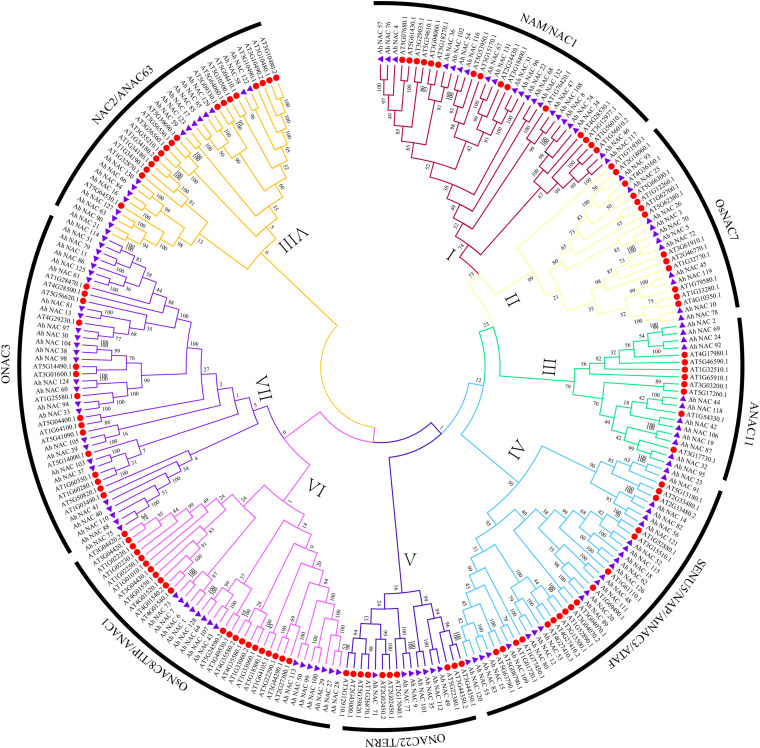
FIGURE 1
FIGURE 1
An unrooted phylogenetic tree representing the relationships among the NAC proteins of peanut and Arabidopsis. All full-length protein sequences were aligned by MUSCLE, and the tree was generated using the neighbor-joining (NJ) method in MEGA7 software. The I–VIII subgroups are represented by different colors, the purple triangles represent NAC proteins from peanut, and the red circles indicate the Arabidopsis protein.
FIGURE 2
FIGURE 2
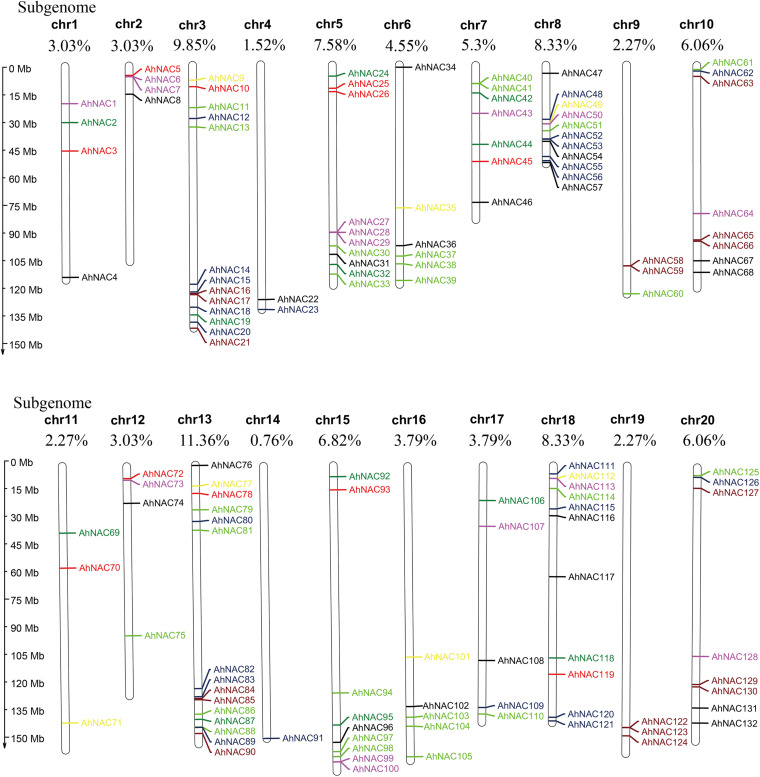
Chromosomal physical map showing the uneven distribution of AhNAC genes on each chromosome. Different colors indicate the different subgroups. The chromosome length is shown to the left of the map, and the serial numbers of chromosomes (chr1–chr20) and the distribution frequencies are shown on the top of each chromosome. Black represents group I, red represents group II, green represents group III, blue–black represents group IV, yellow represents group V, purple represents group VI, light green represents group VII, and brown represents group VIII.
FIGURE 3
FIGURE 3
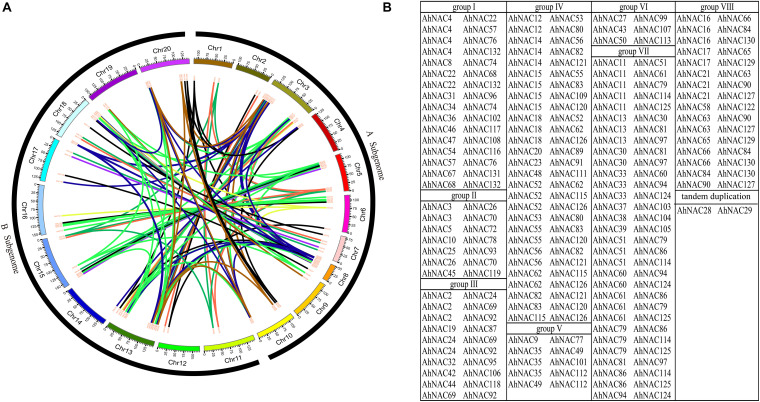
Collinearity analysis results indicating that a number of duplication events existed in AhNAC genes. (A) The colinear relationship among AhNAC genes is shown as a circle map. The red line indicates the duplication events between pairs, and the different-colored bars represent the different chromosomes. (B) The statistics of duplicated gene pairs according to their assigned groups. Black represents group I, red represents group II, green represents group III, blue–black represents group IV, yellow represents group V, purple represents group VI, light green represents group VII, and brown represents group VIII.
FIGURE 4
FIGURE 4
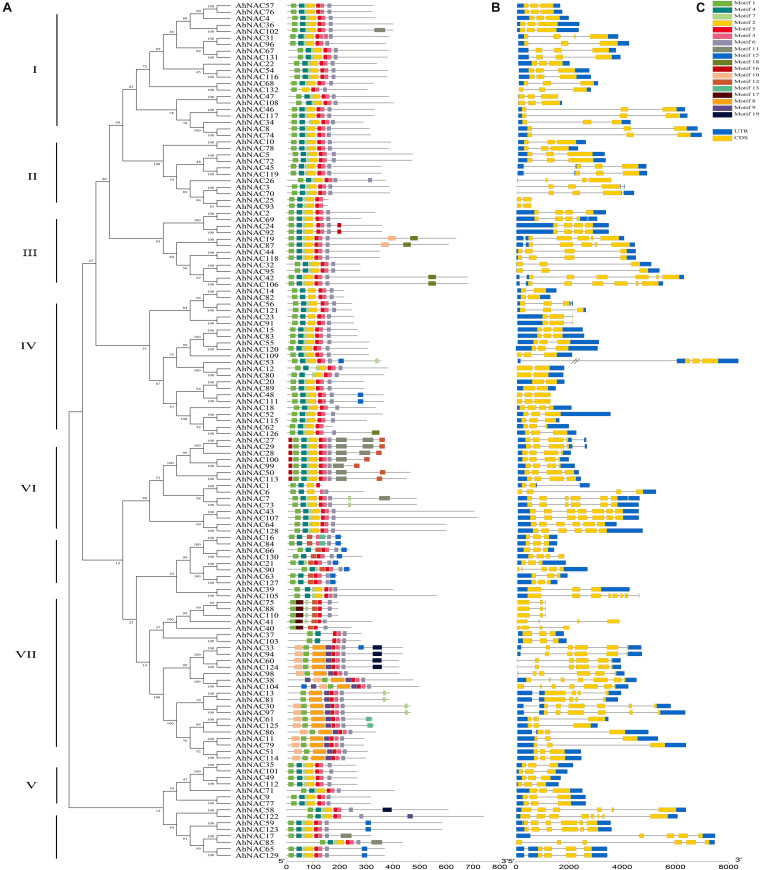
Analysis of the conserved motifs of AhNAC family members and their coding gene structures. (A) The phylogenetic tree of peanut AhNACs was constructed in MEGA7 using the NJ method. (B) Schematic diagrams of putative conserved motifs of 132 AhNAC proteins. The conserved motifs were found using the MEME tool and are shown by different colored boxes. (C) Sketch map of the exon–intron structures of 132 AhNAC genes. The blue and yellow boxes indicate the regions of the 5′- and 3′-UTRs and the exons, respectively, and the black lines indicate the introns in genes.
FIGURE 5
FIGURE 5
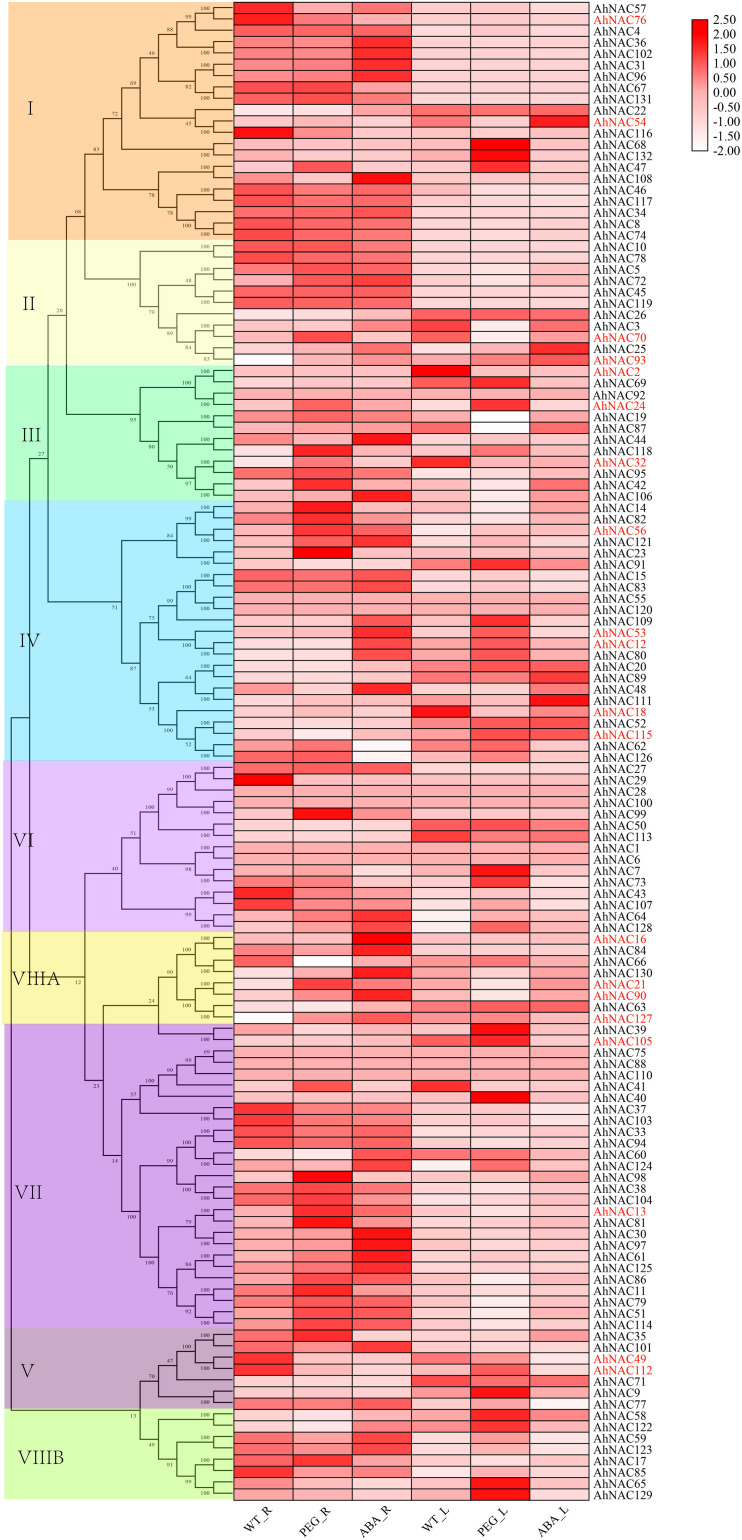
Heat map presenting the expression patterns of AhNAC genes in roots and leaves treated with PEG and ABA. The relative expression values were transformed by log2 of FPKM values and are displayed as colored boxes from light pink to red, and genes selected by qPCR are indicated in red font.
FIGURE 6
FIGURE 6
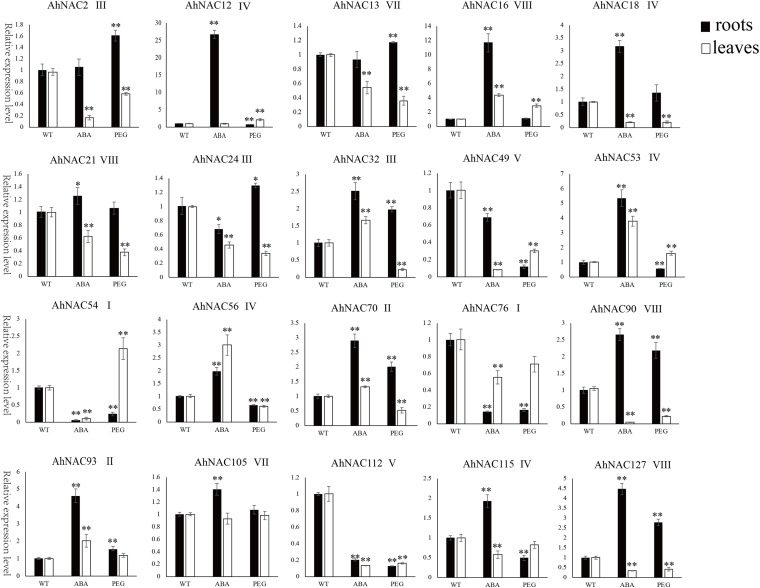
The expression patterns of 20 AhNAC genes in roots and leaves after PEG and ABA treatment were verified by qRT-PCR. The relative expression levels of AhNAC genes in untreated peanut (WT) and PEG and ABA treated for 24 h were compared. Data were calculated from three biological replicates, and the significance of variants between the control and treatment groups was analyzed by one-way ANOVA. Significant differences at the levels of p < 0.05 and ∗∗p < 0.01.

Similar articles

Cited by

References

    1. Ahmad M., Yan X., Li J., Yang Q., Jamil W., Teng Y., et al. (2018). Genome wide identification and predicted functional analyses of NAC transcription factors in Asian pears. BMC Plant Biol. 18:214. 10.1186/s12870-018-1427-x - DOI - PMC - PubMed
    1. Aida M., Ishida T., Fukaki H., Fujisawa H., Tasaka M. (1997). Genes involved in organ separation in Arabidopsis: an analysis of the cup-shaped cotyledon mutant. Plant Cell 9 841–857. 10.1105/tpc.9.6.841 - DOI - PMC - PubMed
    1. Bowers J. E., Chapman B. A., Rong J., Paterson A. H. (2003). Unravelling angiosperm genome evolution by phylogenetic analysis of chromosomal duplication events. Nature 422 433–438. 10.1038/nature01521 - DOI - PubMed
    1. Chen C. J., Chen H., Zhang Y., Thomas H. R., Frank M. H., He Y. H., et al. (2020). TBtools: an integrative toolkit developed for interactive analyses of big biological data. Mol. Plant 13 1194–1202. 10.1016/j.molp.2020.06.009 - DOI - PubMed
    1. Diao W. P., John S., Wang S. B., Liu J. B., Pan B. G., Guo G. J., et al. (2018). Genome-wide analyses of the NAC transcription factor gene family in pepper (Capsicum annuum L.): chromosome location, phylogeny, structure, expression patterns, Cis-elements in the promoter, and interaction network. Int. J. Mol. Sci. 19 1048–1061. 10.3390/ijms19041028 - DOI - PMC - PubMed

LinkOut - more resources