


Genetic mixing for population management: From genetic rescue to provenancing
- PMID: 33767740
- PMCID: PMC7980264
- DOI: 10.1111/eva.13154
Genetic mixing for population management: From genetic rescue to provenancing
Abstract
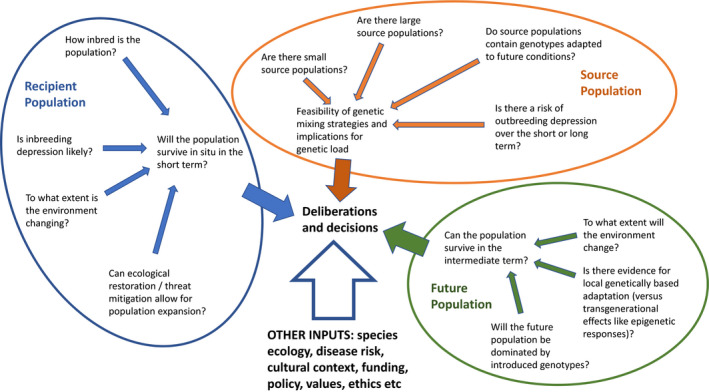
Animal and plant species around the world are being challenged by the deleterious effects of inbreeding, loss of genetic diversity, and maladaptation due to widespread habitat destruction and rapid climate change. In many cases, interventions will likely be needed to safeguard populations and species and to maintain functioning ecosystems. Strategies aimed at initiating, reinstating, or enhancing patterns of gene flow via the deliberate movement of genotypes around the environment are generating growing interest with broad applications in conservation and environmental management. These diverse strategies go by various names ranging from genetic or evolutionary rescue to provenancing and genetic resurrection. Our aim here is to provide some clarification around terminology and to how these strategies are connected and linked to underlying genetic processes. We draw on case studies from the literature and outline mechanisms that underlie how the various strategies aim to increase species fitness and impact the wider community. We argue that understanding mechanisms leading to species decline and community impact is a key to successful implementation of these strategies. We emphasize the need to consider the nature of source and recipient populations, as well as associated risks and trade-offs for the various strategies. This overview highlights where strategies are likely to have potential at population, species, and ecosystem scales, but also where they should probably not be attempted depending on the overall aims of the intervention. We advocate an approach where short- and long-term strategies are integrated into a decision framework that also considers nongenetic aspects of management.
Keywords: adaptation; conservation; genetic variation; population size; revegetation.
© 2020 The Authors. Evolutionary Applications published by John Wiley & Sons Ltd.
Conflict of interest statement
None declared.
Figures
References
-
- Ahrens, C. W. , James, E. A. , Miller, A. D. , Ferguson, S. , Aitken, N. C. , Jones, A. W. , & Rymer, P. D. (2020). Spatial, climate, and ploidy factors drive genomic diversity and resilience in the widespread grass Themeda triandra . Molecular Ecology, 29, 3872–3888. 10.1111/mec.15614 - DOI - PubMed
-
- Aitken, S. N. , & Whitlock, M. C. (2013). Assisted gene flow to facilitate local adaptation to climate change. Annual Review of Ecology, Evolution, and Systematics, 44, 367–388. 10.1146/annurev-ecolsys-110512-135747 - DOI
-
- Allendorf, F. W. , Leary, R. F. , Spruell, P. , & Wenburg, J. K. (2001). The problems with hybrids: Setting conservation guidelines. Trends in Ecology & Evolution, 16(11), 613–622. 10.1016/s0169-5347(01)02290-x - DOI
LinkOut - more resources
Full Text Sources
