


Breakthrough invasive fungal infection after liver transplantation in patients on targeted antifungal prophylaxis: A prospective multicentre study
- PMID: 33768656
- PMCID: PMC8519035
- DOI: 10.1111/tid.13608
Breakthrough invasive fungal infection after liver transplantation in patients on targeted antifungal prophylaxis: A prospective multicentre study
Abstract
Objective: To investigate the rate of and the risk factors for breakthrough-IFI (b-IFI) after orthotopic liver transplantation (OLT) according to the new definition proposed by Mycoses-Study-Group-Education-and-Research-Consortium (MSG-ERC) and the European-Confederation-of-Medical-Mycology (ECMM).
Methods: Multicenter prospective study of adult patients who underwent OLT at three Italian hospitals, from January 2015 to December 2018. Targeted antifungal prophylaxis (TAP) protocol was developed and shared among participating centers. Follow-up was 1-year after OLT. B-IFI was defined as infection occurring during exposure to antifungal prophylaxis. Risk factors for b-IFI were analyzed among patients exposed to prophylaxis by univariable analysis.
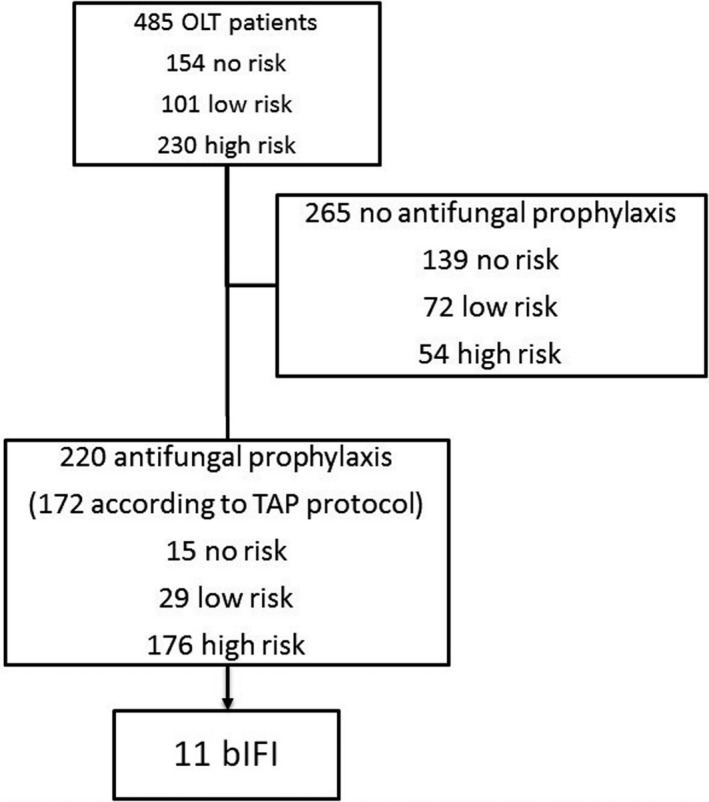
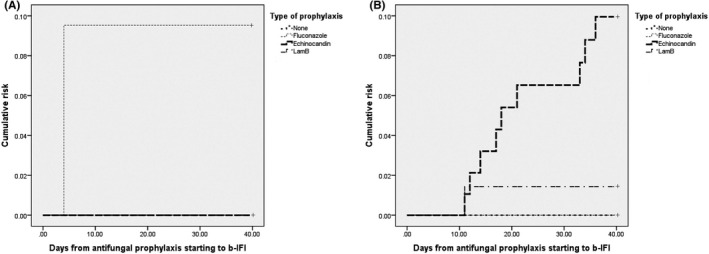
Results: We enrolled 485 OLT patients. Overall compliance to TAP protocol was 64.3%, 220 patients received antifungal prophylaxis, 172 according to TAP protocol. Twenty-nine patients were diagnosed of IFI within 1 year after OLT. Of them, 11 presented with b-IFI within 17 (IQR 11-33) and 16 (IQR 4-30) days from OLT and from antifungal onset, respectively. Then out of 11 patients with b-IFI were classified as having high risk of IFI and were receiving anti-mould prophylaxis, nine with echinocandins and one with polyenes. Comparison of patients with and without b-IFI showed significant differences for prior Candida colonization, need of renal replacement therapy after OLT, re-operation, and CMV infection (whole blood CMV-DNA >100 000 copies/mL). Although non-significant, a higher rate of b-IFI in patients on echinocandins was observed (8.2% vs 1.8%, P = .06).
Conclusions: We observed 5% of b-IFI among OLT patients exposed to antifungal prophylaxis. The impact of echinocandins on b-IFI risk in this setting should be further explored.
Keywords: antifungal prophylaxis; breakthrough IFI; infection risk; invasive fungal infection; liver transplantation.
© 2021 The Authors. Transplant Infectious Disease published by Wiley Periodicals LLC.
Conflict of interest statement
Authors have no conflict of interest related to the present study.
Figures
References
-
- Pappas P, Alexander B, Andes D, et al. Invasive fungal infections among organ transplant recipients: results of the Transplant‐Associated Infection Surveillance Network (TRANSNET). Clin Infect Dis. 2010;50(8):1101‐1111. - PubMed
-
- Neofytos D, Fishman JA, Horn D, et al. Epidemiology and outcome of invasive fungal infections in solid organ transplant recipients. Transpl Infect Dis. 2010;12(3):220‐229. - PubMed
-
- Hosseini‐Moghaddam SM, Ouédraogo A, Naylor KL, et al. Incidence and outcomes of invasive fungal infection among solid organ transplant recipients: a population‐based cohort study. Transpl Infect Dis. 2020;22(2):e13250. - PubMed
-
- Husain S, Camargo JF. Invasive Aspergillosis in solid‐organ transplant recipients: Guidelines from the American Society of Transplantation Infectious Diseases Community of Practice. Clin Transplant. 2019;33(9):e13544. - PubMed
Publication types
MeSH terms
Substances
LinkOut - more resources
Full Text Sources
Other Literature Sources
Medical
Miscellaneous
