. 2021 Oct;268(10):3766-3776.
doi: 10.1007/s00415-021-10521-w. Epub 2021 Mar 26.

Targeted sequencing panels in Italian ALS patients support different etiologies in the ALS/FTD continuum

Affiliations

Targeted sequencing panels in Italian ALS patients support different etiologies in the ALS/FTD continuum

Anna Bartoletti-Stella et al. J Neurol. 2021 Oct.

Abstract

Background: 5-10% of amyotrophic lateral sclerosis (ALS) patients presented a positive family history (fALS). More than 30 genes have been identified in association with ALS/frontotemporal dementia (FTD) spectrum, with four major genes accounting for 60-70% of fALS. In this paper, we aimed to assess the contribution to the pathogenesis of major and rare ALS/FTD genes in ALS patients.

Methods: We analyzed ALS and ALS/FTD associated genes by direct sequencing or next-generation sequencing multigene panels in ALS patients.

Results: Genetic abnormalities in ALS major genes included repeated expansions of hexanucleotide in C9orf72 gene (7.3%), mutations in SOD1 (4.9%), FUS (2.1%), and TARDBP (2.4%), whereas variants in rare ALS/FTD genes affected 15.5% of subjects overall, most frequently involving SQSTM1 (3.4%), and CHMP2B (1.9%). We found clustering of variants in ALS major genes in patients with a family history for "pure" ALS, while ALS/FTD related genes mainly occurred in patients with a family history for other neurodegenerative diseases (dementia and/or parkinsonism).

Conclusions: Our data support the presence of two different genetic components underlying ALS pathogenesis, related to the presence of a family history for ALS or other neurodegenerative diseases. Thus, family history may help in optimizing the genetic screening protocol to be applied.

Keywords: Amyotrophic lateral sclerosis; Frontotemporal degeneration; Genetic heterogeneity; Mutation screening; Next generation sequencing.


Conflict of interest statement

The authors declare no conflict of interest.

Figures
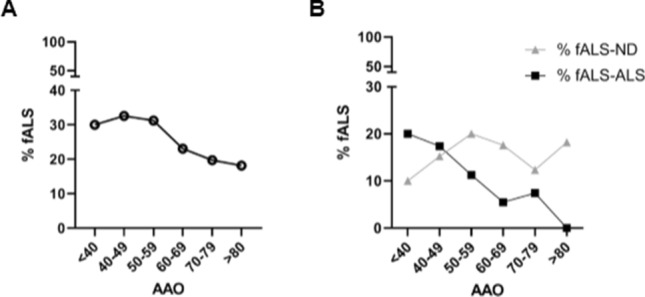
Fig. 1
Fig. 1
Inheritance features of the study population. A, b The graph shows the percentage of ALS patients with positive family history (a, fALS); for ALS (b, fALS-ALS) and for other neurodegenerative diseases (b, fALS-ND) stratified for age at onset (AAO)
Fig. 2
Fig. 2
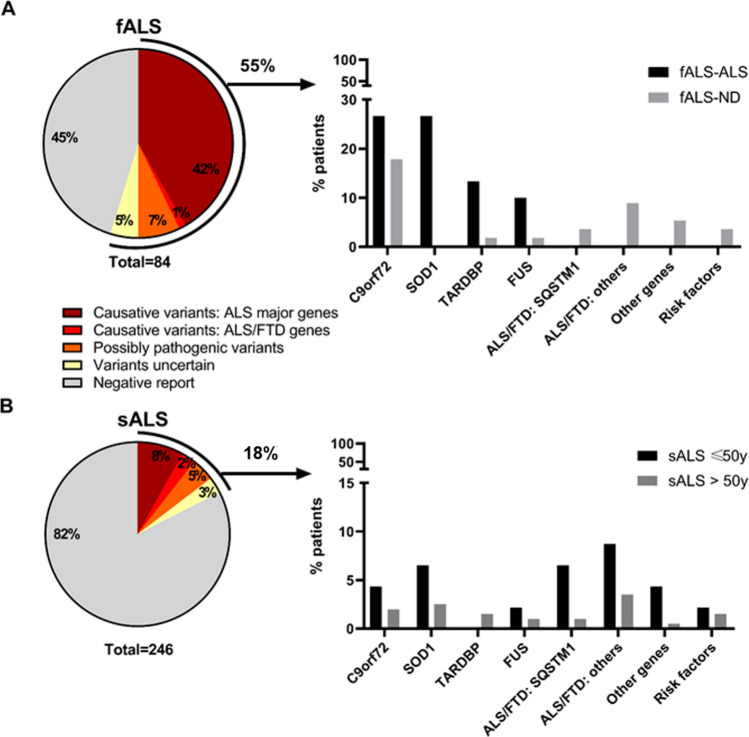
Genetic variants distribution in our ALS population. Variants are classified as causative (ALS major genes and ALS/FTD genes), possibly pathogenic variants and variant of uncertain significant (VUS). The distribution of genetic variants is different between sALS and fALS patients, accounting for 17% of sALS and 55% of fALS patients. Genetic contribution was also different between fALS-ALS and fALS-ND, and between sALS, considering AAO. AAO age at onset; ALS amyotrophic lateral sclerosis; fALS familial ALS; fALS-ALS familial ALS with positive family history for ALS; fALS-ND familial ALS with positive family history for other neurodegenerative diseases; sALS sporadic

References

    1. Chiò A, Logroscino G, Traynor BJ, et al. Global epidemiology of amyotrophic lateral sclerosis: a systematic review of the published literature. Neuroepidemiology. 2013;41(2):118–130. doi: 10.1159/000351153. - DOI - PMC - PubMed
    1. Strong MJ, Abrahams S, Goldstein LH, et al. Amyotrophic lateral sclerosis-frontotemporal spectrum disorder (ALS-FTSD): revised diagnostic criteria. Amyotroph Lateral Scler Frontotemporal Degener. 2017;18(3–4):153–174. doi: 10.1080/21678421.2016.1267768. - DOI - PMC - PubMed
    1. Lattante S, Ciura S, Rouleau GA, Kabashi E. Defining the genetic connection linking amyotrophic lateral sclerosis (ALS) with frontotemporal dementia (FTD) Trends Genet. 2015;31:263–273. doi: 10.1016/j.tig.2015.03.005. - DOI - PubMed
    1. Taylor JP, Brown RH, Jr, Cleveland DW. Decoding ALS: from genes to mechanism. Nature. 2016;539(7628):197–206. doi: 10.1038/nature20413. - DOI - PMC - PubMed
    1. Shahheydari H, Ragagnin A, Walker AK, et al. Protein quality control and the amyotrophic lateral sclerosis/frontotemporal dementia continuum. Front Mol Neurosci. 2017;10:119. doi: 10.3389/fnmol.2017.00119. - DOI - PMC - PubMed

Substances