Incidence and pathophysiology of diabetes in South Asian adults living in India and Pakistan compared with US blacks and whites
- PMID: 33771764
- PMCID: PMC8006839
- DOI: 10.1136/bmjdrc-2020-001927
Incidence and pathophysiology of diabetes in South Asian adults living in India and Pakistan compared with US blacks and whites
Abstract
Introduction: We compared diabetes incidence in South Asians aged ≥45 years in urban India (Chennai and Delhi) and Pakistan (Karachi), two low-income and middle-income countries undergoing rapid transition, with blacks and whites in the US, a high-income country.
Research design and methods: We computed age-specific, sex-specific and body mass index (BMI)-specific diabetes incidence from the prospective Center for Cardiometabolic Risk Reduction in South Asia Study (n=3136) and the Atherosclerosis Risk in Communities Study (blacks, n=3059; whites, n=9924). We assessed factors associated with incident diabetes using Cox proportional hazards regression.
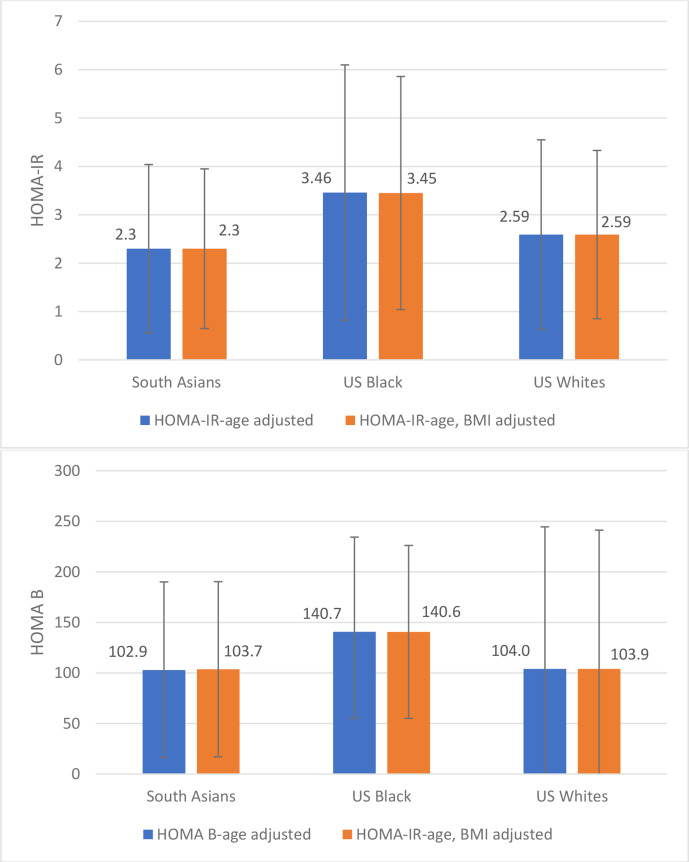
Results: South Asians have lower BMI and waist circumference than blacks and whites (median BMI, kg/m2: 24.9 vs 28.2 vs 26.0; median waist circumference, cm 87.5 vs 96.0 vs 95.0). South Asians were less insulin resistant than blacks and whites (age-BMI-adjusted homeostatic model assessment of insulin resistance, µIU/mL/mmol/L: 2.30 vs 3.45 vs 2.59), and more insulin deficient than blacks but not whites (age-BMI-adjusted homeostasis model assessment of β-cell dysfunction, µIU/mL/mmol/L: 103.7 vs 140.6 vs 103.9). Age-standardized diabetes incidence (cases/1000 person-years (95% CI)) in South Asian men was similar to black men and 1.6 times higher (1.37 to 1.92) than white men (26.0 (22.2 to 29.8) vs 26.2 (22.7 to 29.7) vs 16.1 (14.8 to 17.4)). In South Asian women, incidence was slightly higher than black women and 3 times (2.61 to 3.66) the rate in white women (31.9 (27.5 to 36.2) vs 28.6 (25.7 to 31.6) vs 11.3 (10.2 to 12.3)). In normal weight (BMI <25 kg/m2), diabetes incidence adjusted for age was 2.9 times higher (2.09 to 4.28) in South Asian men, and 5.3 times (3.64 to 7.54) in South Asian women than in white women.
Conclusions: South Asian adults have lower BMI and are less insulin resistant than US blacks and whites, but have higher diabetes incidence than US whites, especially in subgroups without obesity. Factors other than insulin resistance (ie, insulin secretion) may play an important role in the natural history of diabetes in South Asians.
Keywords: India; diabetes mellitus; epidemiology; ethnic groups; type 2.
© Author(s) (or their employer(s)) 2021. Re-use permitted under CC BY-NC. No commercial re-use. See rights and permissions. Published by BMJ.
Conflict of interest statement
Competing interests: None declared.
Figures
Comment in
-
Insulin resistance versus insulin deficiency: evidence of racial differences in the pathogenesis of type 2 diabetes.BMJ Open Diabetes Res Care. 2021 Mar;9(1):e002261. doi: 10.1136/bmjdrc-2021-002261. BMJ Open Diabetes Res Care. 2021. PMID: 33771767 Free PMC article. No abstract available.
References
Publication types
MeSH terms
Grants and funding
- P30 DK111024/DK/NIDDK NIH HHS/United States
- U54 AG062334/AG/NIA NIH HHS/United States
- KL2 TR002381/TR/NCATS NIH HHS/United States
- HHSN268201700004I/HL/NHLBI NIH HHS/United States
- HHSN268201700002I/HL/NHLBI NIH HHS/United States
- R01 HL125442/HL/NHLBI NIH HHS/United States
- HHSN268201700005I/HL/NHLBI NIH HHS/United States
- HHSN268200900026C/HL/NHLBI NIH HHS/United States
- HHSN268201700003I/HL/NHLBI NIH HHS/United States
- UL1 TR002378/TR/NCATS NIH HHS/United States
- D43 TW009135/TW/FIC NIH HHS/United States
- K24 HL152440/HL/NHLBI NIH HHS/United States
- WT084754/Z/08/A/WT_/Wellcome Trust/United Kingdom
- HHSN268201700001I/HL/NHLBI NIH HHS/United States
LinkOut - more resources
Full Text Sources
Other Literature Sources
Medical