. 2021 Mar 26;12(1):1898.
doi: 10.1038/s41467-021-22282-1.

Enzymatic enhancing of triplet-triplet annihilation upconversion by breaking oxygen quenching for background-free biological sensing

Affiliations

Enzymatic enhancing of triplet-triplet annihilation upconversion by breaking oxygen quenching for background-free biological sensing

Ling Huang et al. Nat Commun. .

Abstract

Triplet-triplet annihilation upconversion nanoparticles have attracted considerable interest due to their promises in organic chemistry, solar energy harvesting and several biological applications. However, triplet-triplet annihilation upconversion in aqueous solutions is challenging due to sensitivity to oxygen, hindering its biological applications under ambient atmosphere. Herein, we report a simple enzymatic strategy to overcome oxygen-induced triplet-triplet annihilation upconversion quenching. This strategy stems from a glucose oxidase catalyzed glucose oxidation reaction, which enables rapid oxygen depletion to turn on upconversion in the aqueous solution. Furthermore, self-standing upconversion biological sensors of such nanoparticles are developed to detect glucose and measure the activity of enzymes related to glucose metabolism in a highly specific, sensitive and background-free manner. This study not only overcomes the key roadblock for applications of triplet-triplet annihilation upconversion nanoparticles in aqueous solutions, it also establishes the proof-of-concept to develop triplet-triplet annihilation upconversion nanoparticles as background free self-standing biological sensors.


Conflict of interest statement

Authors declare the following competing interests: L.H. and G.H. have a pending patent application are related to this study. T.L. and K.H. declare no competing interests.

Figures
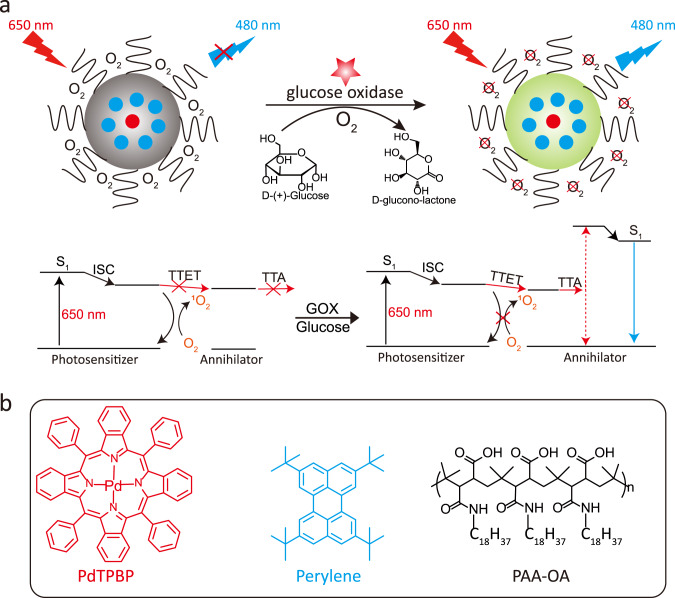
Fig. 1
Fig. 1. Solving the oxygen-quenching issue of TTA-UCNP with glucose oxidase.
a Schematic illustration and the mechanism of lighting up TTA-UCNP in the presence of glucose and glucose oxidase (GOX). The blue dot represents the annihilator of perylene, the red dot represents the photosensitizer of PdTPBP, the left gray nanoparticles stand for origin TTA-UCNP and the right green nanoparticles stand for TTA-UCNP in the presence of GOX and glucose. b Molecular structures of the photosensitizer PdTPBP, the annihilator perylene, and the amphiphilic polymer PAA-OA.
Fig. 2
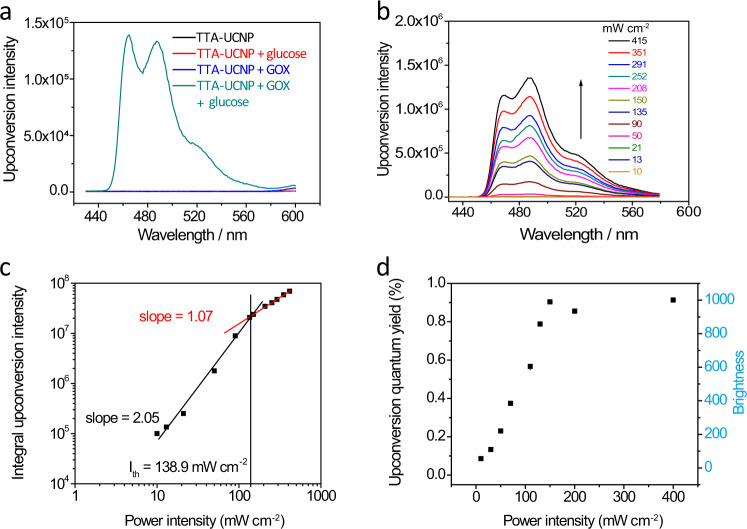
Fig. 2. Upconversion performance of TTA-UCNP in different circumstances.
a TTA-upconversion spectra of TTA-UCNP at different conditions (TTA-UCNP only, TTA-UCNP with glucose, or with GOX, or with both glucose and GOX) in PBS buffer, λex = 650 nm. b Incident light power dependence study of TTA-upconversion emission intensity for TTA-UCNP in PBS buffer. c Double-logarithmic plot of perylene integrated emission intensity as a function of 650 nm excitation power density. Solid lines illustrate a slope of 2.05 (black, quadratic) and a slope of 1.07 (red, linear), Ith is 138.9 mW cm−2. d The upconversion quantum yield and upconversion brightness of TTA-UCNP with different 650 nm incident power densities. c(glucose) = 5 mg mL−1, c(GOX) = 32.5 µg mL−1.
Fig. 3
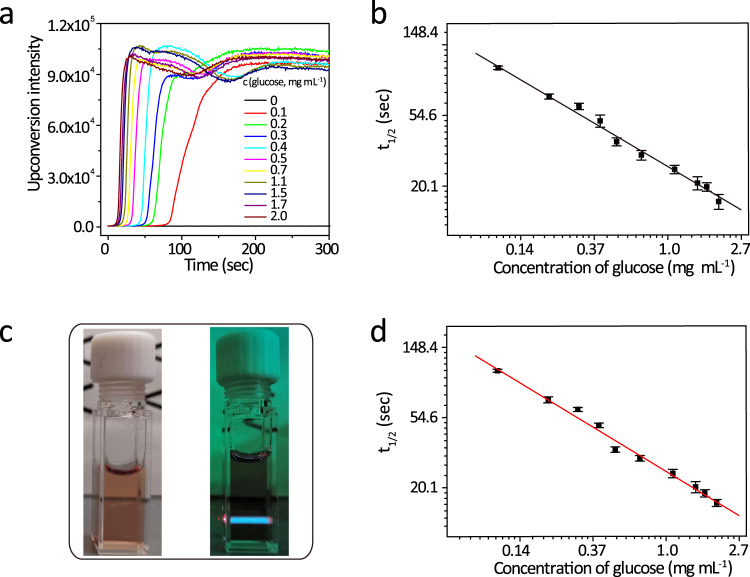
Fig. 3. TTA-UNCP for efficient sensing of glucose.
a The response times of the mixture of TTA-UCNP (1 mg mL−1) and GOX (10 µg mL−1) with different concentrations of glucose, λex = 650 nm, 100 mW cm−2. b In–In coordination fitting of glucose concentration and half response times in deionized water, slope = −0.62783, R = 0.9995, n = 3 means that each experiment is repeated three times independently, the error bar represents the mean of the three times ± standard deviation (SD). c The TTA-UCNP in the cell medium of 20% FBS, phenol red, and GOX (10 µg mL−1) in the absence (left) and in the presence (right) of light, λex = 650 nm. d In–In coordination fitting of glucose concentration and half response times of TTA-upconversion in TTA-UCNP in cell culture medium including 20% FBS, phenol red and GOX (10 µg mL−1), slope = −0.6333, R = 0.994, n = 3 means that each experiment is repeated three times independently, the error bar represents the mean of the three times ± standard deviation (SD).
Fig. 4
Fig. 4. TTA-UCNP measures the activity of invertase.
a Schematic illustration of the mechanism of TTA-UCNP as a biosensor for invertase enzymatic reactions. b The invertase concentration-dependent TTA-upconversion turn-on response. λex = 650 nm, 100 mW cm−2. c In–In coordination fitted linear relationship between the concentration of invertase and TTA-upconversion half response time (slope = −0.625, R = 0.999), n = 3 means that each experiment is repeated three times independently, the error bar represents the mean of the three times ± standard deviation (SD).

References

    1. Singh-Rachford TN, Castellano FN. Photon upconversion based on sensitized triplet–triplet annihilation. Coord. Chem. Rev. 2010;254:2560–2573. doi: 10.1016/j.ccr.2010.01.003. - DOI
    1. Zhou J, Liu Q, Feng W, Sun Y, Li F. Upconversion luminescent materials: advances and applications. Chem. Rev. 2015;115:395–465. doi: 10.1021/cr400478f. - DOI - PubMed
    1. Zhao J, Ji S, Guo H. Triplet–triplet annihilation based upconversion: from triplet sensitizers and triplet acceptors to upconversion quantum yields. RSC Adv. 2011;1:937–950. doi: 10.1039/c1ra00469g. - DOI
    1. Filatov MA, Baluschev S, Landfester K. Protection of densely populated excited triplet state ensembles against deactivation by molecular oxygen. Chem. Soc. Rev. 2016;45:4668–4689. doi: 10.1039/C6CS00092D. - DOI - PubMed
    1. Zhao J, Xu K, Yang W, Wang Z, Zhong F. The triplet excited state of Bodipy: formation, modulation and application. Chem. Soc. Rev. 2015;44:8904–8939. doi: 10.1039/C5CS00364D. - DOI - PubMed

Publication types