. 2021 Dec 16;73(12):2318-2321.
doi: 10.1093/cid/ciab264.

Associations Between Measures of Social Distancing and Severe Acute Respiratory Syndrome Coronavirus 2 Seropositivity: A Nationwide Population-based Study in the Netherlands

Affiliations

Associations Between Measures of Social Distancing and Severe Acute Respiratory Syndrome Coronavirus 2 Seropositivity: A Nationwide Population-based Study in the Netherlands

Eric R A Vos et al. Clin Infect Dis. .

Abstract

This large, nationwide, population-based, seroepidemiological study provides evidence of the effectiveness of physical distancing (>1.5 m) and indoor group size reductions in reducing severe acute respiratory syndrome coronavirus 2 infection. Additionally, young adults may play an important role in viral spread, contrary to children up until age 12 years with whom close contact is permitted.

Clinical trials registration: NTR8473.

Keywords: COVID-19 pandemic; SARS-CoV-2 seroprevalence; social distancing; the Netherlands; transmission.


Figures

Figure 1.
Figure 1.
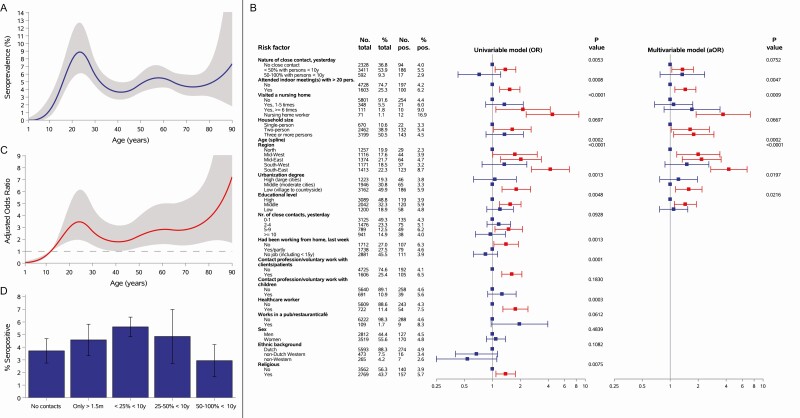
A, The weighted smooth age-specific severe acute respiratory syndrome coronavirus 2 (SARS-CoV-2) seroprevalence with 95% confidence envelope in the general population of the Netherlands after the first epidemic wave. B, The risk factor analyses for SARS-CoV-2 seropositivity. Number and percent of total participants per potential risk factor category are provided as well as the number and percent of seropositive participants and P values. Forest plots are shown of crude odds ratios (ORs) for univariable analyses and aORs for the multivariable analysis and depicted by squares and 95% confidence intervals (95% CIs) with lines. Those in red are significantly associated with seropositivity, and those in blue are nonsignificant. Time window of attending indoor meetings with >20 persons and visiting a nursing home was from the beginning of the epidemic in the Netherlands (27 February 2020) until the day of completing a questionnaire or until closure (for visitors) of nursing homes (20 March 2020), respectively. Nature and number of nonhousehold close contacts yesterday and working from home last week were related to the day or week, respectively, before the questionnaire was completed. Receiver operating characteristic curve analysis of the multivariable model yielded an area under the curve (as a measure of goodness of fit) of 0.72. C, The aOR with 95% confidence envelope for age (which was included with a flexible [spline] function) derived from the multivariable model, with 12 years as reference category. D, The percentage of SARS-CoV-2 seropositive participants (and 95% CIs) by number and nature of nonhousehold close contact the day before the questionnaire was completed. Nature of nonhousehold close contact was defined as the proportion of nonhousehold close contacts with children aged <10 years of the total number of nonhousehold close contacts. Abbreviation: aOR, adjusted odds ratio.

References

    1. Rostami A, Sepidarkish M, Leeflang M, et al. SARS-CoV-2 seroprevalence worldwide: a systematic review and meta-analysis. Clin Microbiol Infect 2021; 19:331–40. - PMC - PubMed
    1. Koopmans M, Haagmans B. Assessing the extent of SARS-CoV-2 circulation through serological studies. Nat Med 2020; 26:1171–2. - PubMed
    1. Vos ERA, den Hartog G, Schepp RM, et al. Nationwide seroprevalence of SARS-CoV-2 and identification of risk factors in the general population of the Netherlands during the first epidemic wave. J Epidemiol Community Health 2020; 75:489–95. - PMC - PubMed
    1. Verberk JDM, Vos RA, Mollema L, et al. Third national biobank for population-based seroprevalence studies in the Netherlands, including the Caribbean Netherlands. BMC Infect Dis 2019; 19:470. - PMC - PubMed
    1. den Hartog G, Schepp RM, Kuijer M, et al. SARS-CoV-2–specific antibody detection for seroepidemiology: a multiplex analysis approach accounting for accurate seroprevalence. J Infect Dis 2020; 222:1452–61. - PMC - PubMed

Publication types

Grants and funding