


Willingness to Vaccinate Against COVID-19 in the U.S.: Representative Longitudinal Evidence From April to October 2020
- PMID: 33773862
- PMCID: PMC7883746
- DOI: 10.1016/j.amepre.2021.01.008
Willingness to Vaccinate Against COVID-19 in the U.S.: Representative Longitudinal Evidence From April to October 2020
Abstract
Introduction: Vaccines against COVID-19 have been developed in unprecedented time. However, the effectiveness of any vaccine is dictated by the proportion of the population willing to be vaccinated. This observational population-based study examines intentions to be vaccinated against COVID-19 throughout the pandemic.
Methods: In November 2020, longitudinal data from a nationally representative sample of 7,547 U.S. adults enrolled in the Understanding America Study were analyzed using multinomial logistic regression. Participants reported being willing, undecided, and unwilling to get vaccinated against COVID-19 across 13 assessments conducted from April to October 2020. Public attitudes to vaccination against COVID-19 were also assessed on a 4-point Likert-type scale.
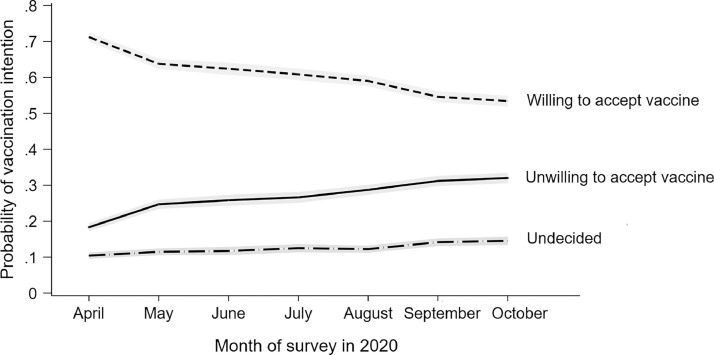
Results: Willingness to vaccinate declined from 71% in April to 53.6% in October. This was explained by an increase in the percentage of participants undecided about vaccinating (from 10.5% to 14.4%) and the proportion of the sample unwilling to vaccinate (from 18.5% to 32%). The population subgroups most likely to be undecided/unwilling to vaccinate were those without a degree (undecided: RR=2.47, 95% CI=2.04, 3.00; unwilling: RR=1.92, 95% CI=1.67, 2.20), Black participants (undecided: RR=2.18, 95% CI=1.73, 2.74; unwilling: RR=1.98, 95% CI=1.63, 2.42), and female participants (undecided: RR=1.41, 95% CI=1.20, 1.65; unwilling: RR=1.29, 95% CI=1.14, 1.46). Participants who were older or were on higher incomes were least likely to be undecided or unwilling to vaccinate. Concerns about potential side effects of a vaccine were common.
Conclusions: Intentions to be vaccinated against COVID-19 have declined rapidly during the pandemic, and close to half of Americans are undecided or unwilling to be vaccinated.
Copyright © 2021 American Journal of Preventive Medicine. Published by Elsevier Inc. All rights reserved.
Figures
Update of
-
Willingness to vaccinate against COVID-19 in the US: Longitudinal evidence from a nationally representative sample of adults from April-October 2020.medRxiv [Preprint]. 2020 Nov 30:2020.11.27.20239970. doi: 10.1101/2020.11.27.20239970. medRxiv. 2020. Update in: Am J Prev Med. 2021 Jun;60(6):766-773. doi: 10.1016/j.amepre.2021.01.008. PMID: 33269354 Free PMC article. Updated. Preprint.
References
-
- WHO; 2021. Weekly epidemiological update - 9 February 2021.https://www.who.int/publications/m/item/weekly-epidemiological-update—9-... Updated February 9.
-
- U.S. Food and Drug Administration. FDA takes additional action in fight against COVID-19 by issuing Emergency Use Authorization for second COVID-19 vaccine. U.S. Food and Drug Administration. December 18, 2020.https://www.fda.gov/news-events/press-announcements/fda-takes-additional.... Accessed December 22, 2020.
Publication types
MeSH terms
Substances
Grants and funding
LinkOut - more resources
Full Text Sources
Other Literature Sources
Medical
Miscellaneous
