


Targeted Next-Generation Sequencing Identifies Pathogenic Variants in Diabetic Kidney Disease
- PMID: 33774617
- PMCID: PMC8653779
- DOI: 10.1159/000514578
Targeted Next-Generation Sequencing Identifies Pathogenic Variants in Diabetic Kidney Disease
Abstract
Introduction: Diabetes is the most common cause of chronic kidney disease (CKD). For patients with diabetes and CKD, the underlying cause of their kidney disease is often assumed to be a consequence of their diabetes. Without histopathological confirmation, however, the underlying cause of their disease is unclear. Recent studies have shown that next-generation sequencing (NGS) provides a promising avenue toward uncovering and establishing precise genetic diagnoses in various forms of kidney disease.
Methods: Here, we set out to investigate the genetic basis of disease in nondiabetic kidney disease (NDKD) and diabetic kidney disease (DKD) patients by performing targeted NGS using a custom panel comprising 345 kidney disease-related genes.
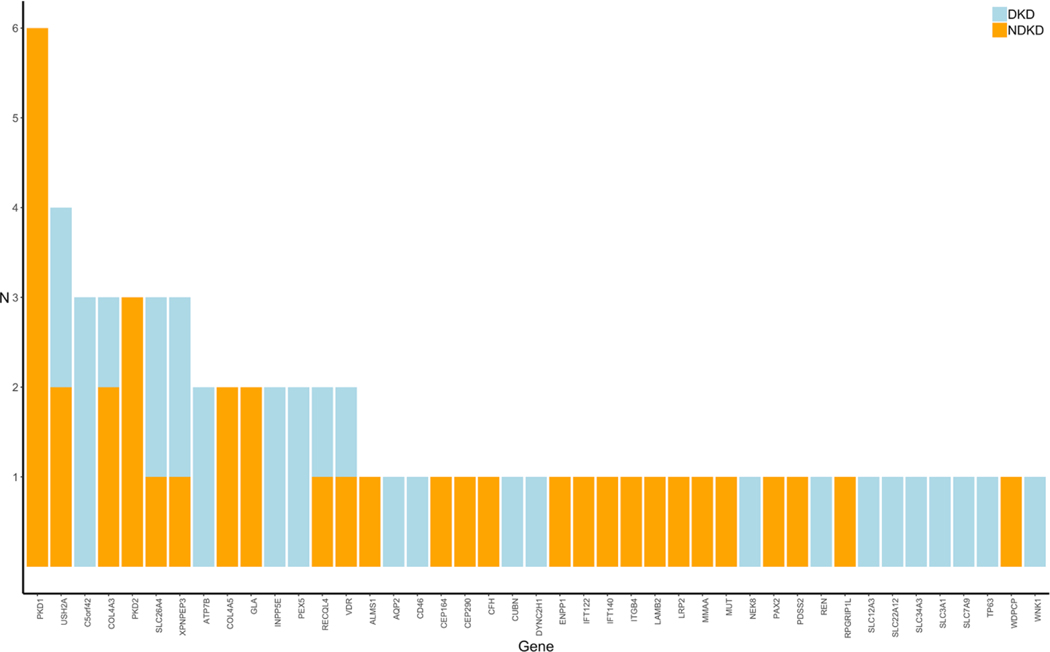
Results: Our analysis identified rare diagnostic variants based on ACMG-AMP guidelines that were consistent with the clinical diagnosis of 19% of the NDKD patients included in this study. Similarly, 22% of DKD patients were found to carry rare pathogenic/likely pathogenic variants in kidney disease-related genes included on our panel. Genetic variants suggestive of NDKD were detected in 3% of the diabetic patients included in this study.
Discussion/conclusion: Our findings suggest that rare variants in kidney disease-related genes in a diabetic background may play a role in the pathogenesis of DKD and NDKD in patients with diabetes.
Keywords: Diabetic kidney disease; Genetics; Targeted sequencing.
© 2021 S. Karger AG, Basel.
Conflict of interest statement
Conflict of Interest Statement
The authors have no conflicts of interest to declare.
Figures
References
-
- U.S. Renal Data System. USRDS 2018 Annual Data Report: Atlas of End-Stage Renal Disease in the United States. In: NIH, editor. Bethesda: 2018.
-
- Anders HJ, Huber TB, Isermann B, Schiffer M. CKD in diabetes: diabetic kidney disease versus nondiabetic kidney disease. Nat Rev Nephrol. 2018;14(6):361–77. - PubMed
-
- Haider DG, Peric S, Friedl A, Fuhrmann V, Wolzt M, Horl WH, et al. Kidney biopsy in patients with diabetes mellitus. Clin Nephrol. 2011;76(3):180–5. - PubMed
-
- Zhuo L, Ren W, Li W, Zou G, Lu J. Evaluation of renal biopsies in type 2 diabetic patients with kidney disease: a clinicopathological study of 216 cases. Int Urol Nephrol. 2013;45(1):173–9. - PubMed
Publication types
MeSH terms
Grants and funding
LinkOut - more resources
Full Text Sources
Other Literature Sources
Medical
