


Targeting von Willebrand factor in liver diseases: A novel therapeutic strategy?
- PMID: 33774926
- PMCID: PMC8582603
- DOI: 10.1111/jth.15312
Targeting von Willebrand factor in liver diseases: A novel therapeutic strategy?
Abstract
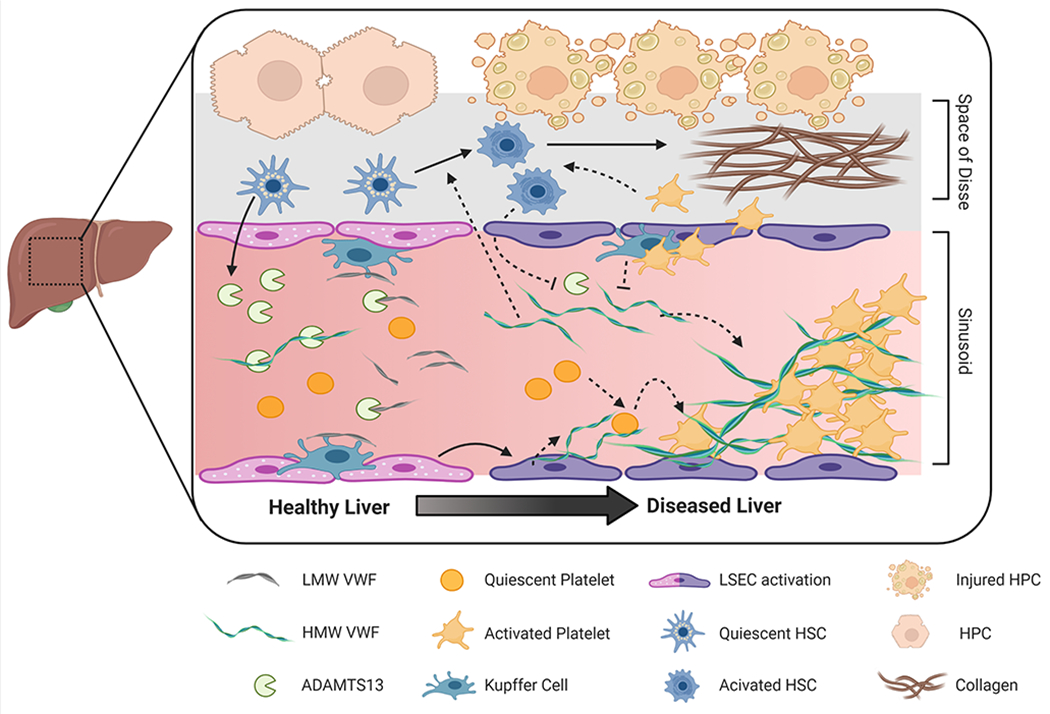
Acute and chronic liver disease are associated with substantial alterations in the hemostatic system. Evidence from both experimental and clinical studies suggests that anticoagulants slow the progression of liver disease. Efficacy of those anticoagulant drugs is, in part, attributed to a reduction of microthrombi formation within the liver. Although anticoagulant drugs show promising results, bleeding risk associated with these drugs is an obvious drawback, particularly in patients with a complex coagulopathy driven by decreased liver function. Identifying therapies that reduce intrahepatic thrombosis with minimal bleeding risk would significantly advance the field. Among the hemostatic alterations observed in patients are substantially increased levels of the platelet-adhesive protein von Willebrand factor (VWF). In contrast, levels of A Disintegrin and Metalloproteinase with Thrombospondin motifs, the enzyme that regulates VWF activity, are significantly reduced in patients with liver disease. Highly elevated VWF levels are proposed to accelerate intrahepatic thrombus formation and thus be a driver of disease progression. Strong clinical evidence suggesting a link between liver disease and changes in VWF is now being matched by emerging mechanistic data showing a detrimental role for VWF in the progression of liver disease. This review focuses on clinical and experimental evidence supporting a connection between VWF function and the progression of acute and chronic liver diseases. Furthermore, with the recent anticipated approval of several novel therapies targeting VWF, we discuss potential strategies and benefits of targeting VWF as an innovative therapy for patients with liver disease.
Keywords: ADAMTS13 protein; blood platelets; fibrosis; liver failure; von Willebrand factor.
© 2021 International Society on Thrombosis and Haemostasis.
Conflict of interest statement
Conflict of Interest
The authors, D. Groeneveld, L.G. Poole, and J.P. Luyendyk, have no conflicts of interest to disclose.
Figures
References
-
- Furlan M Von Willebrand factor: molecular size and functional activity. Ann Hematol. 1996; 72: 341–8. - PubMed
-
- Gallinaro L, Cattini MG, Sztukowska M, Padrini R, Sartorello F, Pontara E, Bertomoro A, Daidone V, Pagnan A, Casonato A. A shorter von Willebrand factor survival in O blood group subjects explains how ABO determinants influence plasma von Willebrand factor. Blood. 2008; 111: 3540–5. 10.1182/blood-2007-11-122945. - DOI - PubMed
Publication types
MeSH terms
Substances
Grants and funding
LinkOut - more resources
Full Text Sources
Other Literature Sources
Medical
Miscellaneous
