


Policy Interventions, Social Distancing, and SARS-CoV-2 Transmission in the United States: A Retrospective State-level Analysis
- PMID: 33775425
- PMCID: PMC7833753
- DOI: 10.1016/j.amjms.2021.01.007
Policy Interventions, Social Distancing, and SARS-CoV-2 Transmission in the United States: A Retrospective State-level Analysis
Abstract
Background: Various non-pharmaceutical interventions (NPIs) such as stay-at-home orders and school closures have been employed to limit the spread of Coronavirus disease (COVID-19). This study measures the impact of social distancing policies on COVID-19 transmission in US states during the early outbreak phase to assess which policies were most effective.
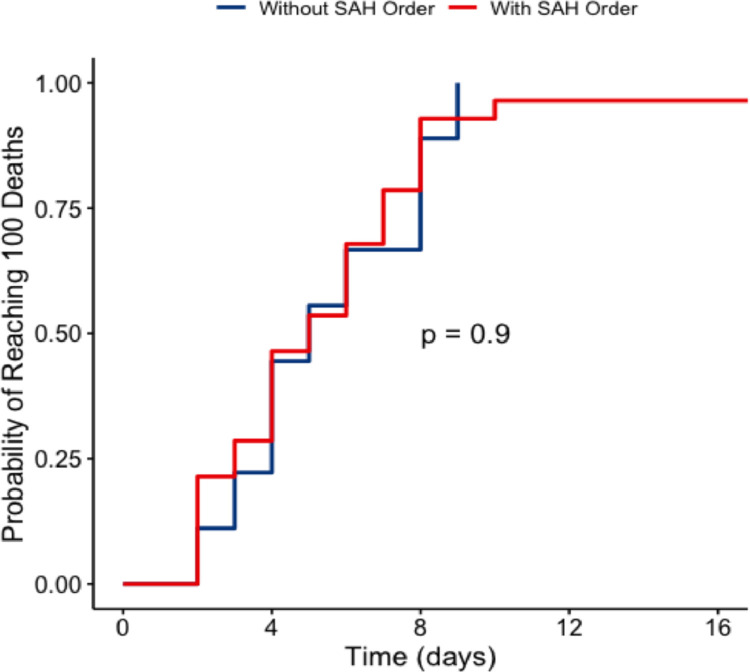
Methods: To measure transmissibility, we analyze the average effective reproductive number (Rt) in each state the week following its 500th case and doubling time from 500 to 1000 cases. Linear and logistic regressions were performed to assess the impact of various NPIs while controlling for population density, GDP, and certain health metrics. This analysis was repeated for deaths with doubling time to 100 deaths with several healthcare infrastructure control variables.
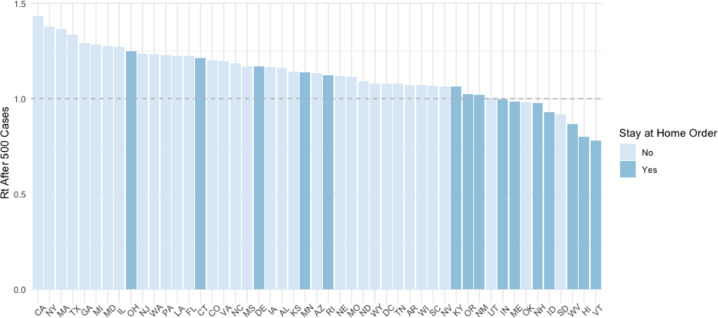
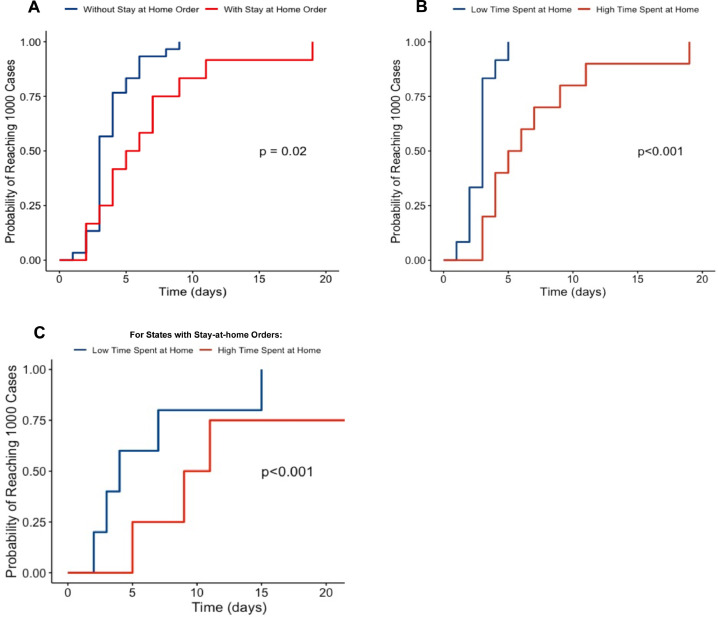
Results: States with stay-at-home orders in place at the time of their 500th case were associated with lower average Rt the following week compared to states without them (p<0.001) and significantly less likely to have an Rt>1 (OR 0.07, 95% CI 0.01-0.37, p = 0.004). These states also experienced longer doubling time from 500 to 1000 cases (HR 0.35, 95% CI 0.17-0.72, p = 0.004). States in the highest quartile of average time spent at home were also slower to reach 1000 cases than those in the lowest quartile (HR 0.18, 95% CI 0.06-0.53, p = 0.002).
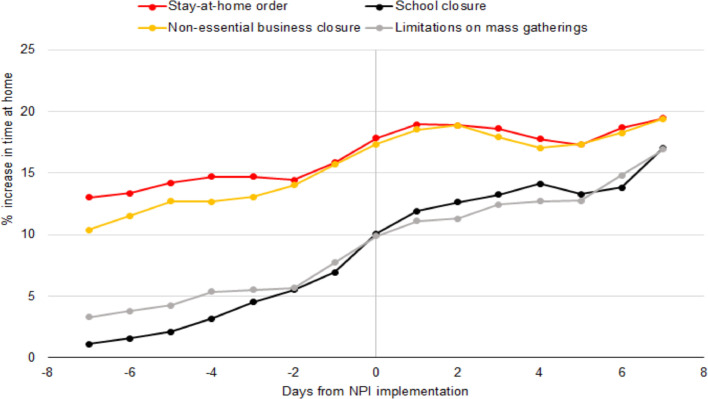
Conclusions: Stay-at-home orders had the largest effect of any policy analyzed. Multivariate analyses with cellphone tracking data suggest social distancing adherence drives these effects. States that plan to scale back such measures should carefully monitor transmission metrics.
Keywords: COVID-19; Coronavirus; Limitations on mass gatherings; Non-essential business closure; Non-pharmaceutical interventions; Novel coronavirus; Public policy; SARS-CoV-2; School closure; Social distancing; Stay-at-home order.
Copyright © 2021 Southern Society for Clinical Investigation. Published by Elsevier Inc. All rights reserved.
Conflict of interest statement
Declaration of Competing Interest The authors of this manuscript have no conflicts of interest to disclose.
Figures
References
-
- Banholzer N., van Weenen E., Kratzwald B. Estimating the impact of non-pharmaceutical interventions on documented infections with COVID-19: a cross-country analysis. medRxiv. 2020
-
- 2020. Institute For Health Metrics and Evaluation. COVID-19 Resources. April 30 [cited 2020 April 30]; Available at: http://www.healthdata.org/covid. Accessed March 22, 2021.
-
- Johns Hopkins Univeristy & Medicine . 2020. COVID-19 Dashboard by the Center for Systems Science and Engineering (CSSE) At Johns Hopkins University (JHU) April 30 [cited 2020 April 30]; Available at: https://coronavirus.jhu.edu/map.html. Accessed March 22, 2021.
MeSH terms
LinkOut - more resources
Full Text Sources
Other Literature Sources
Medical
Miscellaneous
