


A Longitudinal Study on Generalized Anxiety Among University Students During the First Wave of the COVID-19 Pandemic in Switzerland
- PMID: 33776867
- PMCID: PMC7990874
- DOI: 10.3389/fpsyg.2021.643171
A Longitudinal Study on Generalized Anxiety Among University Students During the First Wave of the COVID-19 Pandemic in Switzerland
Abstract
Objective: The COVID-19 pandemic and government measures implemented to counter the spread of the infection may be a major stressor affecting the psychological health of university students. This study aimed to explore how anxiety symptoms changed during the pandemic.
Methods: 676 students (76% females) at Zurich University of Applied Sciences participated in the first (T0) and second (T1) survey waves. Anxiety symptoms were assessed using the Generalized Anxiety Disorder-Scale-7 (GAD-7). Risk and protective factors (e.g., COVID-19-related variables) were examined.
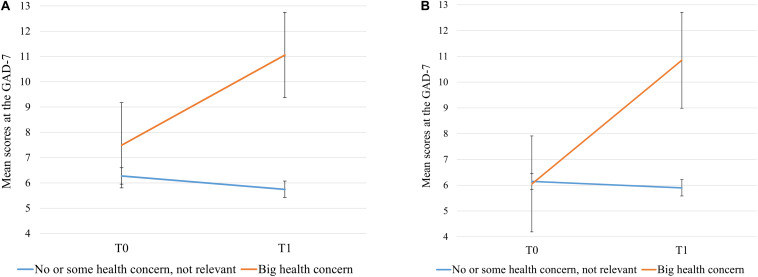
Results: GAD-7 scores decreased significantly from T0 to T1 (mean change: -0.446, SE = 0.132, 95% CI: -0.706, -0.186, t = -3.371, df = 659, p = 0.001). Participants with moderate-to-severe anxiety score were 20.2 and 15.6% at T0 and T1, respectively. The following positively predicted anxiety: older age, female gender, non-Swiss nationality, loneliness, participants' concern about their own health, and interaction between time and participants' concern about their own health. Resilience and social support negatively predicted anxiety.
Conclusions: Our findings provide information for public health measures and psychological interventions supporting the mental health of university students during the COVID-19 emergency.
Keywords: COVID-19 pandemic; anxiety; coronavirus; linear mixed model; lockdown; longitudinal.
Copyright © 2021 Amendola, von Wyl, Volken, Zysset, Huber and Dratva.
Conflict of interest statement
The authors declare that the research was conducted in the absence of any commercial or financial relationships that could be construed as a potential conflict of interest.
Figures
References
-
- Anyan F., Worsley L., Hjemdal O. (2017). Anxiety symptoms mediate the relationship between exposure to stressful negative life events and depressive symptoms: a conditional process modelling of the protective effects of resilience. Asian J. Psychiatr. 29 41–48. 10.1016/j.ajp.2017.04.019 - DOI - PubMed
-
- Bland M. (2015). An Introduction to Medical Statistics, 4th Edn. Oxford: Oxford University Press.
LinkOut - more resources
Full Text Sources
Other Literature Sources
Miscellaneous
