An official website of the United States government
The .gov means it’s official.
Federal government websites often end in .gov or .mil. Before
sharing sensitive information, make sure you’re on a federal
government site.
The site is secure.
The https:// ensures that you are connecting to the
official website and that any information you provide is encrypted
and transmitted securely.
1 Neurointensive Care Unit, Sanatorio Pasteur, Catamarca, Argentina.
2 Intensive Care Unit, Hospital San Juan Bautista, Catamarca, Argentina.
3 Department Anesthesiology and Surgical-Trauma Intensive Care, Hospital Clinic Universitari de Valencia, Valencia, Spain.
4 Department of Surgery, University of Valencia, Valencia, Spain.
5 INCLIVA Research Medical Institute, Valencia, Spain.
6 Department of Anaesthesia and Intensive Care, Policlinico San Martino Istituto di Ricovero e Cura a Carattere Scientifico (IRCCS) for Oncology and Neuroscience, Genoa, Italy.
7 School of Medicine and Surgery, University of Milano - Bicocca, Monza, Italy.
8 Critical Care Medicine, Intensive Care Unit, Virgen del Rocío University Hospital, Sevilla, Spain.
1 Neurointensive Care Unit, Sanatorio Pasteur, Catamarca, Argentina.
2 Intensive Care Unit, Hospital San Juan Bautista, Catamarca, Argentina.
3 Department Anesthesiology and Surgical-Trauma Intensive Care, Hospital Clinic Universitari de Valencia, Valencia, Spain.
4 Department of Surgery, University of Valencia, Valencia, Spain.
5 INCLIVA Research Medical Institute, Valencia, Spain.
6 Department of Anaesthesia and Intensive Care, Policlinico San Martino Istituto di Ricovero e Cura a Carattere Scientifico (IRCCS) for Oncology and Neuroscience, Genoa, Italy.
7 School of Medicine and Surgery, University of Milano - Bicocca, Monza, Italy.
8 Critical Care Medicine, Intensive Care Unit, Virgen del Rocío University Hospital, Sevilla, Spain.
The authors declare that the research was conducted in the absence of any commercial or financial relationships that could be construed as a potential conflict of interest.
Figures
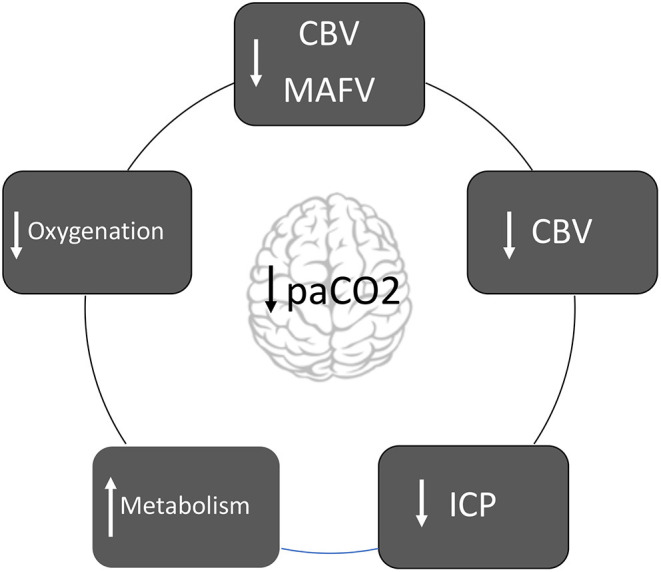
Graphical Abstract
Diagram about the mechanisms in…
Graphical Abstract
Diagram about the mechanisms in which hyperventilation affects the brain pathophysiology.
Graphical Abstract
Diagram about the mechanisms in which hyperventilation affects the brain pathophysiology.
Godoy DA, Seifi A, Garza D, Lubillo-Montenegro S, Murillo-Cabezas F. Hyperventilation therapy for control of posttraumatic intracranial hypertension. Front Neurol. (2017) 8: 250. 10.3389/fneur.2017.00250
-
DOI
-
PMC
-
PubMed
Carney N, Totten AM, O'Reilly C, Ullman JS, Hawryluk GW, Bell MJ, et al. . Guidelines for the management of severe traumatic brain injury, Fourth Edition. Neurosurgery. (2017) 80:6–15. 10.1227/NEU.0000000000001432
-
DOI
-
PubMed
Harper AM, Glass HI. Effect of alterations in the arterial carbon dioxide tension on the blood flow through the cerebral cortex at normal and low arterial blood pressures. J Neurol Neurosurg Psychiatr. (1965) 28: 449–52. 10.1136/jnnp.28.5.449
-
DOI
-
PMC
-
PubMed
Brian JE. Carbon dioxide and the cerebral circulation. Anesthesiology. (1998) 88:365–86. 10.1097/00000542-199805000-00029
-
DOI
-
PubMed
Cold GE. Cerebral blood flow in acute head injury. The regulation of cerebral blood flow and metabolism during the acute phase of head injury, and itssignificance for therapy. Acta Neurochir Suppl. (1990) 49:1– 64. 10.1007/978-3-7091-9101-9_1
-
DOI
-
PubMed
