


The Role of Religiousness and Spirituality in Health-related Quality of Life of Persons Living with HIV: A Latent Class Analysis
- PMID: 33777311
- PMCID: PMC7992907
- DOI: 10.1037/rel0000301
The Role of Religiousness and Spirituality in Health-related Quality of Life of Persons Living with HIV: A Latent Class Analysis
Abstract
Purpose: Understanding how religion and spirituality influence health-related quality of life (HRQoL) is important for developing holistic, patient-centered treatment. This study determined distinct latent classes of religiousness/spirituality for adult persons living with HIV (PLWH) and associations between latent class membership and HRQoL.
Methods: Baseline data was collected from 223 patients in the FAmily CEntered (FACE) Advance Care Planning (ACP) clinical trial for PLWH. Patients completed the Brief Multidimensional Measurement of Religiousness/Spirituality (BMMRS-adapted), Patient Health Questionnaire (PHQ-9), Medical Outcome Study-HIV Survey (MOS-HIV) and the Palliative care Outcome Scale (POS). The optimal number of latent classes was determined by comparing K-Class model with (K-1)-Class model iteratively. The relationship between latent class membership, HRQoL and demographic characteristics was assessed.
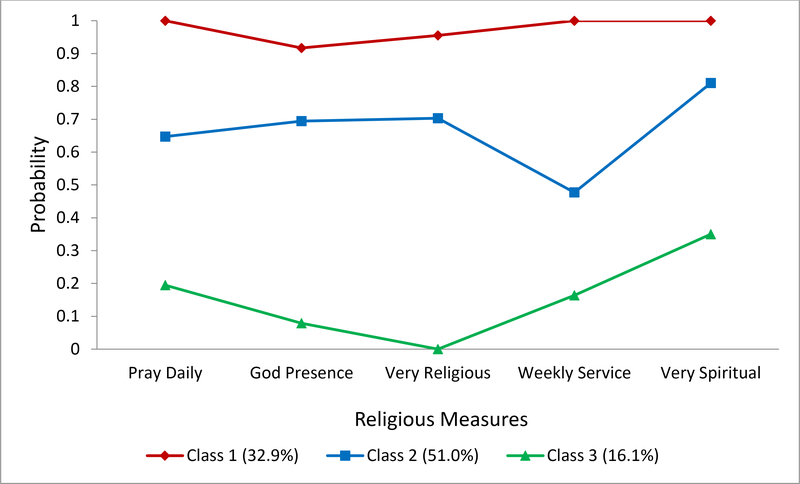
Results: Patients were 56.1% male, 86.1% Black/African American, aged 22-77 (Mean=50.83). 75.3% were Christian. LCA identified three classes: traditionally religious (35%), privately religious (47.1%), and spiritual but not religious (17.9%). MOS-HIV mental health (p < 0.001), MOS-HIV quality of life (p = 0.014) and MOS-HIV health transition (p = 0.016) scores were significantly higher among patients who were traditionally religious. These patients were more likely to be 40+ years and Black. Patients in the privately religious group had the lowest levels of mental health and HRQoL.
Conclusions: Understanding how religiousness and spirituality influence HRQoL can help the medical community develop holistic, patient-centered and culturally-sensitive interventions that could improve outcomes for PLWH and potentially mitigate the impact of health disparities within the Black and LGBTQ communities.
Keywords: HIV/AIDS; health-related quality of life; inclusivity; religion; spirituality.
Figures
References
-
- Asparouhov T, & Muthén B (2012). Auxiliary variables in mixture modeling: A 3-step approach using Mplus. Mplus web notes: No. 15.
-
- Aspinal F, Hughes R, Higginson I, Chidgey J, Drescher U, & Thompson M (2002). A user’s guide to the Palliative care Outcome Scale. London: Palliative Care and Policy Publications, 10.
-
- Astin AW, Astin HS, Lindholm JA, & Bryant AN (2005). The spiritual life of college students: A national study of students’ search for meaning and purpose. Los Angeles, CA: Higher Education Research Institute, UCLA.
-
- Barton YA, & Miller L (2015). Spirituality and positive psychology go hand in hand: An investigation of multiple empirically derived profiles and related protective benefits. Journal of Religion and Health, 54(3), 829–843. - PubMed
-
- Bernstein K, D’Angelo LJ, & Lyon ME (2013). An exploratory study of HIV+ adolescents’ spirituality: will you pray with me?. Journal of Religion and Health, 52(4), 1253–1266. - PubMed
Grants and funding
LinkOut - more resources
Full Text Sources
Medical
Research Materials