Review
. 2021 Mar 9:19:1472-1487.
doi: 10.1016/j.csbj.2021.03.006. eCollection 2021.

The genus bifidobacterium: From genomics to functionality of an important component of the mammalian gut microbiota running title: Bifidobacterial adaptation to and interaction with the host

Affiliations
Review

The genus bifidobacterium: From genomics to functionality of an important component of the mammalian gut microbiota running title: Bifidobacterial adaptation to and interaction with the host

Giulia Alessandri et al. Comput Struct Biotechnol J. .

Abstract

Members of the genus Bifidobacterium are dominant and symbiotic inhabitants of the mammalian gastrointestinal tract. Being vertically transmitted, bifidobacterial host colonization commences immediately after birth and leads to a phase of host infancy during which bifidobacteria are highly prevalent and abundant to then transit to a reduced, yet stable abundance phase during host adulthood. However, in order to reach and stably colonize their elective niche, i.e. the large intestine, bifidobacteria have to cope with a multitude of oxidative, osmotic and bile salt/acid stress challenges that occur along the gastrointestinal tract (GIT). Concurrently, bifidobacteria not only have to compete with the myriad of other gut commensals for nutrient acquisition, but they also require protection against bacterial viruses. In this context, Next-Generation Sequencing (NGS) techniques, allowing large-scale comparative and functional genome analyses have helped to identify the genetic strategies that bifidobacteria have developed in order to colonize, survive and adopt to the highly competitive mammalian gastrointestinal environment. The current review is aimed at providing a comprehensive overview concerning the molecular strategies on which bifidobacteria rely to stably and successfully colonize the mammalian gut.


Conflict of interest statement

The authors declare that they have no known competing financial interests or personal relationships that could have appeared to influence the work reported in this paper.

Figures
None
Graphical abstract
Fig. 1
Fig. 1
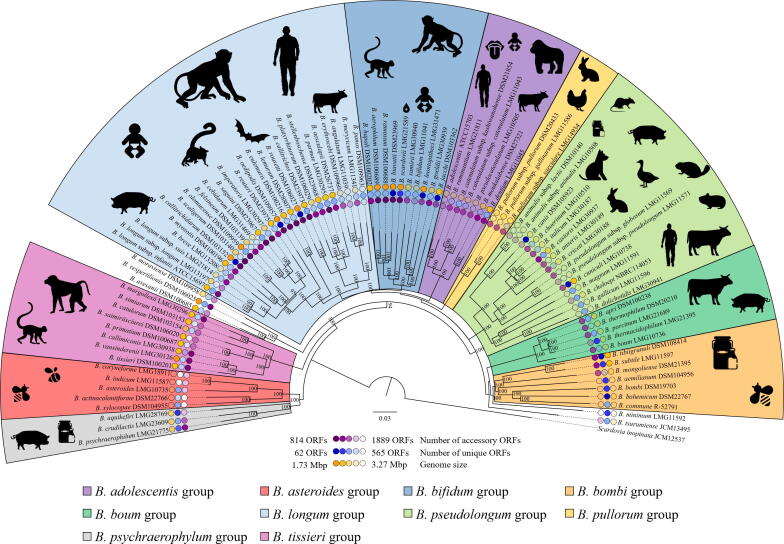
Phylogenetic tree of the genus Bifidobacterium based on the concatenation of the 169 amino acid sequences representing the Bifidobacterium core genome. The phylogenetic tree was generated by the maximum-likelihood method, and COG sequences of Scardovia inopinata JCM 12537 shared with bifidobacterial species were used as an outgroup. Bootstrap percentages above 50 are shown at node points based on 1000 replicates of the phylogenetic tree. The outer circle represents the number of accessory and unique genes as well as the genome size of each bifidobacterial type strain, while the ecological origins of bifidobacteria per each phylogenetic group are reported beside the phylogenetic tree.
Fig. 2
Fig. 2
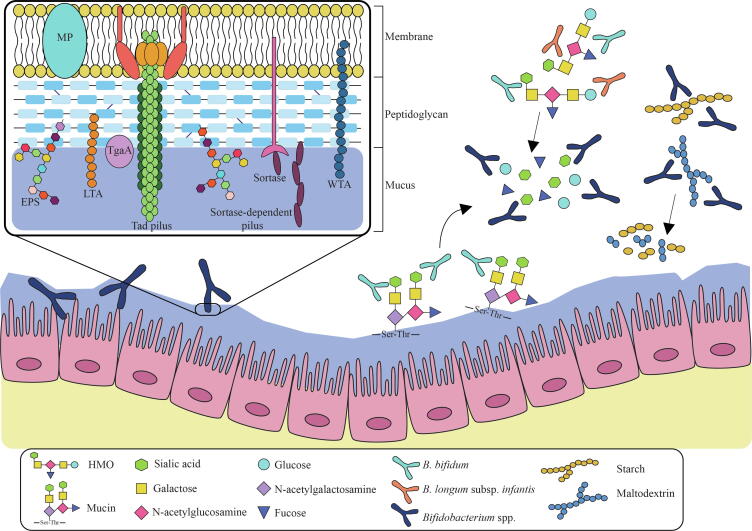
Bifidobacterial strategies to successfully colonize and survive in the human intestine. A schematic overview of the macromolecular structures exposed on the bifidobacterial surface and involved in host-microbe interactions are reported on the left: membrane protein (MP), exopolysaccharide (EPS), TgaA, wall and lipoteichoic acids (WTA and LTA) coupled with sortase-dependent and Tad pili. In addition, on the right, bifidobacterial degradative activities toward different diet- and host-derived complex carbohydrates are depicted. Hydrolysis of complex sugars by certain bifidobacterial species produces simple glycans that can be directly utilize as carbon sources by the same bifidobacterial species and/or metabolized by other members of the Bifidobacterium genus trough cross-feeding.

References

    1. Bottacini F., van Sinderen D., Ventura M. Omics of bifidobacteria: research and insights into their health-promoting activities. Biochem J. 2017;474(24):4137–4152. doi: 10.1042/BCJ20160756. - DOI - PubMed
    1. Hidalgo-Cantabrana C., Delgado S., Ruiz L., Ruas-Madiedo P., Sanchez B., Margolles A. Bifidobacteria and their health-promoting effects. Microbiol Spectr. 2017;5(3) doi: 10.1128/microbiolspec.BAD-0010-2016. - DOI - PMC - PubMed
    1. Alessandri G., Ossiprandi M.C., MacSharry J., van Sinderen D., Ventura M. Bifidobacterial dialogue with its human host and consequent modulation of the immune system. Front Immunol. 2019;10:2348. doi: 10.3389/fimmu.2019.02348. - DOI - PMC - PubMed
    1. Tojo R., Suarez A., Clemente M.G., de los Reyes-Gavilan C.G., Margolles A., Gueimonde M., Ruas-Madiedo P. Intestinal microbiota in health and disease: role of bifidobacteria in gut homeostasis. World J Gastroenterol. 2014;20(41):15163–15176. doi: 10.3748/wjg.v20.i41.15163. - DOI - PMC - PubMed
    1. Ruiz L., Delgado S., Ruas-Madiedo P., Sanchez B., Margolles A. Bifidobacteria and Their Molecular Communication with the Immune System. Front Microbiol. 2017;8:2345. doi: 10.3389/fmicb.2017.02345. - DOI - PMC - PubMed

LinkOut - more resources