Review
. 2021 Mar 12:11:620214.
doi: 10.3389/fonc.2021.620214. eCollection 2021.

Steroid Hormone Receptors: Links With Cell Cycle Machinery and Breast Cancer Progression

Affiliations
Review

Steroid Hormone Receptors: Links With Cell Cycle Machinery and Breast Cancer Progression

Suryendu Saha et al. Front Oncol. .

Abstract

Progression of cells through cell cycle consists of a series of events orchestrated in a regulated fashion. Such processes are influenced by cell cycle regulated expression of various proteins where multiple families of transcription factors take integral parts. Among these, the steroid hormone receptors (SHRs) represent a connection between the external hormone milieu and genes that control cellular proliferation. Therefore, understanding the molecular connection between the transcriptional role of steroid hormone receptors and cell cycle deserves importance in dissecting cellular proliferation in normal as well as malignant conditions. Deregulation of cell cycle promotes malignancies of various origins, including breast cancer. Indeed, SHR members play crucial role in breast cancer progression as well as management. This review focuses on SHR-driven cell cycle regulation and moving forward, attempts to discuss the role of SHR-driven crosstalk between cell cycle anomalies and breast cancer.

Keywords: androgen receptor (AR); breast cancer; cell cycle; estrogen receptor (ER); progesterone receptor (PR); steroid hormone receptors (SHRs).


Conflict of interest statement

The authors declare that the research was conducted in the absence of any commercial or financial relationships that could be construed as a potential conflict of interest.

Figures
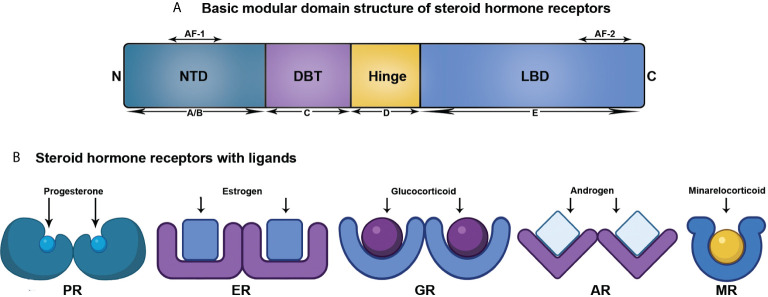
Figure 1
Figure 1
Structural organization of SHRs associated with ligand. (A) Linear representation of domains of SHRs. (B) SHRs and their corresponding ligand.
Figure 2
Figure 2
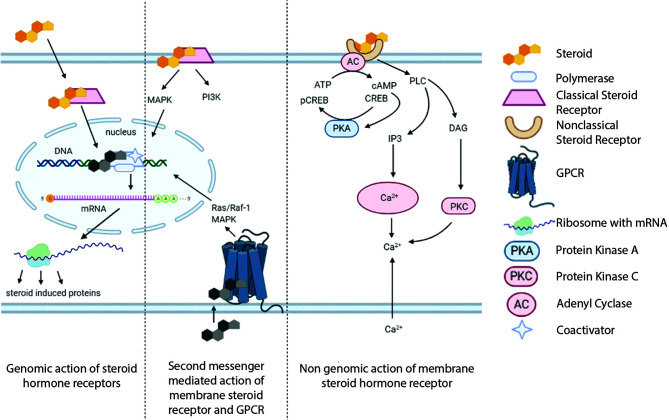
Convergence of genomic and nongenomic mechanisms of steroid hormone receptor action. Both of these pathways together can alter biological processes.
Figure 3
Figure 3
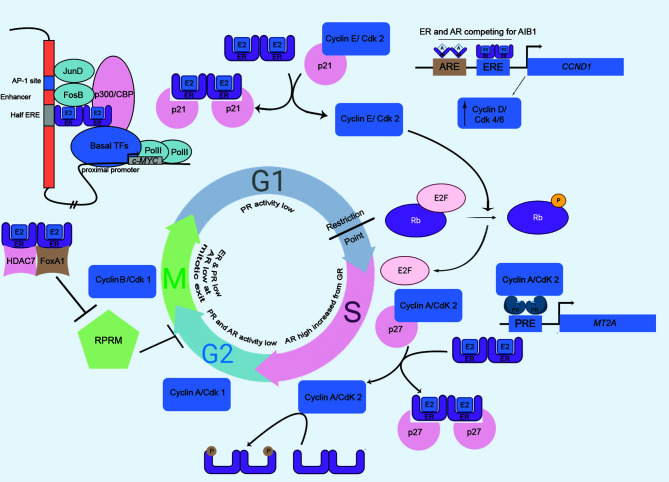
The cell cycle, driven by the master regulators: steroid hormone receptors and kinases. SHRs involve in various cell cycle phase-specific functions, engaging the retinoblastoma protein (Rb), cyclins, and, cyclin-dependent kinases (cdk). MT2A, Metallothionein IIA, a PR target gene; A, Androgen; Pro, Progesterone; ERE, Estrogen Response Element; PRE, Progesterone Response Element; ARE, Androgen Response Element.
Figure 4
Figure 4
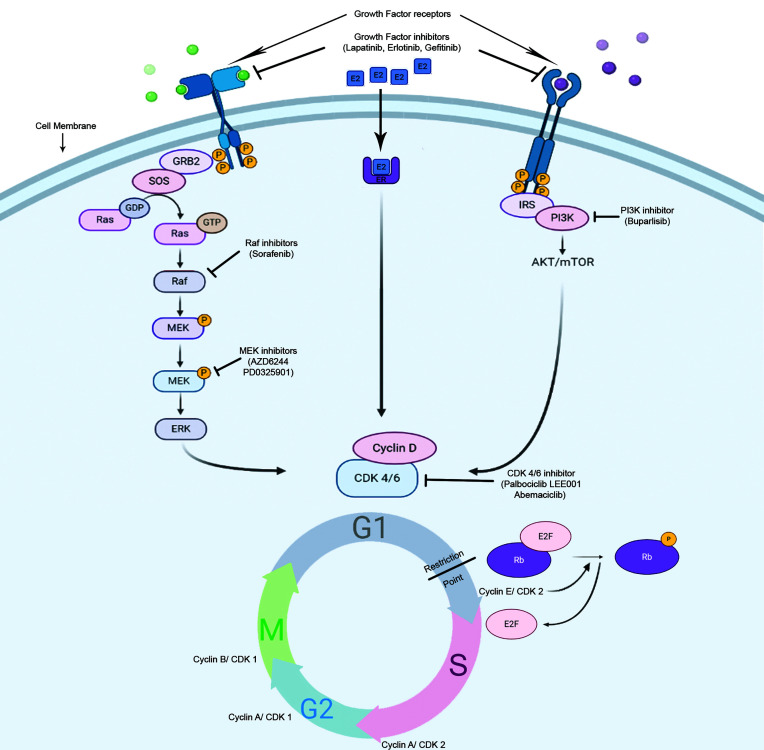
Potential mode of action of cell cycle inhibitors in hormone-responsive breast tumors. There are numerous anti-cancer strategies that specifically target cell proliferation in breast cancer. The dependence of the HR+ve cells on Rb/E2F/CDK4/6 axis for progression through restriction point makes them vulnerable for CDK4/6 inhibitors.

References

    1. Barnum KJ, O’Connell MJ. Cell cycle regulation by checkpoints. Methods Mol Biol (2014) 1170:29–40. 10.1007/978-1-4939-0888-2_2 - DOI - PMC - PubMed
    1. Visconti R, Della Monica R, Grieco D. Cell cycle checkpoint in cancer: a therapeutically targetable double-edged sword. J Exp Clin Cancer Res (2016) 35:153. 10.1186/s13046-016-0433-9 - DOI - PMC - PubMed
    1. Wenzel ES, Singh ATK. Cell-cycle Checkpoints and Aneuploidy on the Path to Cancer. In Vivo (2018) 32:1–5. 10.21873/invivo.11197 - DOI - PMC - PubMed
    1. Beato M, Klug J. Steroid hormone receptors: an update. Hum Reprod Update (2000) 6:225–36. 10.1093/humupd/6.3.225 - DOI - PubMed
    1. Truong TH, Lange CA. Deciphering Steroid Receptor Crosstalk in Hormone-Driven Cancers. Endocrinology (2018) 159:3897–907. 10.1210/en.2018-00831 - DOI - PMC - PubMed