


Clinical Safety and Efficacy of Ablation for Atrial Fibrillation Patients With a History of Stroke
- PMID: 33778023
- PMCID: PMC7987660
- DOI: 10.3389/fcvm.2021.630090
Clinical Safety and Efficacy of Ablation for Atrial Fibrillation Patients With a History of Stroke
Abstract
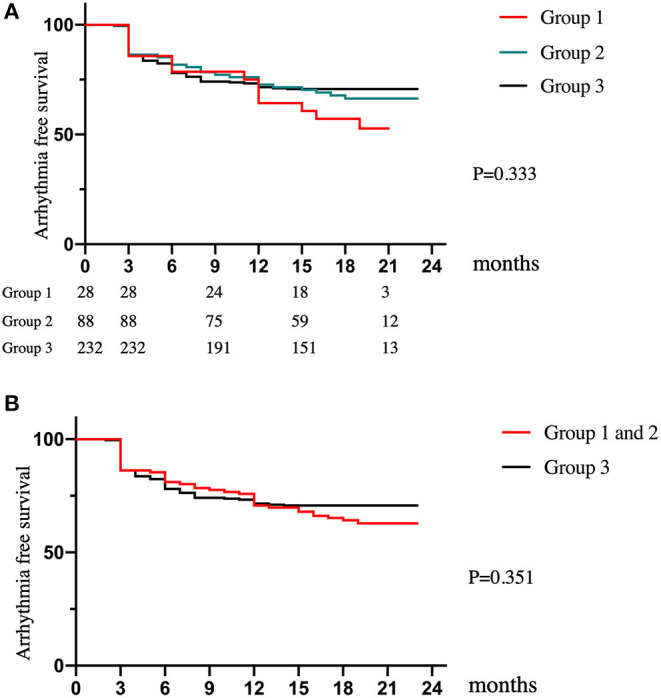
Objectives: To evaluate the clinical safety and efficacy of radiofrequency catheter ablation for atrial fibrillation patients with a history of stroke. Methods and Results: A total of 116 symptomatic, drug-refractory AF patients with a history of stroke, and 1:2 matched patients without a history of stroke were enrolled. Of these, 28 cases occurred stroke within 3 months (Group 1), 88 cases with stroke history longer than 3 months (Group 2), and 232 cases without stroke (Group 3). PVI was performed in all patients, extended to ablation of linear lesions ablation. The periprocedural stroke rates and other procedure-related in-hospital complications did not differ significantly among the three groups. The maintenance rate of SR after the procedure showed no significant difference (p = 0.333), 52.7, 66.4, and 70.7% in Group 1, 2, and 3, respectively. Furthermore, the comparison between a history of stroke and those without it were also shown no significant difference (p = 0.351). Conclusions: Radiofrequency ablation for AF patients occurred stroke, even within 3 months is safe and effective, without higher periprocedural complication rate and recurrence rate.
Keywords: atrial fibrillation; catheter ablation; efficacy; safety; stroke.
Copyright © 2021 Song, Wu, Zhang, Jiang, Qin and Liu.
Conflict of interest statement
The authors declare that the research was conducted in the absence of any commercial or financial relationships that could be construed as a potential conflict of interest.
Figures
References
LinkOut - more resources
Full Text Sources
Other Literature Sources
Research Materials
