


Evaluating Rapid-cycle Deliberate Practice Versus Mastery Learning in Training Nurse Anesthetists on the Universal Anaesthesia Machine Ventilator in Sierra Leone
- PMID: 33778103
- PMCID: PMC7983184
- DOI: 10.46374/volxxiii_issue1_sampson
Evaluating Rapid-cycle Deliberate Practice Versus Mastery Learning in Training Nurse Anesthetists on the Universal Anaesthesia Machine Ventilator in Sierra Leone
Abstract
Background: Underserved sub-Saharan countries have 0.1 to 1.4 anesthesia providers per 100 000 citizens, below the Lancet Commission's target of 20 per 100 000 needed for safe surgery. Most of these anesthesia providers are nurse anesthetists, with anesthesiologists numbering as few as zero in some nations and 2 per 7 million in others, such as Sierra Leone. In this study, we compared 2 simulation-based techniques for training nurse anesthetists on the Universal Anaesthesia Machine Ventilator-rapid-cycle deliberate practice and mastery learning.
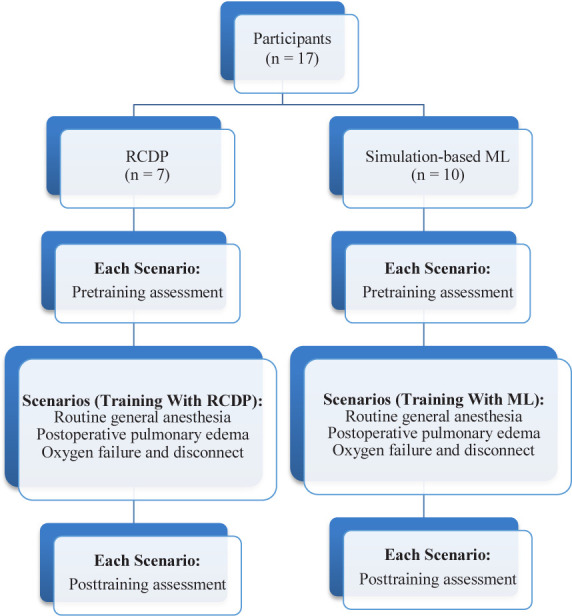
Methods: A 2-week Universal Anaesthesia Machine Ventilator course was administered to 17 participants in Sierra Leone. Seven were randomized to the rapid-cycle deliberate practice group and 10 to the mastery learning group. Participants underwent baseline and posttraining evaluations in 3 scenarios: general anesthesia, intraoperative power failure, and postoperative pulmonary edema. Performance was analyzed based on checklist performance scores and the number of times participants were stopped for a mistake. Statistical significance to 0.05 was determined with the Mann-Whitney U Test.
Results: Checklist performance scores did not differ significantly between the 2 groups. When the groups were combined, simulation-based training resulted in a statistically significant improvement in performance. The highest-frequency problem areas were preoxygenation, switching from spontaneous to mechanical ventilation, and executing appropriate treatment interventions for a postoperative emergency.
Conclusion: Both rapid-cycle deliberate practice and mastery learning are effective methods for simulation-based training to improve nurse anesthetist performance with the Universal Anaesthesia Machine Ventilator in 3 separate scenarios. The data did not indicate any difference between these methods; however, a larger sample size may support or refute our findings.
Keywords: Medical simulation; Sub-Saharan Africa; anesthesia training; low-resource environment; mastery learning; rapid-cycle deliberate practice.
© 2021 Society for Education in Anesthesia.
Figures

References
-
- Vaughan E, Sesay F, Chima A, et al. An assessment of surgical and anesthesia staff at 10 government hospitals in Sierra Leone. JAMA Surg. 2015;150(3):237–44. - PubMed
-
- Cook DA, Hatala R, Brydges R, et al. Technology-enhanced simulation for health professions education: a systematic review and meta-analysis. JAMA. 2011;306(9):978–88. - PubMed
-
- Cook DA, Brydges R, Hamstra SJ, et al. Comparative effectiveness of technology-enhanced simulation versus other instructional methods: a systematic review and meta-analysis. Simul Healthc. 2012;7(5):308–20. - PubMed
-
- Steadman RH, Coates WC, Huang YM, et al. Simulation-based training is superior to problem-based learning for the acquisition of critical assessment and management skills. Crit Care Med. 2006;34(1):151–7. - PubMed
LinkOut - more resources
Full Text Sources