. 2021 Mar 9;6(10):3085-3096.
doi: 10.1016/j.bioactmat.2021.02.029. eCollection 2021 Oct.

An in situ-forming polyzwitterion hydrogel: Towards vitreous substitute application

Affiliations

An in situ-forming polyzwitterion hydrogel: Towards vitreous substitute application

Binbin He et al. Bioact Mater. .

Abstract

Development of a biostable and biosafe vitreous substitute is highly desirable, but remains a grand challenge. Herein, we propose a novel strategy for constructing a readily administered vitreous substitute based on a thiol-acrylate clickable polyzwitterion macromonomer. A biocompatible multivinyl polycarboxybetaine (PCB-OAA) macromonomer is designed and synthesized, and mixed with dithiothreitol (DTT) via a Michael addition reaction to form a hydrogel in vitreous cavity. This resultant PCB-OAA hydrogel exhibits controllable gelation time, super anti-fouling ability against proteins and cells, excellent biocompatibility, and approximate key parameters to human vitreous body including equilibrium water content, density, optical properties, modulus. Remarkably, outperforming clinically used silicone oil in biocompatibility, this rapidly formed hydrogel in the vitreous cavity of rabbit eyes remains stable in vitreous cavity, showing an appealing ability to prevent significantly inflammatory response, fibrosis and complications such as raised intraocular pressure (IOP), and cataract formation. This zwitterionic polymer hydrogel holds great potential as a vitreous substitute.

Keywords: Anti-fouling; Hydrogel; Vitreous substitute; Zwitterion.


Conflict of interest statement

The authors declare that they have no known competing financial interests or personal relationships that could have appeared to influence the work reported in this paper.

Figures

Image 1
Graphical abstract
Fig. 1
Fig. 1
(A) Synthesis procedure, molecular structures of PCB-OAA zwitterionic polymer and PCB-OAA-DTT hydrogel. (B) Schematic illustration of injection of PCB-OAA and DTT into rabbit vitreous cavity to form a hydrogel in situ, serving as a vitreous substitute.
Fig. 2
Fig. 2
Characterizations of PCB-OAA hydrogels. (A) Gelation time of PCB-OAA hydrogels by vial-inversion test at 37 °C. (B) Swelling ratios of PCB-OAA hydrogels in physiological saline solution (0.9 wt% NaCl) at 37 °C for 1 month. (C) Light transmittance of the hydrogels over a wavelength range of 380–780 nm. (D) Protein adsorption of PHEMA hydrogel (control) and PCB-OAA hydrogels. (***p < 0.001). (E–H) Images of cellular attachment on tissue culture polystyrene surface (TCPS), PCB-OAA-7, PCB-OAA-8.5, and PCB-OAA-10 hydrogel after rinsing, respectively. The remaining cells were denoted by blue circles. The scale bars were 200 μm. (I) Relative cell viability of ARPE-19 cells co-cultured with PCB-OAA hydrogels for 24, 48 and 72 h.
Fig. 3
Fig. 3
Rheological properties of PCB-OAA hydrogels. (A) Time sweep curves of PCB-OAA hydrogels at 1 Hz frequency and 1% strain within 1800 s. (B) Frequency sweep curves of PCB-OAA hydrogels at a frequency range from 0.01 to 10 Hz at 1% strain. Storage modulus (G′) and loss modulus (G″) were recorded. (C) Frequency sweep curves of PCB-OAA hydrogels before (M0) and after (M1) immersion for 1 month in physiological saline solution. (D) Average values of G′ for PCB-OAA hydrogels before and after immersion. (E) Strain curves and (F) creep compliance curves of PCB-OAA-7 hydrogel plotted as a function of time in shear creep test under different applied shear stress (0.5 and 1.0 Pa). All tests were performed for at least 3 times at 37 °C.
Fig. 4
Fig. 4
In vivo images of rabbit eyes at 1 month (1 M) and 6 months (6 M) post-operation. (A–B) B-scan ultrasound images; (C–D) posterior fundus photographs; (E–F) fluorescein angiographs. Column (A1-F1): Normal eye groups, Column (A2-F2): Sham-operated groups. Column (A3-F3): Silicone oil (SO) groups. Column (A4-F4): PCB-OAA-7 hydrogel groups.
Fig. 5
Fig. 5
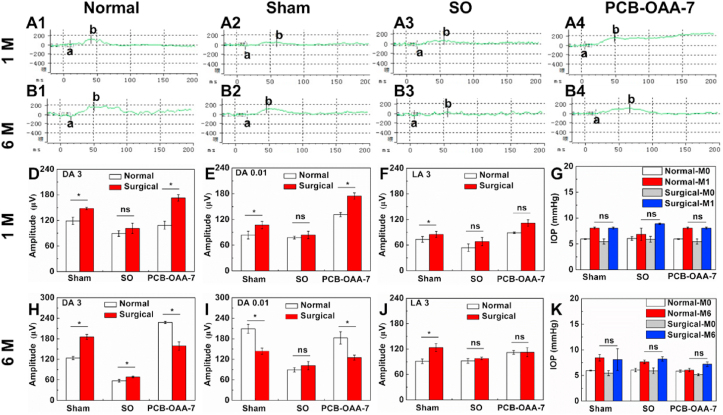
The retina functions and intraocular pressure (IOP) of rabbit eyes at 1 month (1 M) or 6 months (6 M) post-operation. (A–B) Waveforms of dark-adapted 0.01 ERG (DA 0.01 ERG) tests for the normal, sham, SO and PCB-OAA-7 hydrogel group. (D-F, H-J) B-wave amplitudes recorded in dark-adapted 3 (DA 3), dark-adapted 0.01 (DA 0.01), light-adapted 3 (LA 3) ERG tests. (G and K) IOP values of rabbit eyes before (M0) and after (M1, M6) surgery at 1 month and 6 months, respectively (*P < 0.05, ns represents no statistical difference). The aforementioned 0.01 and 3 respectively represents 0.01 cd × s/m2 and 2.562 cd × s/m2 stimulus in ERG tests.
Fig. 6
Fig. 6
Appearance of rabbit eyes at 6 months post-operation. (A) External appearance of rabbit eyes at 6 months post-operation. (B) Images of excised eyeball at 6 months post-operation. Obvious opaque region was shown in SO group while normal states were maintained in the other three groups.
Fig. 7
Fig. 7
Histopathological examinations and immunostaining of rabbit eyes at 6 months post-operation. (A–C) Hematoxylin and eosin (H&E) staining of cornea, iris, and retina, respectively. Blue asterisk and rectangle denotes the location of vitreous cavity in all groups and defective morphology in SO group, respectively. The scale bars of cornea and iris were 200 μm. The scale bar of retina was 40 μm.

References

    1. Kleinberg T.T., Tzekov R.T., Stein L., Ravi N., Kaushal S. Vitreous substitutes: a comprehensive review. Surv. Ophthalmol. 2011;56(4):300–323. - PubMed
    1. Baino F. Towards an ideal biomaterial for vitreous replacement: historical overview and future trends. Acta Biomater. 2011;7(3):921–935. - PubMed
    1. Recchia F.M., Ruby A.J., Carvalho Recchia C.A. Pars plana vitrectomy with removal of the internal limiting membrane in the treatment of persistent diabetic macular edema. Am. J. Ophthalmol. 2005;139(3):447–454. - PubMed
    1. Alovisi C., Panico C., Sanctis U.D., Eandi C.M. Vitreous substitutes: old and new materials in vitreoretinal surgery. J. Ophthalmol. 2017;2017:1–6. - PMC - PubMed
    1. Kim R., Baumal C. Anterior segment complications related to vitreous substitutes. Ophthalmol. Clin. North. Am. 2004;17(4):569–576. - PubMed

LinkOut - more resources