


Wildfire particulate matter in Shasta County, California and respiratory and circulatory disease-related emergency department visits and mortality, 2013-2018
- PMID: 33778357
- PMCID: PMC7939433
- DOI: 10.1097/EE9.0000000000000124
Wildfire particulate matter in Shasta County, California and respiratory and circulatory disease-related emergency department visits and mortality, 2013-2018
Abstract
Wildfire smoke harms health. We add to this literature by evaluating the health effects of California's 2018 Carr Fire and preceding wildfire seasons in Shasta County.
Methods: With data from the Shasta County Health and Human Services Agency, we examined the link between weekly wildfire fine particulate matter (PM2.5) exposure estimated using a spatiotemporal multiple imputation approach and emergency department (ED) visits and mortality using time-series models that controlled for temporal trends and temperature.
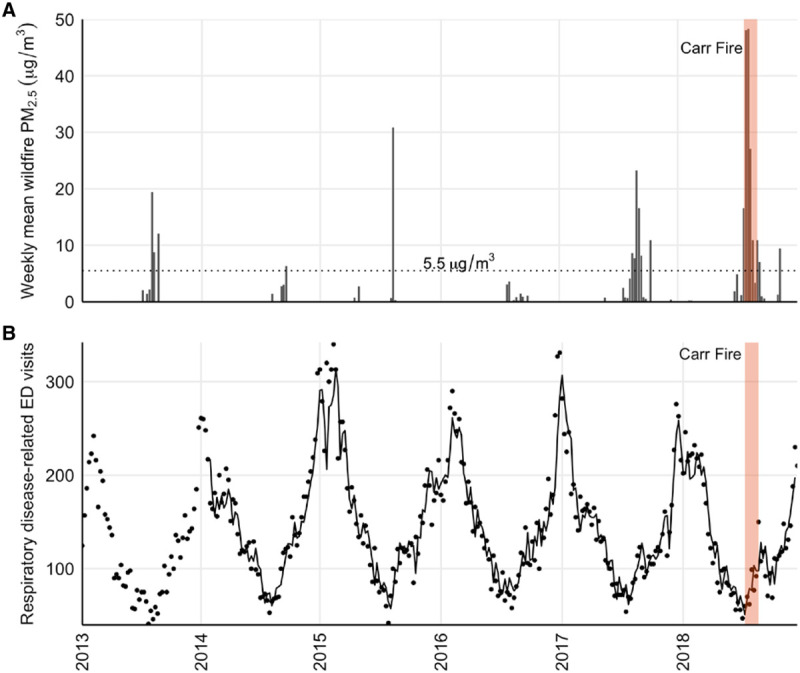
Results: Between 2013 and 2018, Shasta County experienced 19 weeks with average wildfire PM2.5 ≥5.5 μg/m3 (hereafter, "high wildfire PM2.5 concentration"). Among all Shasta County Zip Code Tabulation Areas (ZCTAs; n = 36), we detected no association between high wildfire PM2.5 concentrations and respiratory or circulatory disease-related ED visits or mortality. Subsequent analyses were confined to valley ZCTAs (n = 11, lower elevation, majority of population, worse air quality in general). In valley ZCTAs, high wildfire PM2.5 was associated with a 14.6% (95% confidence interval [CI] = 4.2, 24.9) increase in same-week respiratory disease-related ED visits but no increase in the subsequent 2 weeks nor on circulatory disease-related mortality or ED visits or all-cause mortality. Two weeks after high wildfire PM2.5 weeks, respiratory disease-related deaths decreased (-31.5%, 95% CI = -64.4, 1.5). The 2018 Carr Fire appeared to increase respiratory disease-related ED visits by 27.0% (95% CI = 4.0, 50.0) over expectation and possibly reduce circulatory disease-related deaths (-18.2%, 95% CI = -39.4, 2.9).
Conclusions: As climate change fuels wildfire seasons, studies must continue to evaluate their health effects, particularly in highly exposed populations.
Keywords: Air pollution; California; Cause of death; Emergency service; Hospital; Respiratory tract diseases; Smoke; Wildfires.
Copyright © 2020 The Authors. Published by Wolters Kluwer Health, Inc. on behalf of The Environment Epidemiology. All rights reserved.
Conflict of interest statement
The authors declare that they have no conflicts of interest with regard to the content of this report. Supported, in part, by R00 ES027023, P30 ES009089, and R01 ES030616 from the National Institute of Environmental Health Sciences.Sponsorships or competing interests that may be relevant to content are disclosed at the end of the article.
Figures
References
-
- Jaffe DA, Wigder N, Downey N, Pfister G, Boynard A, Reid SB. Impact of wildfires on ozone exceptional events in the Western U.S. Environ Sci Technol. 2013; 47:11065–11072. - PubMed
-
- Adetona O, Reinhardt TE, Domitrovich J, et al. . Review of the health effects of wildland fire smoke on wildland firefighters and the public. Inhal Toxicol. 2016; 28:95–139. - PubMed
Grants and funding
LinkOut - more resources
Full Text Sources
Research Materials