


Effects of systemically administered abaloparatide, an osteoanabolic PTHrP analog, as an adjuvant therapy for spinal fusion in rats
- PMID: 33778406
- PMCID: PMC7984001
- DOI: 10.1002/jsp2.1132
Effects of systemically administered abaloparatide, an osteoanabolic PTHrP analog, as an adjuvant therapy for spinal fusion in rats
Abstract
Background: Abaloparatide is a parathyroid hormone receptor agonist that increases bone formation and reduces vertebral and nonvertebral fracture risk in women with postmenopausal osteoporosis. Animal studies indicate abaloparatide stimulates vertebral bone formation and enhances bony bridging and biomechanical stability of fracture calluses.
Aims: The current study is evaluating the potential utility for abaloparatide as an adjunct therapy for spinal fusions.
Material and methods: The effects of 14 or 28 days of daily subcutaneous injections of abaloparatide (20 μg/kg/d) or vehicle were evaluated in 32 male Sprague-Dawley rats starting 1 day after noninstrumented posterolateral fusion (PLF) with bone autograft. Fusion mass microarchitecture was analyzed by micro-computed tomography (micro-CT) and serum markers of bone formation and bone resorption were evaluated. Motion segments were scored in a blinded manner as fused or unfused by postmortem radiography and manual palpation.
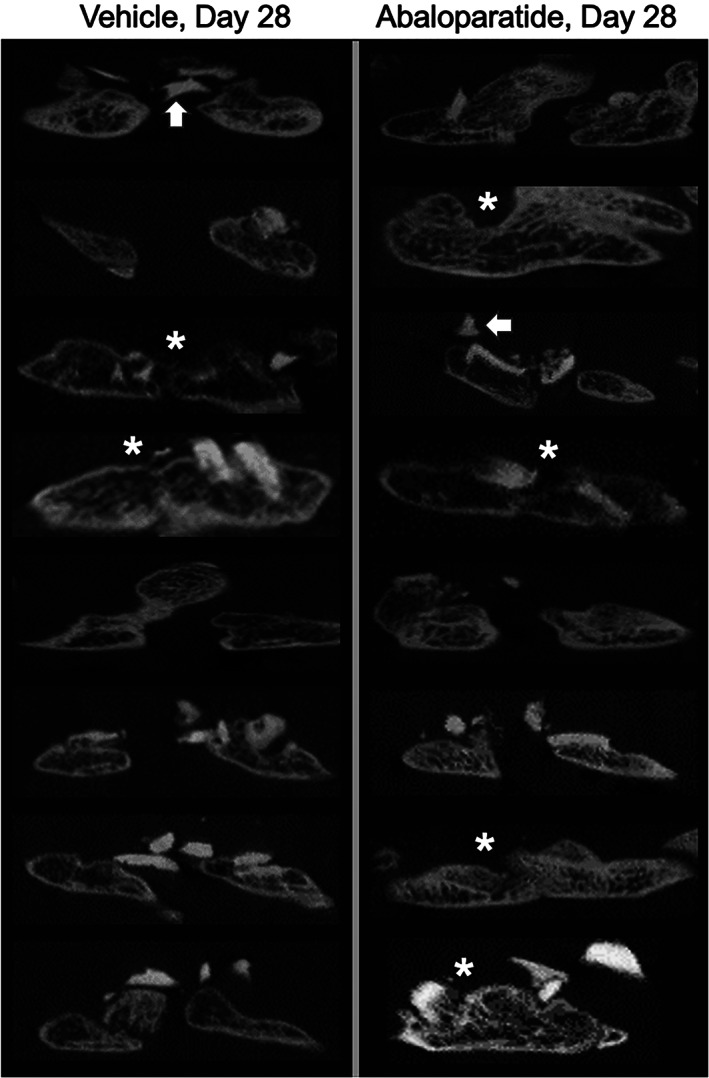
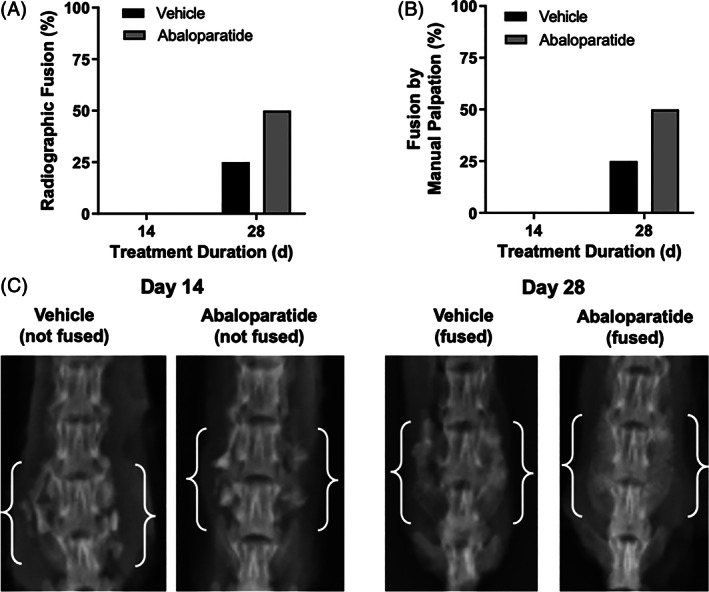
Results: Abaloparatide-treated rats showed higher bone formation (serum osteocalcin) at day 14 and 28 compared with vehicle controls, without increases in the bone resorption marker serum TRACP-5b. Micro-CT showed greater trabecular number in fusion masses from the abaloparatide group vs vehicle controls at day 14. Manual palpation and radiography indicated no fusions in either group at day 14, whereas 25% of vehicle-treated rats and 50% of abaloparatide-treated rats had bilateral fusion at day 28.
Discussion and conclusion: In summary, this rat PLF model showed that abaloparatide treatment was associated with higher levels of the bone formation marker osteocalcin, improved fusion mass architecture, and a non- significant 2-fold higher fusion rate compared with vehicle.
Keywords: arthrodesis; bone formation; bone‐forming agent; fusion mass; spine surgery.
© 2020 The Authors. JOR Spine published by Wiley Periodicals LLC on behalf of Orthopaedic Research Society.
Conflict of interest statement
Heike Arlt, Tatiana Besschetnova, Michael S. Ominsky, and Beate Lanske are current or former employees of Radius Health and may own shares or stock options in Radius Health. The University of Iowa received financial support from Radius Health for DCF to conduct the animal study.
Figures


References
-
- Rajaee SS, Bae HW, Kanim LE, et al. Spinal fusion in the United States: analysis of trends from 1998 to 2008. Spine (Phila pa 1976). 2012;37:67‐76. - PubMed
-
- Boden SD, Schimandle JH, Hutton WC. An experimental lumbar intertransverse process spinal fusion model. Radiographic, histologic, and biomechanical healing characteristics. Spine (Phila pa 1976). 1995;20:412‐420. - PubMed
-
- Lawrence JP, Ennis F, White AP, et al. Effect of daily parathyroid hormone (1‐34) on lumbar fusion in a rat model. Spine J. 2006;6:385‐390. - PubMed
-
- O'Loughlin PF, Cunningham ME, Bukata SV, et al. Parathyroid hormone (1‐34) augments spinal fusion, fusion mass volume, and fusion mass quality in a rabbit spinal fusion model. Spine (Phila pa 1976). 2009;34:121‐130. - PubMed
-
- Kaiser MG, Groff MW, Watters WC 3rd, et al. Guideline update for the performance of fusion procedures for degenerative disease of the lumbar spine. Part 16: bone graft extenders and substitutes as an adjunct for lumbar fusion. J Neurosurg Spine. 2014;21:106‐132. - PubMed
LinkOut - more resources
Full Text Sources
Other Literature Sources
Research Materials
