Review
. 2021 Jun:10:100140.
doi: 10.1016/j.mtadv.2021.100140. Epub 2021 Mar 20.

Toward the prevention of coronavirus infection: what role can polymers play?

Affiliations
Review

Toward the prevention of coronavirus infection: what role can polymers play?

X Jiang et al. Mater Today Adv. 2021 Jun.

Abstract

Severe acute respiratory syndrome-associated coronavirus 2 has caused a global public health crisis with high rates of infection and mortality. Treatment and prevention approaches include vaccine development, the design of small-molecule antiviral drugs, and macromolecular neutralizing antibodies. Polymers have been designed for effective virus inhibition and as antiviral drug delivery carriers. This review summarizes recent progress and provides a perspective on polymer-based approaches for the treatment and prevention of coronavirus infection. These polymer-based partners include polyanion/polycations, dendritic polymers, macromolecular prodrugs, and polymeric drug delivery systems that have the potential to significantly improve the efficacy of antiviral therapeutics.

Keywords: Antiviral; Biomaterials; Drug delivery; Polyanion; Polycation.


Conflict of interest statement

The authors declare that they have no known competing financial interests or personal relationships that could have appeared to influence the work reported in this paper.

Figures
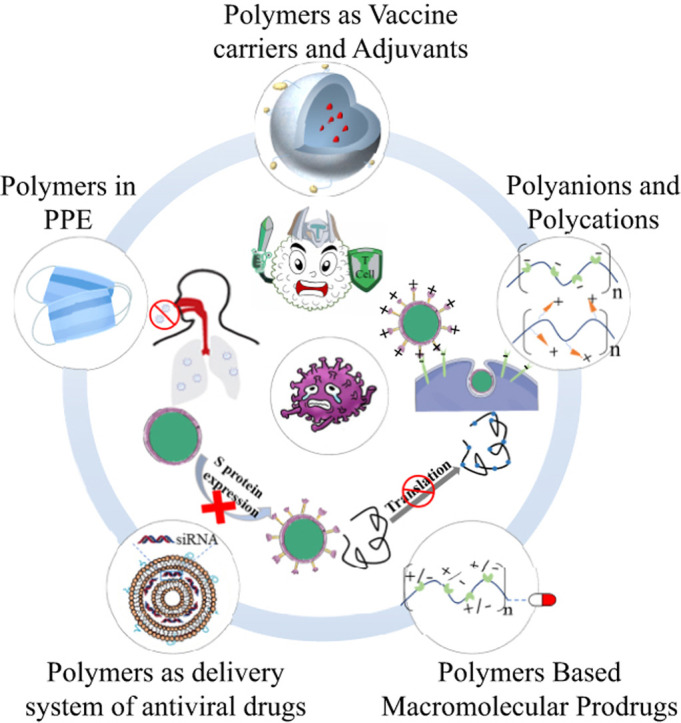
Image 1
Graphical abstract
Fig. 1
Fig. 1
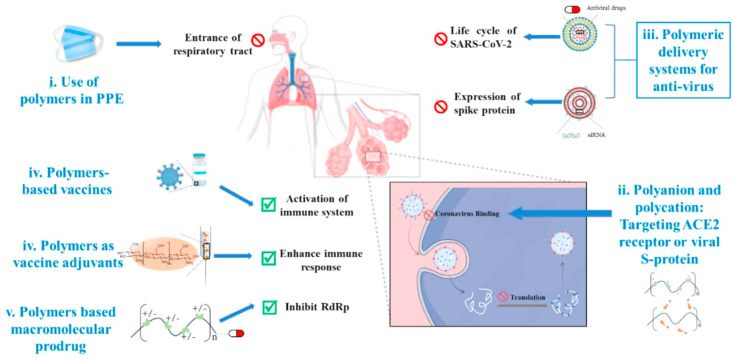
Polymeric approaches for the prevention or treatment of coronavirus. (i) Integrating functional polymers into personal protective equipment (PPE) can prevent the entrance of virus into the respiratory system. (ii) Cellular binding of viral particles at the alveoli can be inhibited using polyanion and polycation against viral S protein or angiotensin-converting enzyme 2 (ACE2) receptors. (iii) Polymers could also be used to deliver antivirus drugs. (iv) Polymers could also be useful when being covalently combined with small-molecule drugs to form macromolecular prodrugs. (v) Polymer-based vaccines or vaccine adjuvants can be used to prevent virus infection or even to boost the immune response during infection [25]. SARS-CoV-2, Severe acute respiratory syndrome–associated coronavirus 2.
Fig. 2
Fig. 2
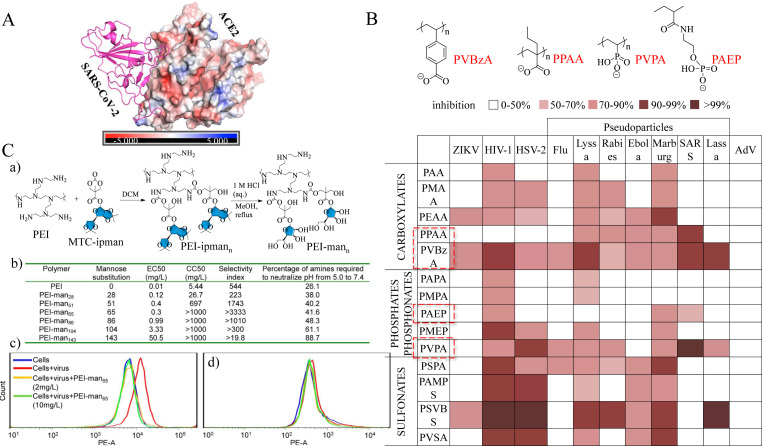
(A) Electrostatic potential maps (in kT/e) SARS-CoV-2 and ACE2 shown in a cartoon view [31]. (B) The structure of PVBzA, PPAA, PVPA, and PAEP and antiviral activities of 14 polyanions [34]. (C) Synthesis and characterization of PEI-mann [42]. (a) Synthetic scheme and chemical structure of mannose-functionalized carbonate-modified PEI polymers. (b) Antiviral activity (EC50), cytotoxicity (CC50), selectivity index (SI, CC50/EC50), and pH neutralization capacity of unmodified and mannose-functionalized PEI polymers. Prevention of DENV-2 infection in human primary peripheral blood mononuclear cells (PBMCs) (c) and macrophages (d) by PEI-man65. ACE2, angiotensin-converting enzyme 2; PEI, poly(ethylene imine); PPAA, poly(propylacrylic acid); PVPA, poly(vinylphosphonic acid); PVBzA, poly(vinylbenzoic acid); SARS-CoV-2, severe acute respiratory syndrome–associated coronavirus 2.
Fig. 3
Fig. 3
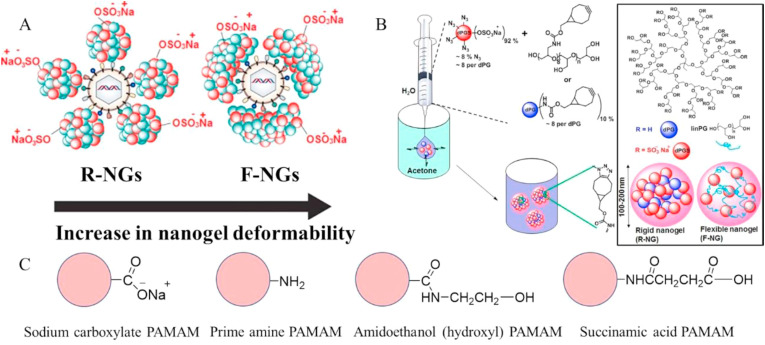
(A) Sulfide nanogels (simulating HS) to shield virus particles (rigid nanogel [R-NG] and flexible nanogel [F-NG]) [46]. (B) Schematic representation of flexible and rigid dPGS-based nanogels. Using linPG and dPG as cross-linkers, respectively, they were prepared by strain-promoted azide–alkyne ring addition reaction via reverse nanoprecipitation technique. The scheme shows the structure of dPG and the models of rigid and flexible nanogels [46]. (C) The terminal groups of the PAMAM dendrimers used were sodium carboxylate, primary amine, hydroxyl, and succinic acid. PAMAM, polyamidoamine [44].
Fig. 4
Fig. 4
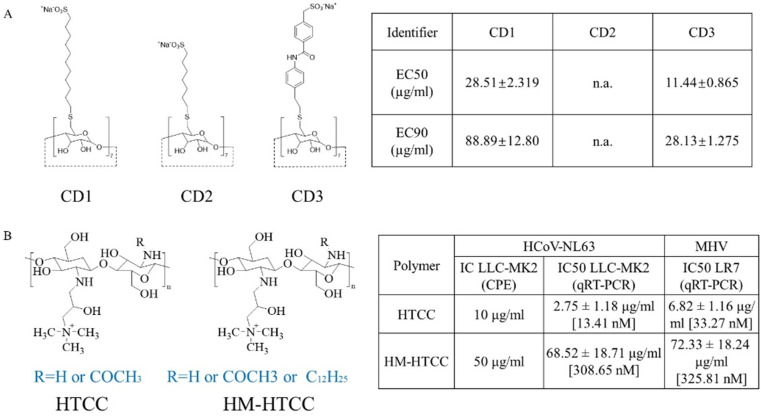
(A) Structures of modified CDs and relative effective concentrations of inhibition of HSV-2 growth [52]. (B) Structures of HTCC and HM-HTCC and inhibition of HCoV-NL63 and MHV replication in vitro [54]. CD, cyclodextrin; HSV, herpes simplex virus; HTCC, N-(2-hydroxypropyl)-3-trimethylammonium chitosan chloride; HCoV-NL63, human coronavirus strain; MHV, murine hepatitis virus.
Fig. 5
Fig. 5
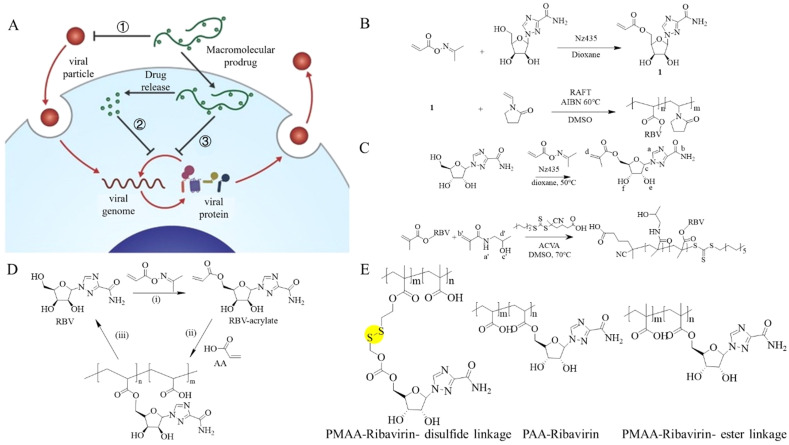
(A) Mechanism of macromolecular prodrugs inhibiting viruses [59]. (B) Ribavirin acrylate monomer is synthesized via a chemotaxis pathway (top). RAFT controlled the copolymerization of RBV acrylate with N-vinylpyrrolidone (NVP) to provide a macromolecular precursor for RBV (bottom). Phthalimidomethyl-O-ethyl xanthate was used as an RAFT agent [56]. (C) Synthesis of ribavirin (RBV( methacrylate and macromolecular prodrugs for RBV based on HPMA [57]. (D) Proposed synthesis of macromolecular prodrugs of RBV. The polymerizable acrylate of RBV was synthesized by a chemoenzymatic method using Nz435/CAL-B in dioxane (i) for RAFT polymerization and AA as a co-monomer to obtain a macromolecular precursor (ii). The synthesized polymer released the original RBV on hydrolysis (iii) [58]. (E) Structures of polyanionic macromolecular prodrugs of ribavirin based on these polymers, whereby RBV is conjugated to the polymer via an ester linkage or a disulfide linkage to achieve ultrafast intracellular drug release [59].
Fig. 6
Fig. 6
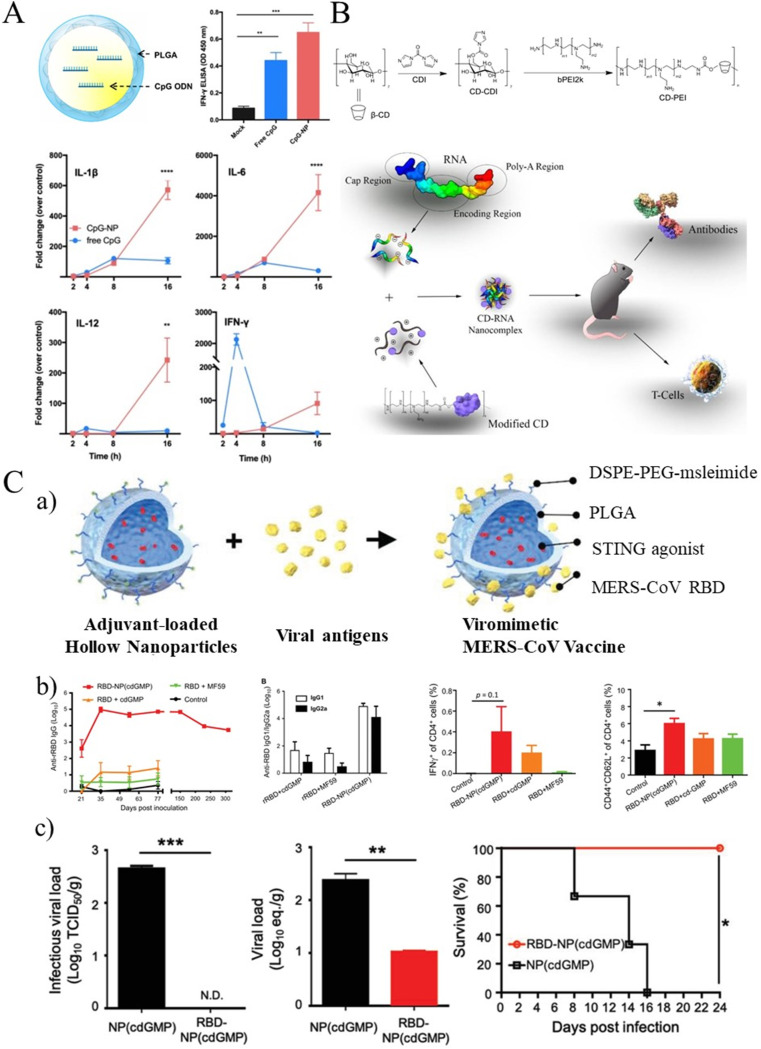
(A) Schematic illustration of a PLGA hollow nanoparticle encapsulating CpG (CpG-NP). And CpG (CpG-NP) showed results of more effective and long-lasting immune activation in chBMDCs [67]. (B) The synthetic route to CD-PEI conjugates and a CD-based mRNA vaccine platform [86,87]. (C, a) Preparation of viromimetic nanoparticle vaccine. Hollow PLGA nanoparticles with encapsulated adjuvant and surface maleimide linkers were prepared using a double emulsion technique. Recombinant viral antigens were then coupled to the surface of nanoparticles via thiol-maleimide bonds. Synthetic viral-like nanoparticles facilitate coordinated delivery of antigens and adjuvants in vitro and in vivo. (b) Viromimetic nanoparticle induces robust and long-lasting humoral and CD4+ T cell responses. (c) Viral-like nanoparticles vaccine grants protection against MERS-CoV infection in DPP4-transplanted mice [68].
Fig. 7
Fig. 7
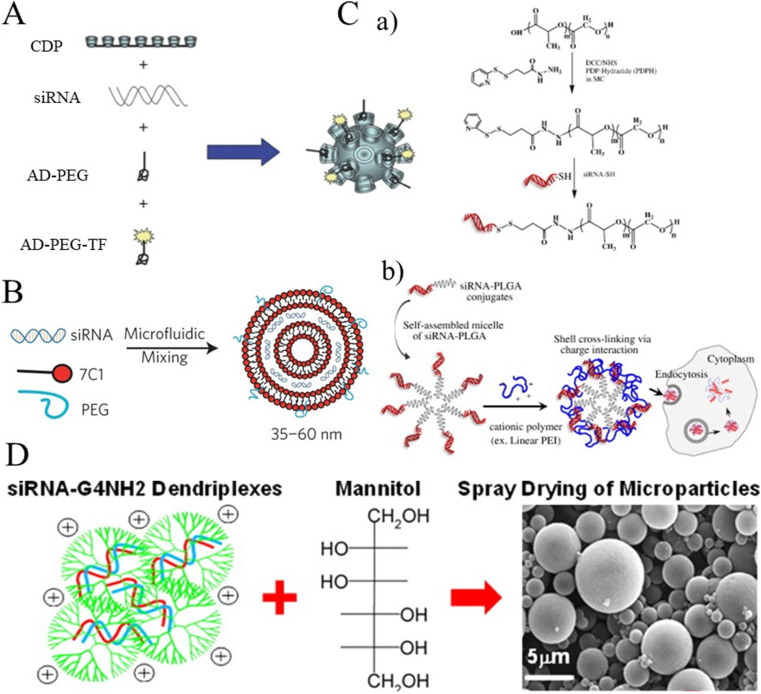
(A) Schematic diagram of the targeted nanoparticles. Polyethylene glycol (PEG) molecules were endowed with adamantane (AD) to form inclusion complexes with surface CDs, which decorated the nanoparticle surface with PEG for steric stabilization and PEG-TF for targeting [99]. (B) 7C1 Synthesis scheme.7C1 nanoparticles were mixed with C14PEG2000 and siRNA in a high-throughput microfluidic chamber [97]. (C, a) Synthesis program for siRNA-PLGA conjugates via cleavable disulfide linkers. (b) Schematic illustration of the preparation of surface crosslinked siRNA-PLGA–conjugated microbubbles with cationic LPEI and their efficient intracellular uptake by polyelectrolyte charge interaction [95]. (D) Preparation of mannitol microparticles loaded with dendriplexes [107].

References

    1. Wang Q.H., Zhang Y.F., Wu L.L., Niu S., Song C.L., Zhang Z.Y., Lu G.W., Qiao C.P., Hu Y., Yuen K.Y., Wang Q.S., Zhou H., Yan J.H., Qi J.X. Structural and functional basis of SARS-CoV-2 entry by using human ACE2. Cell. 2020;181(4) 894-+ - PMC - PubMed
    1. Totura A.L., Bavari S. Broad-spectrum coronavirus antiviral drug discovery. Expet Opin. Drug Discov. 2019;14(4):397–412. - PMC - PubMed
    1. Song W.F., Gui M., Wang X.Q., Xiang Y. Cryo-EM structure of the SARS coronavirus spike glycoprotein in complex with its host cell receptor ACE2. PLoS Pathog. 2018;14(8) - PMC - PubMed
    1. de Wit E., van Doremalen N., Falzarano D., Munster V.J. SARS and MERS: recent insights into emerging coronaviruses. Nat. Rev. Microbiol. 2016;14(8):523–534. - PMC - PubMed
    1. Chang L., Yan Y., Wang L.N. Coronavirus disease 2019: coronaviruses and blood safety. Transfus. Med. Rev. 2020;34(2):75–80. - PMC - PubMed

LinkOut - more resources