. 2020 May 29;2(3):e190076.
doi: 10.1148/rycan.2020190076. eCollection 2020 May.

High-Spatial-Resolution Multishot Multiplexed Sensitivity-encoding Diffusion-weighted Imaging for Improved Quality of Breast Images and Differentiation of Breast Lesions: A Feasibility Study

Affiliations

High-Spatial-Resolution Multishot Multiplexed Sensitivity-encoding Diffusion-weighted Imaging for Improved Quality of Breast Images and Differentiation of Breast Lesions: A Feasibility Study

Isaac Daimiel Naranjo et al. Radiol Imaging Cancer. .

Abstract

Multishot multiplexed sensitivity-encoding diffusion-weighted imaging is a feasible and easily implementable routine breast MRI protocol that yields high-quality diffusion-weighted breast images.Purpose: To compare multiplexed sensitivity-encoding (MUSE) diffusion-weighted imaging (DWI) and single-shot DWI for lesion visibility and differentiation of malignant and benign lesions within the breast.Materials and Methods: In this prospective institutional review board-approved study, both MUSE DWI and single-shot DWI sequences were first optimized in breast phantoms and then performed in a group of patients. Thirty women (mean age, 51.1 years ± 10.1 [standard deviation]; age range, 27-70 years) with 37 lesions were included in this study and underwent scanning using both techniques. Visual qualitative analysis of diffusion-weighted images was accomplished by two independent readers; images were assessed for lesion visibility, adequate fat suppression, and the presence of artifacts. Quantitative analysis was performed by calculating apparent diffusion coefficient (ADC) values and image quality parameters (signal-to-noise ratio [SNR] for lesions and fibroglandular tissue; contrast-to-noise ratio) by manually drawing regions of interest within the phantoms and breast tumor tissue. Interreader variability was determined using the Cohen κ coefficient, and quantitative differences between MUSE DWI and single-shot DWI were assessed using the Mann-Whitney U test; significance was defined at P < .05.Results: MUSE DWI yielded significantly improved image quality compared with single-shot DWI in phantoms (SNR, P = .001) and participants (lesion SNR, P = .009; fibroglandular tissue SNR, P = .05; contrast-to-noise ratio, P = .008). MUSE DWI ADC values showed a significant difference between malignant and benign lesions (P < .001). No significant differences were found between MUSE DWI and single-shot DWI in the mean, maximum, and minimum ADC values (P = .96, P = .28, and P = .49, respectively). Visual qualitative analysis resulted in better lesion visibility for MUSE DWI over single-shot DWI (κ = 0.70).Conclusion: MUSE DWI is a promising high-spatial-resolution technique that may enhance breast MRI protocols without the need for contrast material administration in breast screening.Keywords: Breast, MR-Diffusion Weighted Imaging, OncologySupplemental material is available for this article.© RSNA, 2020.


Conflict of interest statement

Disclosures of Conflicts of Interest: I.D.N. disclosed no relevant relationships. R.L.G. disclosed no relevant relationships. E.A.M. disclosed no relevant relationships. T.L. disclosed no relevant relationships. M.M.F. Activities related to the present article: disclosed no relevant relationships. Activities not related to the present article: is and employee of and holds stock in GE Healthcare. Other relationships: disclosed no relevant relationships. A.G. Activities related to the present article: disclosed no relevant relationships. Activities not related to the present article: is an employee of GE Healthcare. Other relationships: disclosed no relevant relationships. K.P. editorial board member for Radiology: Imaging Cancer. S.B.T. disclosed no relevant relationships.

Figures
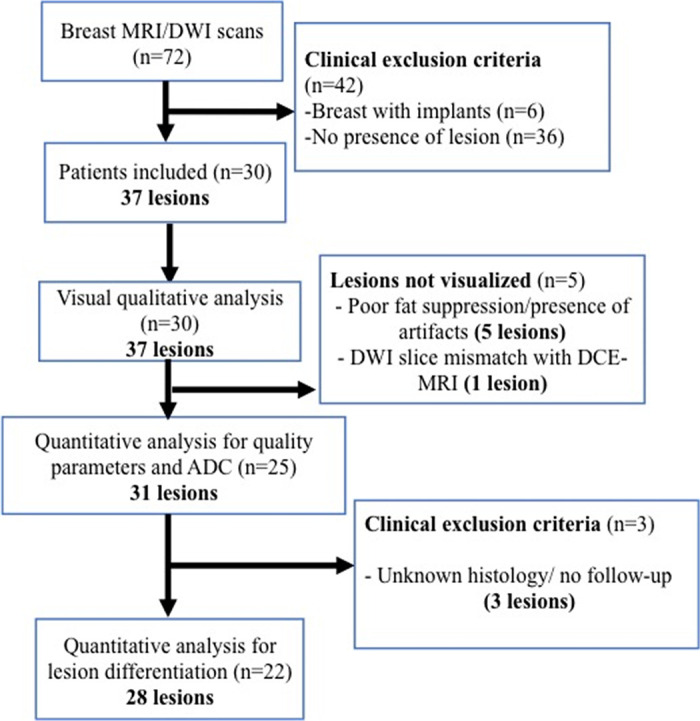
Flowchart for patient selection. ADC = apparent diffusion coefficient, DCE-MRI = dynamic contrast-enhanced MRI, DWI = diffusion-weighted image, n = number of patients.
Figure 1:
Flowchart for patient selection. ADC = apparent diffusion coefficient, DCE-MRI = dynamic contrast-enhanced MRI, DWI = diffusion-weighted image, n = number of patients.
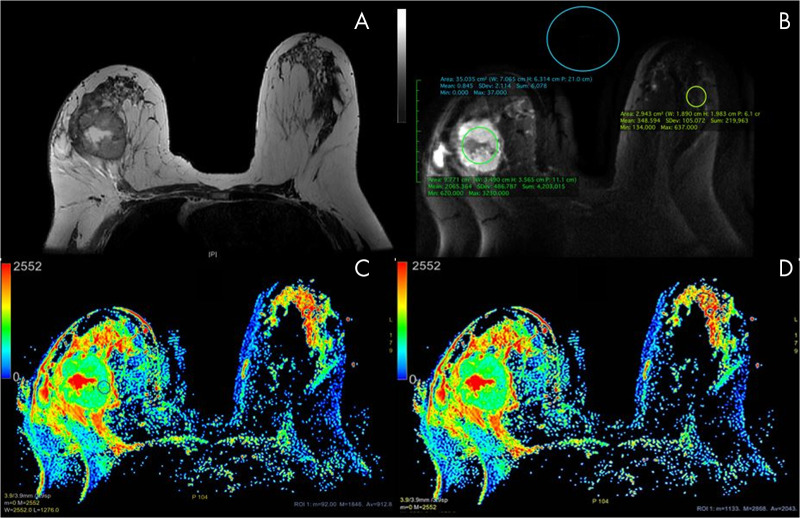
Axial images in a 59-year-old woman with a 50-mm invasive ductal carcinoma in the right breast. A, T2-weighted image without fat saturation shows a necrotic mass in the right breast and a normal contralateral breast. B, Multiplexed sensitivity-encoding (MUSE) diffusion-weighted image (b value, 800 sec/mm2) in the same slice as A depicting region of interest (ROI) positioning for quality parameters. C, D, Apparent diffusion coefficient (ADC) color maps derived from multishot MUSE diffusion-weighted imaging shows ROI placement. Note the ROI placement within the “darkest” part of the solid component of this necrotic mass in, C. The ROI of the healthy fibroglandular tissue is delineated in, D. The color bar in, C, and, D, indicates the ADC value range in × 10−6 mm2/sec. ADC values obtained from the ROI in, B: mean, 912.8 × 10⁻⁶ mm2/sec; minimum, 92 × 10−6 mm2/sec; maximum, 1846 × 10−6 mm2/sec; ROI area, 59.37 mm2. The ROI values in, C: mean, 2043 × 10−6 mm2/sec; minimum, 1133 × 10−6 mm2/sec; maximum, 2868 × 10−6 mm2/sec; ROI area, 52.5 mm2.
Figure 2:
Axial images in a 59-year-old woman with a 50-mm invasive ductal carcinoma in the right breast. A, T2-weighted image without fat saturation shows a necrotic mass in the right breast and a normal contralateral breast. B, Multiplexed sensitivity-encoding (MUSE) diffusion-weighted image (b value, 800 sec/mm2) in the same slice as A depicting region of interest (ROI) positioning for quality parameters. C, D, Apparent diffusion coefficient (ADC) color maps derived from multishot MUSE diffusion-weighted imaging shows ROI placement. Note the ROI placement within the “darkest” part of the solid component of this necrotic mass in, C. The ROI of the healthy fibroglandular tissue is delineated in, D. The color bar in, C, and, D, indicates the ADC value range in × 10−6 mm2/sec. ADC values obtained from the ROI in, B: mean, 912.8 × 10⁻⁶ mm2/sec; minimum, 92 × 10−6 mm2/sec; maximum, 1846 × 10−6 mm2/sec; ROI area, 59.37 mm2. The ROI values in, C: mean, 2043 × 10−6 mm2/sec; minimum, 1133 × 10−6 mm2/sec; maximum, 2868 × 10−6 mm2/sec; ROI area, 52.5 mm2.
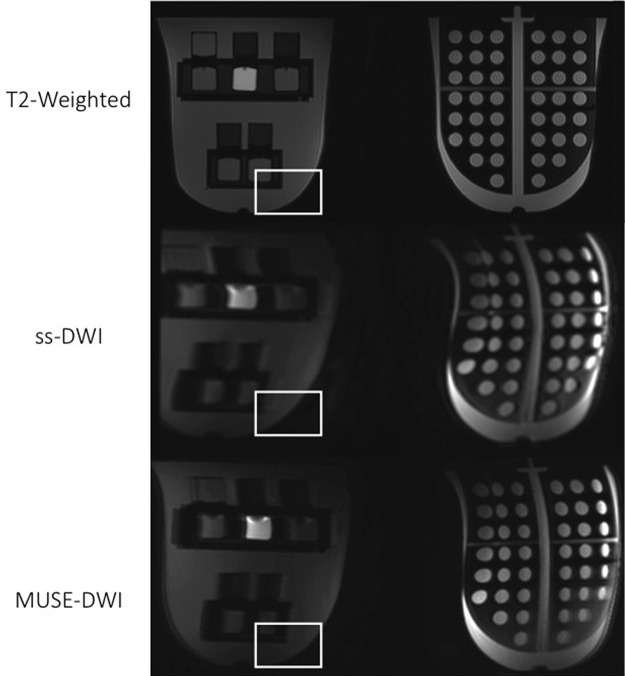
Axial images from phantom testing. T2-weighted image (top panel), single-shot diffusion-weighted image (ss-DWI) (middle panel), and high-spatial-resolution multiplexed sensitivity-encoding diffusion weighted image (MUSE-DWI) with protocol D (bottom panel) are shown. The region of interest is placed to show the presence of geometric distortion artifact on diffusion-weighted images, which is partially corrected with MUSE DWI.
Figure 3:
Axial images from phantom testing. T2-weighted image (top panel), single-shot diffusion-weighted image (ss-DWI) (middle panel), and high-spatial-resolution multiplexed sensitivity-encoding diffusion weighted image (MUSE-DWI) with protocol D (bottom panel) are shown. The region of interest is placed to show the presence of geometric distortion artifact on diffusion-weighted images, which is partially corrected with MUSE DWI.
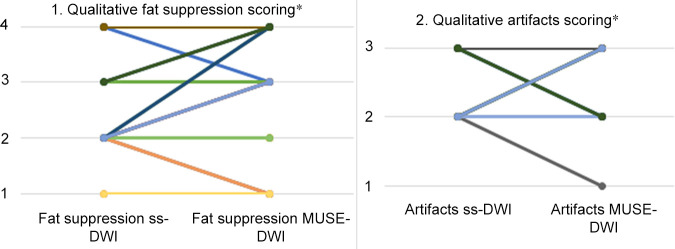
Plot 1 shows the improvement in fat suppression for multishot multiplexed sensitivity-encoding diffusion-weighted imaging (MUSE-DWI) compared with single-shot DWI (ss-DWI) in 37 patients for reader 1. The numbers on the y-axis represent categories as follows: 1, failure in suppression; 2, regional fat-water failures but still interpretable; 3, minimal failures in image periphery; 4, perfect fat-water separation. In nine cases, MUSE DWI improved fat suppression; MUSE DWI performed worse than single-shot DWI in only three cases. This represents a 21% increase in fat suppression quality. Similar findings were found with reader 2. Plot 2 shows an improvement of 5% in image artifacts for MUSE DWI compared with single-shot DWI in 37 patients for reader 1. The numbers in the y-axis represent categories as follows: 1, nondiagnostic; 2, artifacts but diagnostic; 3, no artifacts. In six cases, MUSE DWI presented fewer artifacts. Reader 2 did not find an improvement compared with reader 1. * = numbers shown of a total of 37 breast lesions assessed.
Figure 4:
Plot 1 shows the improvement in fat suppression for multishot multiplexed sensitivity-encoding diffusion-weighted imaging (MUSE-DWI) compared with single-shot DWI (ss-DWI) in 37 patients for reader 1. The numbers on the y-axis represent categories as follows: 1, failure in suppression; 2, regional fat-water failures but still interpretable; 3, minimal failures in image periphery; 4, perfect fat-water separation. In nine cases, MUSE DWI improved fat suppression; MUSE DWI performed worse than single-shot DWI in only three cases. This represents a 21% increase in fat suppression quality. Similar findings were found with reader 2. Plot 2 shows an improvement of 5% in image artifacts for MUSE DWI compared with single-shot DWI in 37 patients for reader 1. The numbers in the y-axis represent categories as follows: 1, nondiagnostic; 2, artifacts but diagnostic; 3, no artifacts. In six cases, MUSE DWI presented fewer artifacts. Reader 2 did not find an improvement compared with reader 1. * = numbers shown of a total of 37 breast lesions assessed.
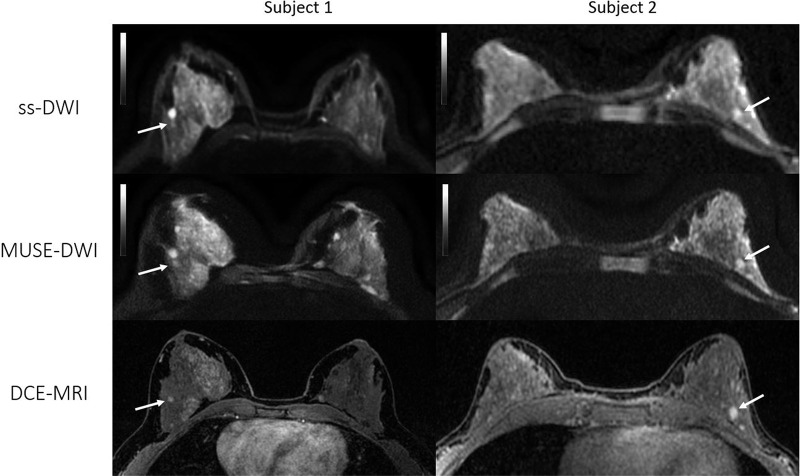
Axial images from two patients with benign lesions. Left: Patient 1, a 43-year-old woman with a 5-mm enhancing focus in the outer right breast in which stability was verified after 2-year follow-up (arrow). Right: Patient 2, a 47-year-old woman with an enhancing 7-mm nodule in the lower inner left quadrant (arrow). Biopsy results revealed fibroadenoma. Multiplexed sensitivity-encoding diffusion-weighted imaging (MUSE-DWI) yielded a sharper delineation of the breast parenchyma, and lesion contours appear to be more defined than in single-shot DWI (b value, 800 sec/mm2) (ss-DWI). These two examples were categorized as 1 (better overall image quality with MUSE DWI than with single-shot DWI) by both readers. DCE-MRI = dynamic contrast-enhanced MRI.
Figure 5:
Axial images from two patients with benign lesions. Left: Patient 1, a 43-year-old woman with a 5-mm enhancing focus in the outer right breast in which stability was verified after 2-year follow-up (arrow). Right: Patient 2, a 47-year-old woman with an enhancing 7-mm nodule in the lower inner left quadrant (arrow). Biopsy results revealed fibroadenoma. Multiplexed sensitivity-encoding diffusion-weighted imaging (MUSE-DWI) yielded a sharper delineation of the breast parenchyma, and lesion contours appear to be more defined than in single-shot DWI (b value, 800 sec/mm2) (ss-DWI). These two examples were categorized as 1 (better overall image quality with MUSE DWI than with single-shot DWI) by both readers. DCE-MRI = dynamic contrast-enhanced MRI.
Axial images from two patients with biopsy-proven invasive ductal carcinoma. Left: Patient 1, a 36-year-old woman with a 9-mm mass in the upper outer quadrant of the right breast (arrow). Right: Patient 2, a 57-year-old woman with a 36-mm necrotic mass in the right upper breast (arrow). Both readers assigned category 1 (better overall image quality with multishot multiplexed sensitivity-encoding diffusion-weighted imaging [MUSE-DWI] than with single-shot DWI [ss-DWI]) for overall image quality since MUSE DWI (b value, 800 sec/mm2) showed better lesion delineation compared with single-shot DWI (b value, 800 sec/mm2). Note also that artifact seen with single-shot DWI is partially corrected at MUSE DWI in patient 1.
Figure 6:
Axial images from two patients with biopsy-proven invasive ductal carcinoma. Left: Patient 1, a 36-year-old woman with a 9-mm mass in the upper outer quadrant of the right breast (arrow). Right: Patient 2, a 57-year-old woman with a 36-mm necrotic mass in the right upper breast (arrow). Both readers assigned category 1 (better overall image quality with multishot multiplexed sensitivity-encoding diffusion-weighted imaging [MUSE-DWI] than with single-shot DWI [ss-DWI]) for overall image quality since MUSE DWI (b value, 800 sec/mm2) showed better lesion delineation compared with single-shot DWI (b value, 800 sec/mm2). Note also that artifact seen with single-shot DWI is partially corrected at MUSE DWI in patient 1.
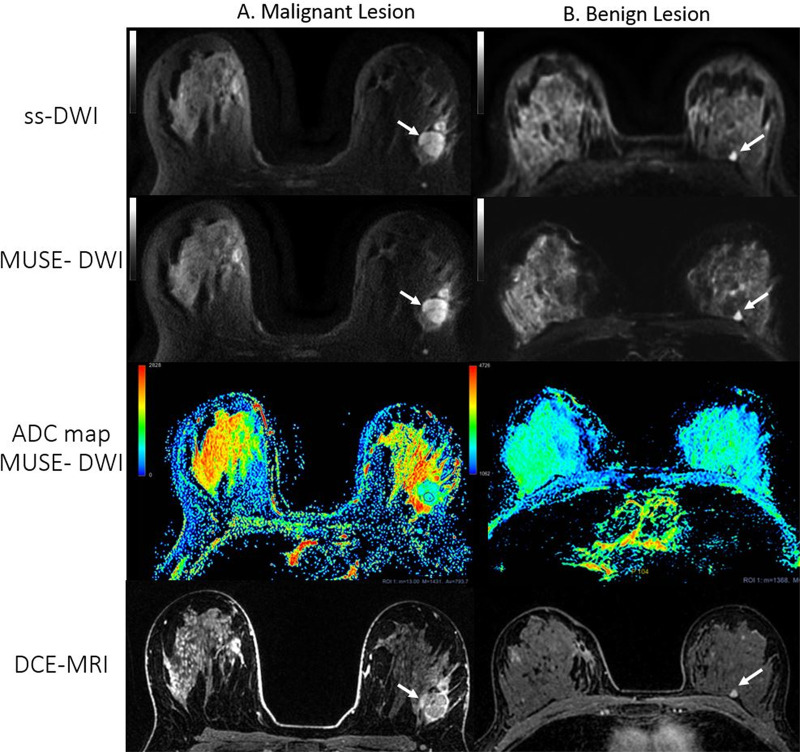
Axial single-shot diffusion-weighted images (ss-DWI), images from multiplexed sensitivity-encoding DWI (MUSE-DWI), apparent diffusion coefficient (ADC) maps, and dynamic contrast-enhanced MRI (DCE-MRI) images from two patients with lesions (white arrows). A, Images in a 27-year-old woman with a 25-mm irregular heterogeneously enhancing mass in the left breast. A satellite nodule is evident anterior to the main lesion. At biopsy, the lesion was identified as invasive ductal carcinoma. Readers considered the overall image quality for this case to be worse (category 3) with MUSE DWI than with single-shot DWI. B, A 55-year-old woman with a history of right breast cancer after right lumpectomy. A 6-mm enhancing lesion is seen in the posterior third of the left breast (arrow), which was unchanged for the previous 2 years. Both readers scored a better overall image quality (category 1) with MUSE DWI for this case. ADC values are measured in × 10−6 mm2/sec for both images. ADC values obtained from the region of interest (ROI) in, A: mean, 793.7 × 10⁻⁶ mm2/sec; minimum, 13 × 10–6 mm2/sec; maximum, 1431 × 10–6 mm2/sec; region of interest area, 57.4 mm2. ADC values obtained from the ROI in, B: mean, 2200 × 10–6 mm2/sec; minimum, 1368 × 10−6 mm2/sec; maximum, 2928 × 10−6 mm2/sec; region of interest area, 41.2 mm2. Blue indicates lower ADC value, red indicates higher ADC value. Note that the minimum ADC threshold value in the color bar for lesion A is 0,whereas in the color bar for lesion B it is 1062 to enhance visibility of this benign lesion.
Figure 7:
Axial single-shot diffusion-weighted images (ss-DWI), images from multiplexed sensitivity-encoding DWI (MUSE-DWI), apparent diffusion coefficient (ADC) maps, and dynamic contrast-enhanced MRI (DCE-MRI) images from two patients with lesions (white arrows). A, Images in a 27-year-old woman with a 25-mm irregular heterogeneously enhancing mass in the left breast. A satellite nodule is evident anterior to the main lesion. At biopsy, the lesion was identified as invasive ductal carcinoma. Readers considered the overall image quality for this case to be worse (category 3) with MUSE DWI than with single-shot DWI. B, A 55-year-old woman with a history of right breast cancer after right lumpectomy. A 6-mm enhancing lesion is seen in the posterior third of the left breast (arrow), which was unchanged for the previous 2 years. Both readers scored a better overall image quality (category 1) with MUSE DWI for this case. ADC values are measured in × 10−6 mm2/sec for both images. ADC values obtained from the region of interest (ROI) in, A: mean, 793.7 × 10⁻⁶ mm2/sec; minimum, 13 × 10–6 mm2/sec; maximum, 1431 × 10–6 mm2/sec; region of interest area, 57.4 mm2. ADC values obtained from the ROI in, B: mean, 2200 × 10–6 mm2/sec; minimum, 1368 × 10−6 mm2/sec; maximum, 2928 × 10−6 mm2/sec; region of interest area, 41.2 mm2. Blue indicates lower ADC value, red indicates higher ADC value. Note that the minimum ADC threshold value in the color bar for lesion A is 0,whereas in the color bar for lesion B it is 1062 to enhance visibility of this benign lesion.

References

    1. Partridge SC, Nissan N, Rahbar H, Kitsch AE, Sigmund EE. Diffusion-weighted breast MRI: clinical applications and emerging techniques. J Magn Reson Imaging 2017;45(2):337–355. - PMC - PubMed
    1. Jezzard P, Balaban RS. Correction for geometric distortion in echo planar images from B0 field variations. Magn Reson Med 1995;34(1):65–73. - PubMed
    1. Wu W, Miller KL. Image formation in diffusion MRI: a review of recent technical developments. J Magn Reson Imaging 2017;46(3):646–662. - PMC - PubMed
    1. van Pul C, Roos FG, Derksen OS, et al. A comparison study of multishot vs. single-shot DWI-EPI in the neonatal brain: reduced effects of ghosting compared to adults. Magn Reson Imaging 2004;22(9):1169–1180. - PubMed

    1. Madore B, Chiou JY, Chu R, Chao TC, Maier SE. Accelerated multi-shot diffusion imaging. Magn Reson Med 2014;72(2):324–336. - PMC - PubMed