


Trends in "Deaths of Despair" Among Working-Aged White and Black Americans, 1990-2017
- PMID: 33778856
- PMCID: PMC8579049
- DOI: 10.1093/aje/kwab088
Trends in "Deaths of Despair" Among Working-Aged White and Black Americans, 1990-2017
Abstract
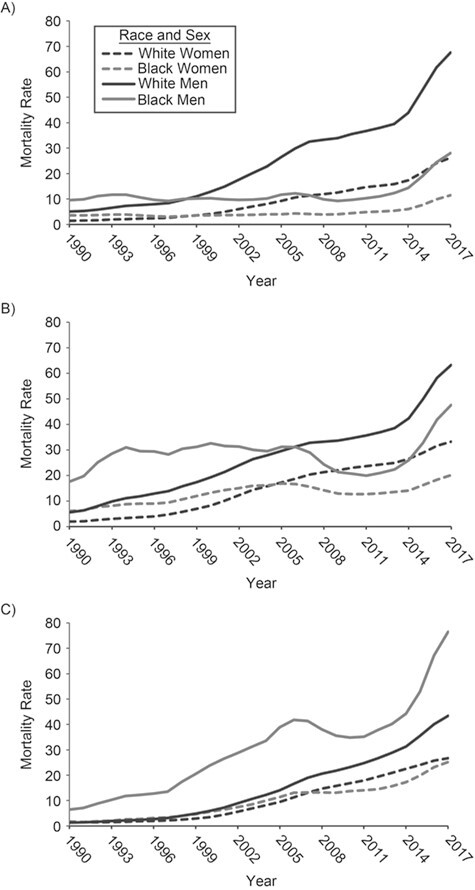
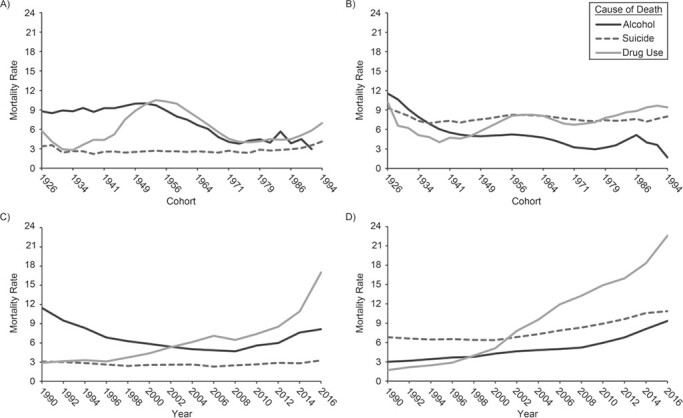
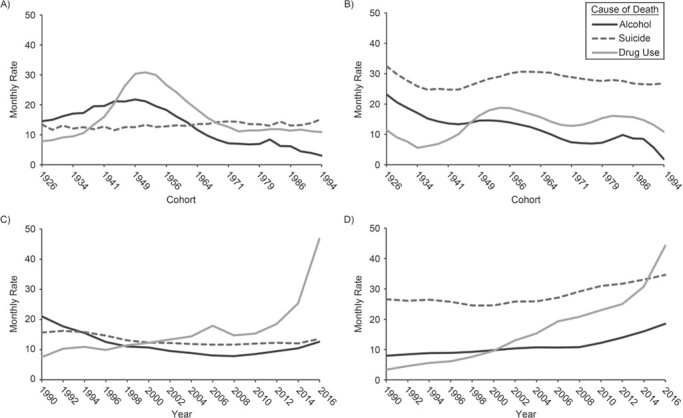
Life expectancy for US White men and women declined between 2013 and 2017. Initial explanations for the decline focused on increases in "deaths of despair" (i.e., deaths from suicide, drug use, and alcohol use), which have been interpreted as a cohort-based phenomenon afflicting middle-aged White Americans. There has been less attention on Black mortality trends from these same causes, and whether the trends are similar or different by cohort and period. We complement existing research and contend that recent mortality trends in both the US Black and White populations most likely reflect period-based exposures to 1) the US opioid epidemic and 2) the Great Recession. We analyzed cause-specific mortality trends in the United States for deaths from suicide, drug use, and alcohol use among non-Hispanic Black and non-Hispanic White Americans, aged 20-64 years, over 1990-2017. We employed sex-, race-, and cause-of-death-stratified Poisson rate models and age-period-cohort models to compare mortality trends. Results indicate that rising "deaths of despair" for both Black and White Americans are overwhelmingly driven by period-based increases in drug-related deaths since the late 1990s. Further, deaths related to alcohol use and suicide among both White and Black Americans changed during the Great Recession, despite some racial differences across cohorts.
Keywords: United States; age-period-cohort models; deaths of despair; midlife mortality; mortality trends; opioid; racial/ethnic trends.
© The Author(s) 2021. Published by Oxford University Press on behalf of the Johns Hopkins Bloomberg School of Public Health. All rights reserved. For permissions, please e-mail: journals.permissions@oup.com.
Figures
Comment in
-
RE: "TRENDS IN 'DEATHS OF DESPAIR' AMONG WORKING-AGED WHITE AND BLACK AMERICANS, 1990-2017".Am J Epidemiol. 2022 Jan 24;191(2):363-365. doi: 10.1093/aje/kwab256. Am J Epidemiol. 2022. PMID: 34664613 Free PMC article. No abstract available.
-
AN AUTHOR REPLIES.Am J Epidemiol. 2022 Jan 24;191(2):363-365. doi: 10.1093/aje/kwab257. Am J Epidemiol. 2022. PMID: 34664617 Free PMC article. No abstract available.
References
-
- Murphy SL, Xu JQ, Kochanek KD, et al. Mortality in the United States, 2017. Hyattsville, MD: National Center for Health Statistics. 2018. (NCHS Data Brief, no. 328.) https://www.cdc.gov/nchs/data/databriefs/db328-h.pdf. Accessed February 1, 2020.
-
- Xu J, Murphy SL, Kochanek KD, et al. Mortality in the United States, 2015. Hyattsville, MD: National Center for Health Statistics. 2016. (NCHS Data Brief, no. 267.) https://www.cdc.gov/nchs/data/databriefs/db267.pdf. Accessed February 1, 2020.
-
- Hedegaard H, Curtin SC, Warner M. Suicide rates in the United States continue to increase. Hyattsville, MD: National Center for Health Statistics. 2018. (NCHS Data Brief, no. 309). https://www.cdc.gov/nchs/data/databriefs/db309.pdf. Accessed February 1, 2020. - PubMed
-
- Hedegaard H, Miniño AM, Warner M. Drug overdose deaths in the United States, 1999–2017. Hyattsville, MD: National Center for Health Statistics. 2018. (NCHS Data Brief, no. 329). https://www.cdc.gov/nchs/data/databriefs/db329-h.pdf. Accessed February 1, 2020. - PubMed
Publication types
MeSH terms
Grants and funding
LinkOut - more resources
Full Text Sources
Other Literature Sources
