


Does Medicaid coverage of Medicare cost sharing affect physician care for dual-eligible Medicare beneficiaries?
- PMID: 33778957
- PMCID: PMC8143678
- DOI: 10.1111/1475-6773.13650
Does Medicaid coverage of Medicare cost sharing affect physician care for dual-eligible Medicare beneficiaries?
Abstract
Objective: To assess changes in physicians' provision of care to duals (low-income individuals with Medicare and Medicaid) in response to a policy that required Medicaid to fully pay Medicare's cost sharing for office visits with these patients. This policy-a provision of the Affordable Care Act-effectively increased payments for office visits with duals by 0%-20%, depending on the state, in 2013 and 2014.
Data sources: Fee-for-service claims for a 5% random sample of Medicare beneficiaries in 2010-2016.
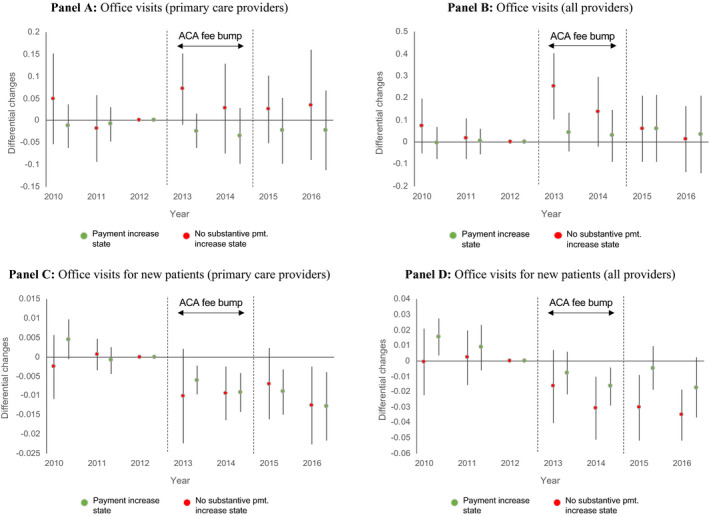
Study design: We conducted a difference-in-differences analysis to compare changes in office visits among Qualified Medicare Beneficiaries (QMBs)-the largest subpopulation of duals for whom payment rates were affected by this policy-to changes among other low-income Medicare beneficiaries for whom payment rates were unaffected (pooled across all states). Next, we conducted a triple-differences analysis that compared changes between QMBs and other low-income beneficiaries in 33 states with payment rate increases of approximately 20% to analogous changes in 14 states without payment increases.
Data collection: The study included administrative Medicare enrollment and claims data for QMBs and a comparison group of other low-income Medicare beneficiaries (1 914 073 beneficiary-years from 2010 to 2016).
Principal findings: Nationally, we did not find a differential increase in office visits among QMBs versus other low-income beneficiaries that coincided with this payment change. In the triple-differences analysis, we did not observe a greater increase in visits among QMBs vs other low-income beneficiaries in states where the policy resulted in large (approximately 20%) increases in payment rates vs states where payment rates were unaffected (triple-differences estimate: -0.12 annual visits, 95% CI: -0.28, 0.04; P = 0.15).
Conclusions: Physicians' provision of care to low-income Medicare beneficiaries may not be responsive to short-run payment changes.
Keywords: Affordable Care Act; dual eligibles; physician incentives.
© 2021 Health Research and Educational Trust.
Figures
References
-
- MedPAC . Data Book: Beneficiaries Dually Eligible for Medicare and Medicaid. Washington, DC: Medicare Payment Advisory Commission and Medicaid and CHIP Payment and Access Commission; 2018. https://www.macpac.gov/publication/data‐book‐beneficiaries‐dually‐eligib...
-
- MedPAC . Medicaid Coverage of Premiums and Cost Sharing for Low‐Income Medicare Beneficiaries. In: Commission MaCPA , ed. Report to Congress on Medicaid and CHIP; 2013:128‐148.
-
- MedPAC . Data Book: Beneficiaries Dually Eligible for Medicare and Medicaid. Washington, DC: Medicare Payment Advisory Commission and Medicaid and CHIP Payment and Access Commission; 2018:7‐10. https://www.macpac.gov/publication/data‐book‐beneficiaries‐dually‐eligib...
Publication types
MeSH terms
Grants and funding
LinkOut - more resources
Full Text Sources
Other Literature Sources
Medical
