


Assessment of Diagnosis and Triage in Validated Case Vignettes Among Nonphysicians Before and After Internet Search
- PMID: 33779741
- PMCID: PMC8008286
- DOI: 10.1001/jamanetworkopen.2021.3287
Assessment of Diagnosis and Triage in Validated Case Vignettes Among Nonphysicians Before and After Internet Search
Abstract
Importance: When confronted with new medical symptoms, many people turn to the internet to understand why they are ill as well as whether and where they should get care. Such searches may be harmful because they may facilitate misdiagnosis and inappropriate triage.
Objective: To empirically measure the association of an internet search for health information with diagnosis, triage, and anxiety by laypeople.
Design, setting, and participants: This survey study used a nationally representative sample of US adults who were recruited through an online platform between April 1, 2019, and April 15, 2019. A total of 48 validated case vignettes of both common (eg, viral illness) and severe (eg, heart attack) conditions were used. Participants were asked to relay their diagnosis, triage, and anxiety regarding 1 of these cases before and after searching the internet for health information.
Exposures: Short, validated case vignettes written at or below the sixth-grade reading level randomly assigned to participants.
Main outcomes and measures: Correct diagnosis, correct triage, and flipping (changing) or anchoring (not changing) diagnosis and triage decisions were the main outcomes. Multivariable modeling was performed to identify patient factors associated with correct triage and diagnosis.
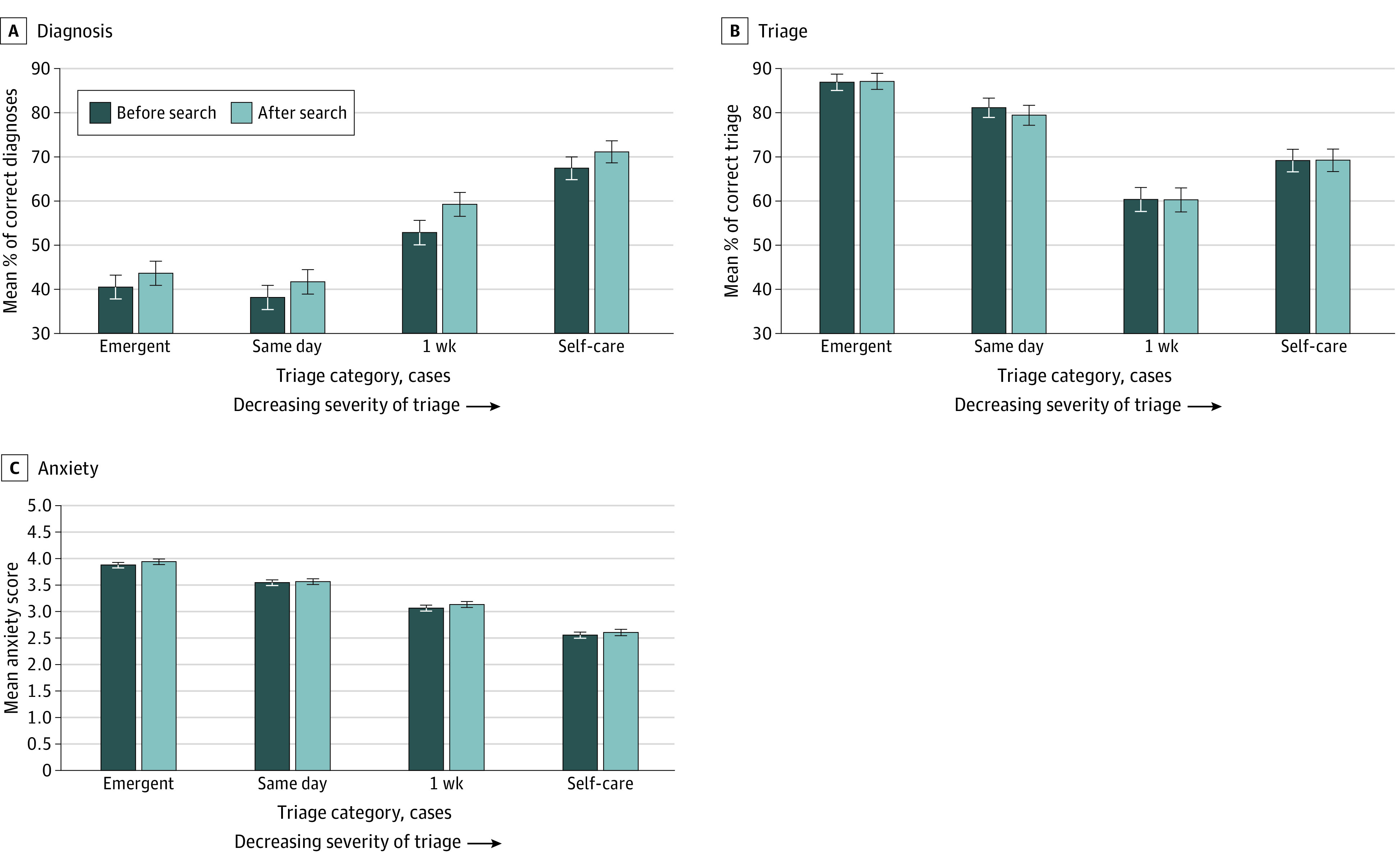
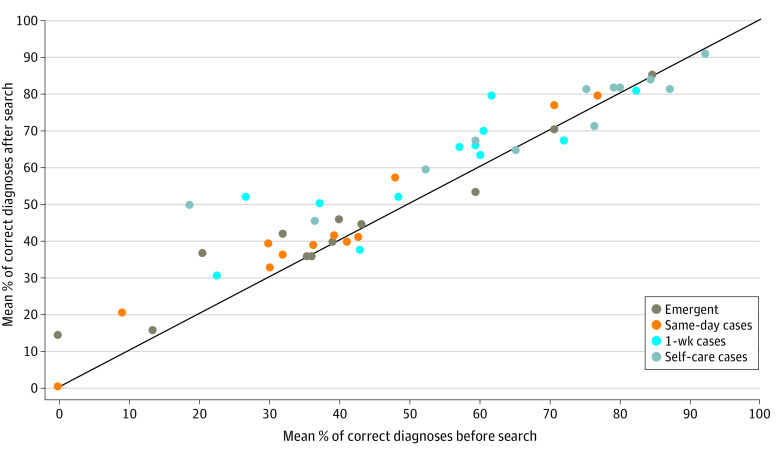
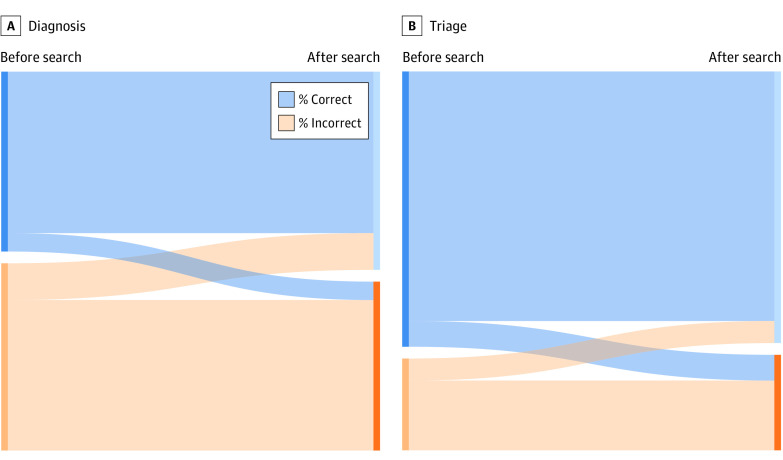
Results: Of the 5000 participants, 2549 were female (51.0%), 3819 were White (76.4%), and the mean (SD) age was 45.0 (16.9) years. Mean internet search time was 12.1 (95% CI, 10.7-13.5) minutes per case. No difference in triage accuracy was found before and after search (74.5% vs 74.1%; difference, -0.4 [95% CI, -1.4 to 0.6]; P = .06), but improved diagnostic accuracy was found (49.8% vs 54.0%; difference, 4.2% [95% CI, 3.1%-5.3%]; P < .001). Most participants (4254 [85.1%]) were anchored on their diagnosis. Of the 14.9% of participants (n = 746) who flipped their diagnosis, 9.6% (n = 478) flipped from incorrect to correct and 5.4% (n = 268) flipped from correct to incorrect. The following groups had an increased rate of correct diagnosis: adults 40 years or older (eg, 40-49 years: 5.1 [95% CI, 0.8-9.4] percentage points better than those aged <30 years; P = .02), women (9.4 [95% CI, 6.8-12.0] percentage points better than men; P < .001), and those with perceived poor health status (16.3 [95% CI, 6.9-25.6] percentage points better than those with excellent status; P = .001) and with more than 2 chronic diseases (6.8 [95% CI, 1.5-12.1] percentage points better than those with 0 conditions; P = .01).
Conclusions and relevance: This study found that an internet search for health information was associated with small increases in diagnostic accuracy but not with triage accuracy.
Conflict of interest statement
Figures
References
-
- Schoenherr GP, White RW. Interactions between health searchers and search engines. In: SIGIR '14: Proceedings of the 37th International ACM SIGIR Conference on Research & Development in Information Retrieval. ACM Press; 2014:143-152. doi: 10.1145/2600428.2609602 - DOI
-
- Loos A. Cyberchondria: too much information for the health anxious patient? J Consum Health Internet. 2013;17(4):439-445. doi: 10.1080/15398285.2013.833452 - DOI
Publication types
MeSH terms
LinkOut - more resources
Full Text Sources
Other Literature Sources
Medical
Miscellaneous
