Pandemic velocity: Forecasting COVID-19 in the US with a machine learning & Bayesian time series compartmental model
- PMID: 33780443
- PMCID: PMC8031749
- DOI: 10.1371/journal.pcbi.1008837
Pandemic velocity: Forecasting COVID-19 in the US with a machine learning & Bayesian time series compartmental model
Abstract
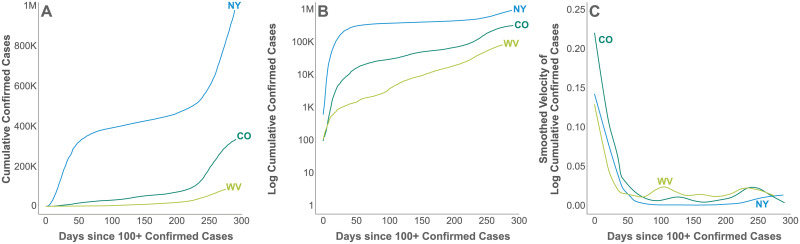
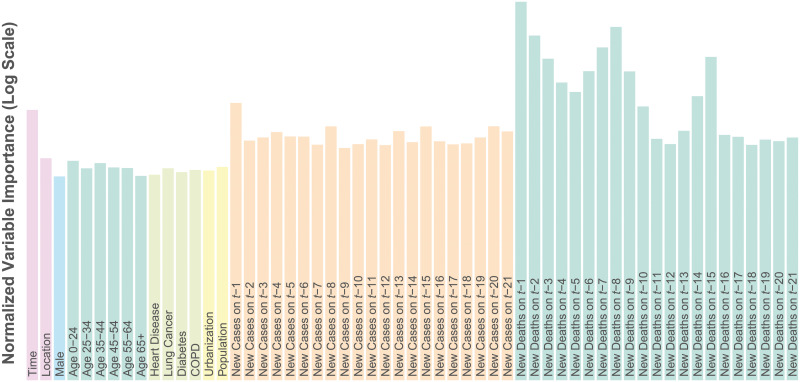
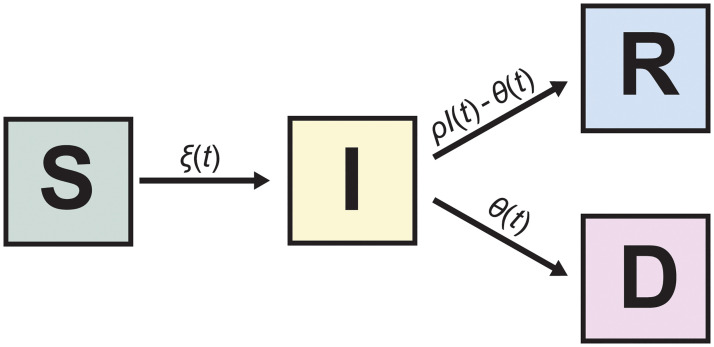
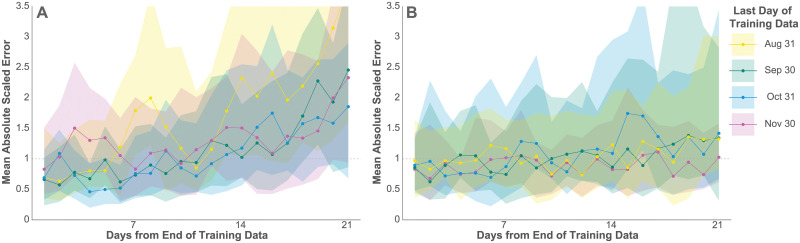
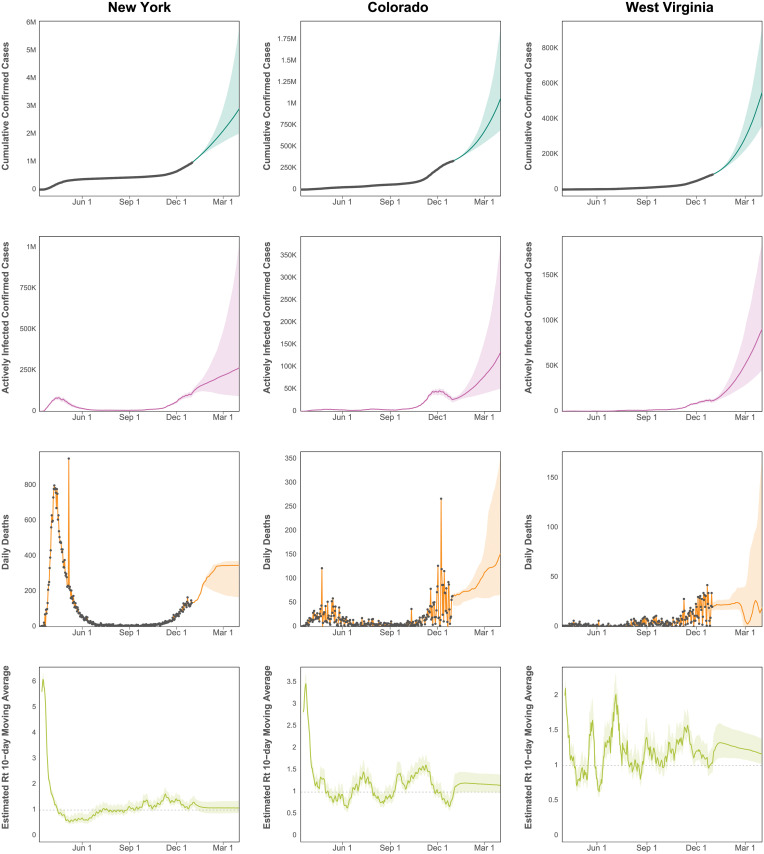
Predictions of COVID-19 case growth and mortality are critical to the decisions of political leaders, businesses, and individuals grappling with the pandemic. This predictive task is challenging due to the novelty of the virus, limited data, and dynamic political and societal responses. We embed a Bayesian time series model and a random forest algorithm within an epidemiological compartmental model for empirically grounded COVID-19 predictions. The Bayesian case model fits a location-specific curve to the velocity (first derivative) of the log transformed cumulative case count, borrowing strength across geographic locations and incorporating prior information to obtain a posterior distribution for case trajectories. The compartmental model uses this distribution and predicts deaths using a random forest algorithm trained on COVID-19 data and population-level characteristics, yielding daily projections and interval estimates for cases and deaths in U.S. states. We evaluated the model by training it on progressively longer periods of the pandemic and computing its predictive accuracy over 21-day forecasts. The substantial variation in predicted trajectories and associated uncertainty between states is illustrated by comparing three unique locations: New York, Colorado, and West Virginia. The sophistication and accuracy of this COVID-19 model offer reliable predictions and uncertainty estimates for the current trajectory of the pandemic in the U.S. and provide a platform for future predictions as shifting political and societal responses alter its course.
Conflict of interest statement
I have read the journal’s policy and the authors of this manuscript have the following competing interests: GLW, JAZ, PS, TB, and report personal fees from Private Health Management during the conduct of the study. CMR reports grants and personal fees from Private Health Management. MAS reports grants from US National Institutes of Health, grants from IQVIA, personal fees from Janssen Research and Development, and personal fees from Private Health Management during the conduct of the study. DX, LZ, JS, and AWR declare that they have no known competing financial interests or personal relationships that could have appeared to influence the work reported in this paper.
Figures
References
-
- Walker PG, Whittaker C, Watson O, Baguelin M, Ainslie K, Bhatia S, et al. The global impact of COVID-19 and strategies for mitigation and suppression. Imperial College London. 2020; 10.1126/science.abc0035 - DOI
-
- Mandal S, Bhatnagar T, Arinaminpathy N, Agarwal A, Chowdhury A, Murhekar M, et al. Prudent public health intervention strategies to control the coronavirus disease 2019 transmission in India: A mathematical model-based approach. Indian J Med Res. 2020;151. 10.4103/ijmr.IJMR_504_20 - DOI - PMC - PubMed
Publication types
MeSH terms
Grants and funding
LinkOut - more resources
Full Text Sources
Other Literature Sources
Medical