


What do patients and dermatologists prefer regarding low-risk basal cell carcinoma follow-up care? A discrete choice experiment
- PMID: 33780499
- PMCID: PMC8007023
- DOI: 10.1371/journal.pone.0249298
What do patients and dermatologists prefer regarding low-risk basal cell carcinoma follow-up care? A discrete choice experiment
Abstract
Background: Follow-up after low-risk basal cell carcinoma (BCC) is being provided more frequently than recommended by guidelines. To design an acceptable strategy to successfully reduce this 'low-value' care, it is important to obtain insights into the preferences of patients and dermatologists.
Objective: To determine the preferences and needs of patients and dermatologists to reduce low-risk BCC follow-up care, and the trade-offs they are willing to make.
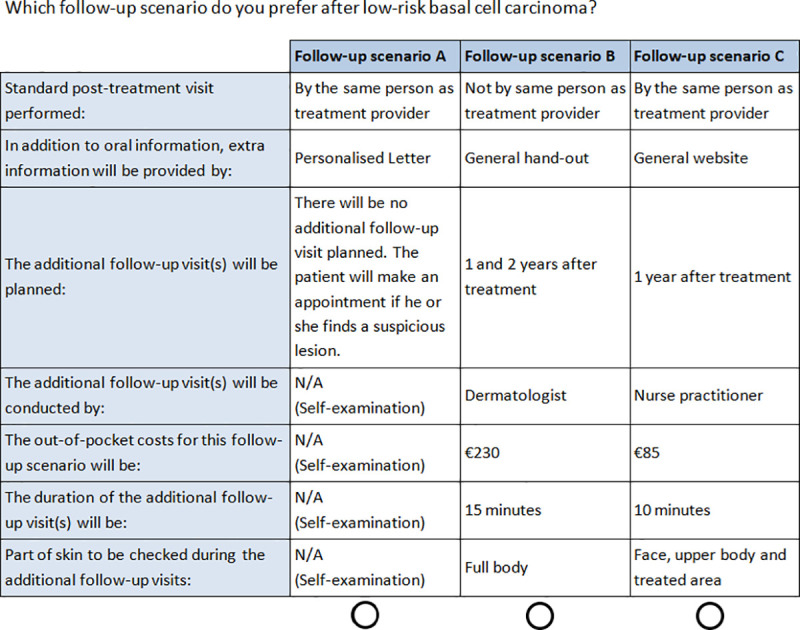
Methods: A questionnaire including a discrete choice experiment was created, containing attributes regarding amount of follow-up, continuity of care, method of providing addition information, type of healthcare provider, duration of follow-up visits and skin examination. In total, 371 BCC patients and all Dutch dermatologists and dermatology residents (n = 620) were invited to complete the questionnaire. A panel latent class model was used for analysis.
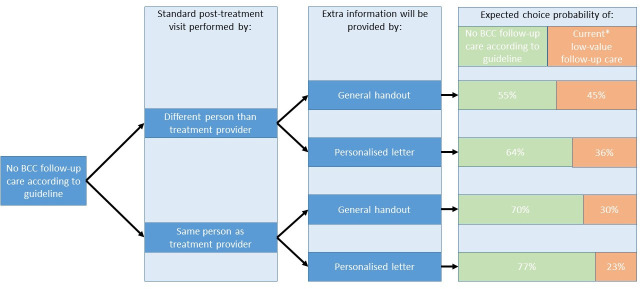
Results: Eighty-four dermatologists and 266 BCC patients (21% and 72% response rates respectively) completed the discrete choice experiment. If the post-treatment visit was performed by the same person as treatment provider and a hand-out was provided to patients containing personalised information, the acceptance of having no additional follow-up visits (i.e. following the guidelines) would increase from 55% to 77% by patients. Female patients and older dermatologists, however, are less willing to accept the guidelines and prefer additional follow-up visits.
Limitations: The low response rate of dermatologists.
Conclusion: This discrete choice experiment revealed a feasible strategy to substantially reduce costs, while maintaining quality of care, based on the preferences and needs of BCC patients, which is supported by dermatologists.
Conflict of interest statement
We understand that VGZ must be explicitly mentioned as a commercial funder. We would like to alter our Competing Interest Statement to: “The authors and funders (Dutch Ministry of Health, Welfare and Sport and the health insurance company VGZ) have declared that no competing interests exist. This does not alter our adherence to PLOS ONE policies on sharing data and materials.
Figures
References
-
- Gordon LG, Rowell D. Health system costs of skin cancer and cost-effectiveness of skin cancer prevention and screening: a systematic review. European journal of cancer prevention: the official journal of the European Cancer Prevention Organisation (ECP). 2015;24(2):141–9. Epub 2014/08/05. 10.1097/CEJ.0000000000000056 - DOI - PubMed
-
- Leavitt M. Medscape’s response to the Institute of Medicine Report: Crossing the quality chasm: a new health system for the 21st century. MedGenMed: Medscape general medicine. 2001;3(2):2. Epub 2001/09/11. - PubMed
MeSH terms
LinkOut - more resources
Full Text Sources
Other Literature Sources
Medical
