


Homelessness, unstable housing, and risk of HIV and hepatitis C virus acquisition among people who inject drugs: a systematic review and meta-analysis
- PMID: 33780656
- PMCID: PMC8097637
- DOI: 10.1016/S2468-2667(21)00013-X
Homelessness, unstable housing, and risk of HIV and hepatitis C virus acquisition among people who inject drugs: a systematic review and meta-analysis
Abstract
Background: People who inject drugs (PWID) are at increased risk for HIV and hepatitis C virus (HCV) infection and also have high levels of homelessness and unstable housing. We assessed whether homelessness or unstable housing is associated with an increased risk of HIV or HCV acquisition among PWID compared with PWID who are not homeless or are stably housed.
Methods: In this systematic review and meta-analysis, we updated an existing database of HIV and HCV incidence studies published between Jan 1, 2000, and June 13, 2017. Using the same strategy as for this existing database, we searched MEDLINE, Embase, and PsycINFO for studies, including conference abstracts, published between June 13, 2017, and Sept 14, 2020, that estimated HIV or HCV incidence, or both, among community-recruited PWID. We only included studies reporting original results without restrictions to study design or language. We contacted authors of studies that reported HIV or HCV incidence, or both, but did not report on an association with homelessness or unstable housing, to request crude data and, where possible, adjusted effect estimates. We extracted effect estimates and pooled data using random-effects meta-analyses to quantify the associations between recent (current or within the past year) homelessness or unstable housing compared with not recent homelessness or unstable housing, and risk of HIV or HCV acquisition. We assessed risk of bias using the Newcastle-Ottawa Scale and between-study heterogeneity using the I2 statistic and p value for heterogeneity.
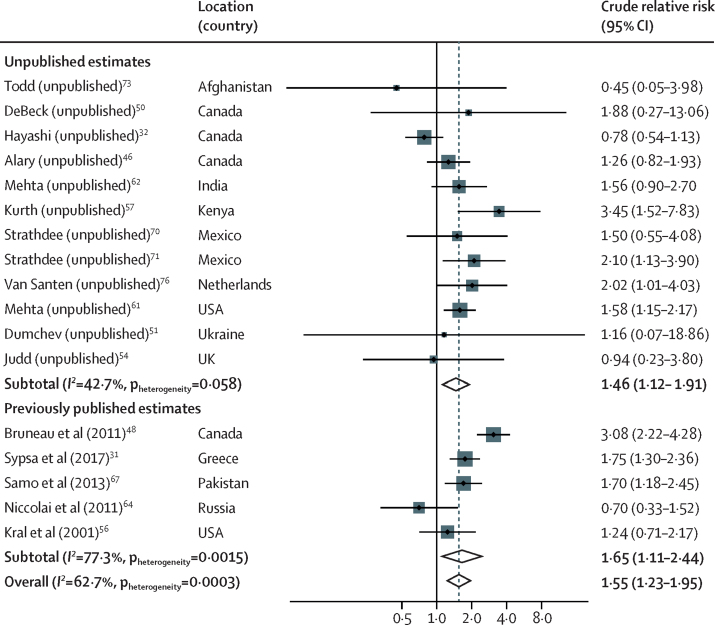
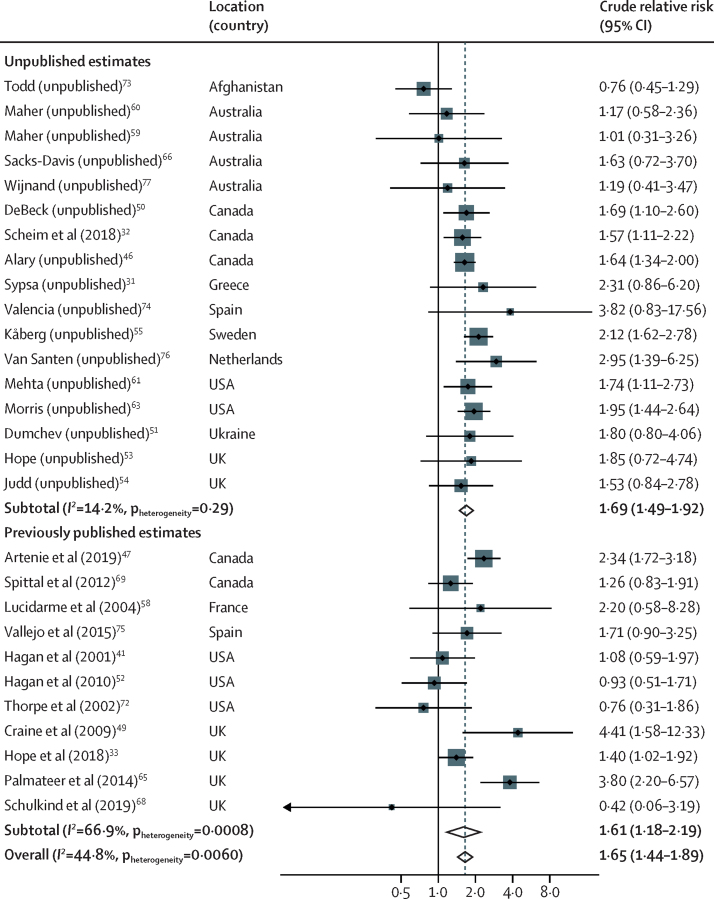
Findings: We identified 14 351 references in our database search, of which 392 were subjected to full-text review alongside 277 studies from our existing database. Of these studies, 55 studies met inclusion criteria. We contacted the authors of 227 studies that reported HIV or HCV incidence in PWID but did not report association with the exposure of interest and obtained 48 unpublished estimates from 21 studies. After removal of duplicate data, we included 37 studies with 70 estimates (26 for HIV; 44 for HCV). Studies originated from 16 countries including in North America, Europe, Australia, east Africa, and Asia. Pooling unadjusted estimates, recent homelessness or unstable housing was associated with an increased risk of acquiring HIV (crude relative risk [cRR] 1·55 [95% CI 1·23-1·95; p=0·0002]; I2= 62·7%; n=17) and HCV (1·65 [1·44-1·90; p<0·0001]; I2= 44·8%; n=28]) among PWID compared with those who were not homeless or were stably housed. Associations for both HIV and HCV persisted when pooling adjusted estimates (adjusted relative risk for HIV: 1·39 [95% CI 1·06-1·84; p=0·019]; I2= 65·5%; n=9; and for HCV: 1·64 [1·43-1·89; p<0·0001]; I2= 9·6%; n=14). For risk of HIV acquisition, the association for unstable housing (cRR 1·82 [1·13-2·95; p=0·014]; n=5) was higher than for homelessness (1·44 [1·13-1·83; p=0·0036]; n=12), whereas no difference was seen between these outcomes for risk of HCV acquisition (1·72 [1·48-1·99; p<0·0001] for unstable housing, 1·66 [1·37-2·00; p<0·0001] for homelessness).
Interpretation: Homelessness and unstable housing are associated with increased risk of HIV and HCV acquisition among PWID. Our findings support the development of interventions that simultaneously address homelessness and unstable housing and HIV and HCV transmission in this population.
Funding: National Institute for Health Research, National Institute on Drug Abuse, National Institute of Allergy and Infectious Diseases, and Commonwealth Scholarship Commission.
Copyright © 2021 The Author(s). Published by Elsevier Ltd. This is an Open Access article under the CC BY 4.0 license. Published by Elsevier Ltd.. All rights reserved.
Conflict of interest statement
Declaration of interests HF reports honoraria from MSD outside of the submitted work. JA reports grants from National Institutes of Health (NIH) during the conduct of the study. SSS reports grants from NIH during the conduct of the study, and grants from Gilead Sciences and Abbot Diagnostics outside of the submitted work. VS reports grants, personal fees, and non-financial support from Gilead Sciences and AbbVie and personal fees from Janssen outside of the submitted work. JGW reports grants from Gilead Sciences outside of the submitted work. All other authors declare no competing interests.
Figures

Comment in
-
The impact of unstable housing on health.Lancet Public Health. 2021 May;6(5):e265-e266. doi: 10.1016/S2468-2667(21)00035-9. Epub 2021 Mar 26. Lancet Public Health. 2021. PMID: 33780657 No abstract available.
References
-
- Degenhardt L, Charlson F, Stanaway J. Estimating the burden of disease attributable to injecting drug use as a risk factor for HIV, hepatitis C, and hepatitis B: findings from the Global Burden of Disease Study 2013. Lancet Infect Dis. 2016;16:1385–1398. - PubMed
-
- Joint United Nations Programme on HIV/AIDS (UNAIDS) UNAIDS; 2017. UNAIDS Data 2017.https://www.unaids.org/sites/default/files/media_asset/20170720_Data_boo... - PubMed
Publication types
MeSH terms
Grants and funding
LinkOut - more resources
Full Text Sources
Other Literature Sources
Medical
Miscellaneous
