. 2021 Sep;61(3):434-438.
doi: 10.1016/j.amepre.2021.01.030. Epub 2021 Mar 6.

Who Is (and Is Not) Receiving Telemedicine Care During the COVID-19 Pandemic

Affiliations

Who Is (and Is Not) Receiving Telemedicine Care During the COVID-19 Pandemic

Jonathan H Cantor et al. Am J Prev Med. 2021 Sep.

Abstract

Introduction: The COVID-19 pandemic has forced telehealth to be the primary means through which patients interact with their providers. There is a concern that the pandemic will exacerbate the existing disparities in overall healthcare utilization and telehealth utilization. Few national studies have examined the changes in telehealth use during the COVID-19 pandemic.

Methods: Data on 6.8 and 6.4 million employer-based health plan beneficiaries in 2020 and 2019, respectively, were collected in 2020. Unadjusted rates were compared both before and after the week of the declaration of the COVID-19 pandemic as a national emergency. Trends in weekly utilization were also examined using a difference-in-differences regression framework to quantify the changes in telemedicine and office-based care utilization while controlling for the patient's demographic and county-level sociodemographic measures. All analyses were conducted in 2020.

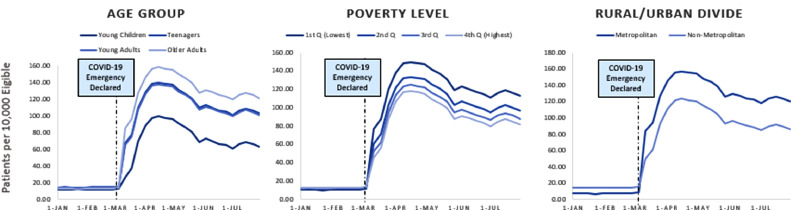
Results: More than a 20-fold increase in the incidence of telemedicine utilization after March 13, 2020 was observed. Conversely, the incidence of office-based encounters declined by almost 50% and was not fully offset by the increase in telemedicine. The increase in telemedicine was greatest among patients in counties with low poverty levels (β=31.70, 95% CI=15.17, 48.23), among patients in metropolitan areas (β=40.60, 95% CI=30.86, 50.34), and among adults than among children aged 0-12 years (β=57.91, 95% CI=50.32, 65.49).

Conclusions: The COVID-19 pandemic has affected telehealth utilization disproportionately on the basis of patient age and both the county-level poverty rate and urbanicity.


Figures

Figure 1
Figure 1
Adjusted rates of telemedicine utilization before versus that after the start of COVID-19 pandemic. Note: The graph shows the number of persons receiving telemedicine care per 10,000 eligible beneficiaries. Young children represent ages 0‒12 years, teenagers represent ages 13‒18 years, young adults represent ages 19‒45 years, and older adults represent ages ≥46 years. Q represents the share of U.S. county (%) living below the federal poverty line in the county where the patient resides (https://www.census.gov/topics/income-poverty/poverty/data/tables/acs.html). The highest Q represents the counties that have the highest share of the population who are below the federal poverty line, whereas the lowest Q represents the counties that have the lowest share of the population who are below the federal poverty line. U.S. county metropolitan classification was done on the basis of the county where the patient resides (https://www.cdc.gov/nchs/data_access/urban_rural.htm). The full regression results for the figure can be found in Appendix Table 3 (available online). APR, April; FEB, February; JAN, January; JUL, July; JUN, June; MAR, March; Q, quartile.

References

    1. Hartnett KP, Kite-Powell A, DeVies J. Impact of the COVID-19 pandemic on emergency department visits - United States, January 1, 2019-May 30, 2020. MMWR Morb Mortal Wkly Rep. 2020;69(23):699–704. doi: 10.15585/mmwr.mm6923e1. - DOI - PMC - PubMed
    1. Shachar C, Engel J, Elwyn G. Implications for telehealth in a postpandemic future: regulatory and privacy issues. JAMA. 2020;323(23):2375–2376. doi: 10.1001/jama.2020.7943. - DOI - PubMed
    1. Wosik J, Fudim M, Cameron B. Telehealth transformation: COVID-19 and the rise of virtual care. J Am Med Inform Assoc. 2020;27(6):957–962. doi: 10.1093/jamia/ocaa067. - DOI - PMC - PubMed
    1. Alexander GC, Tajanlangit M, Heyward J, Mansour O, Qato DM, Stafford RS. Use and content of primary care office-based vs telemedicine care visits during the COVID-19 pandemic in the U.S. JAMA Netw Open. 2020;3(10) doi: 10.1001/jamanetworkopen.2020.21476. - DOI - PMC - PubMed
    1. Whaley CM, Pera MF, Cantor J. Changes in health services use among commercially insured U.S. populations during the COVID-19 pandemic. JAMA Network Open. 2020;3(11) doi: 10.1001/jamanetworkopen.2020.24984. - DOI - PMC - PubMed

Publication types